 Blaine Siding
 Peace Arch Sits Where Weather Gets Serious
Homes near Peace Arch, on the Whatcom County side of the border at Blaine, deal with a specific combination of conditions that most exterior products simply weren't built around. You're close enough to Semiahmoo Bay and the Strait of Georgia to get real salt-laden air, exposed enough to catch driving rain off Puget Sound weather systems, and shaded enough in many yards to grow moss on anything that holds moisture for more than a day or two. None of that is unusual for Whatcom County. But it adds up faster here than it does twenty miles inland, and it shows up first on the exterior of the house.
We work on siding, roofing, windows, and decks, and we treat all four as one system rather than four separate trades. On a Peace Arch property, that matters — water that gets past a flashing detail on the roof ends up behind the siding, and a deck ledger attached without the right moisture break can rot a wall from the inside before anyone notices from the street.
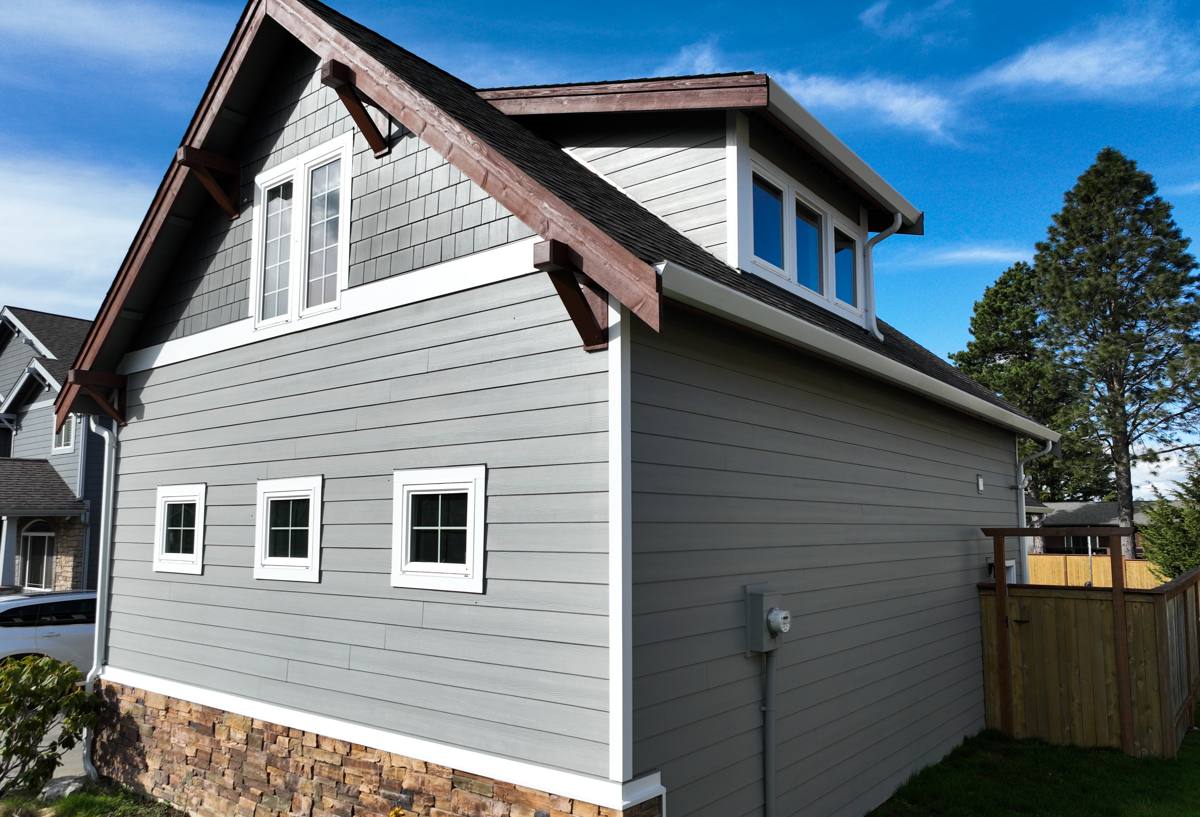
What Salt Air, Rain, and Moss Actually Do to a House
Salt Air and Coastal Moisture
Airborne salt is corrosive to fasteners and metal trim, and it's hygroscopic — meaning it actually pulls moisture out of the air and holds it against whatever surface it lands on. For wood-based siding products, that means the surface stays damp longer than it would a few miles inland, which accelerates rot, paint failure, and delamination at seams and edges.
Moss and Shade
Whatcom County's tree cover and cloud cover give moss and algae exactly what they want: shade, moisture, and time. On siding, moss isn't just cosmetic — it holds water against the surface and, on products that aren't dimensionally stable, that trapped moisture is what drives swelling, cupping, and eventual failure at panel edges.
Driving Rain
Storms coming off the water don't just fall straight down — wind-driven rain gets pushed sideways into wall assemblies, which is why lap siding, flashing, and caulking details matter so much more here than in drier climates. A siding job that looks fine on a calm day can fail during the first real windstorm if the water management behind it wasn't done correctly.
Why We Only Install James Hardie Fiber Cement
We made a decision as a company to install one siding system, and we stand behind it: James Hardie fiber cement, and nothing else. That's not a sales pitch — it's a standard we hold ourselves to because of what we've seen coastal Whatcom County weather do to other products over time.
- Non-combustible material — fiber cement doesn't feed a fire the way wood-based products can, which matters for insurance conversations as much as safety.
- ColorPlus factory finish — the color is baked on at the factory under controlled conditions, which holds up better against salt air and UV than field-applied paint, and it means fewer repaint cycles over the life of the siding.
- HZ5 climate-engineered formulation — Hardie makes region-specific product lines, and the HZ5 line is engineered for the Pacific Northwest's wet, moderate climate specifically, rather than being a one-size-fits-all product.
- Dimensional stability — fiber cement doesn't swell and shrink with moisture the way wood or wood-composite products do, so it holds paint lines, caulk joints, and reveals over years, not just the first season.
- A strong, transferable warranty — one that's backed by installation to Hardie's specifications, which is part of why correct install technique matters as much as the product itself.
Fiber cement isn't magic, and we won't pretend it's maintenance-free. It still needs to be installed with correct clearances, flashed properly, and caulked at the right joints. But it gives us a starting point that's actually suited to what this coastline does to a house, instead of fighting the climate from day one.
Why We Don't Install Everything Else
We get asked fairly often about vinyl, LP SmartSide, cedar, and primed spruce siding, usually because a homeowner is comparing quotes and wants to understand the difference. We're happy to explain it honestly, product by product, rather than just steering people toward what we sell.
| Material | What it does well | Why it's a harder fit here |
|---|---|---|
| Vinyl | Low upfront cost, low maintenance in mild climates | Can warp or become brittle with temperature swings; seams and coloring don't hold up to salt air and UV the same way |
| LP SmartSide | Engineered wood strand product, easier to install than solid wood | Wood-based, so edges and cut ends are moisture-sensitive; relies heavily on caulking and paint maintenance in wet climates |
| Cedar | Natural look, long tradition in the Pacific Northwest | Requires ongoing sealing/staining; moss, mildew, and rot are real maintenance issues under constant coastal moisture |
| Primed spruce | Lower material cost than cedar | Softer wood, more prone to swelling and rot; primer is not a substitute for a factory finish |
| James Hardie fiber cement | Non-combustible, dimensionally stable, factory-cured color | Higher install skill requirement; heavier material to work with |
Every one of those products has a legitimate use case somewhere. Our position is narrower: for this specific climate — salt air, driving rain, long moss seasons — we don't think they hold up as well as fiber cement over a 20-30 year window, and we'd rather turn down the install than put something on a house we don't believe in.
Siding Doesn't Work in Isolation
A house is one connected water-management system, which is why we handle roofing, windows, and decks alongside siding rather than treating them as separate projects.
Roofing
Roof-to-wall flashing, valleys, and moss buildup on the roof surface all affect how much water ends up running down the siding. A roof that's shedding moss and holding moisture behind it is sending that same moisture toward the wall assembly below.
Windows
Window flashing integration is one of the most common failure points we see on older homes in wet coastal areas — siding installed around a window without proper head flashing and drainage will trap water at exactly the spot where it does the most damage.
Decks
Deck ledger boards attach directly to the house structure, and if that connection isn't flashed and gapped correctly, it becomes a direct path for water into the wall behind the siding — often invisible until there's already rot.
What Correct Installation Actually Looks Like
The warranty on any siding product, Hardie included, depends on installation matching the manufacturer's specifications. On a Peace Arch property, that generally means:
- Proper clearance between siding and grade, decks, and roof lines to keep the bottom edge from sitting in standing moisture
- Correctly lapped and sealed house wrap or weather-resistive barrier underneath the siding
- Rain-screen or drainage gap detailing appropriate to a high-moisture climate
- Stainless or coated fasteners suited to salt-air exposure, not standard fasteners that will corrode over time
- Factory-mitered or properly caulked joints at corners, windows, and butt seams
- Flashing integration between siding, roofing, window, and deck trades — not each crew working in isolation
Skipping any one of these doesn't usually cause a visible problem in year one. It shows up in year five or ten, as moisture damage that's expensive to trace back and repair.
What to Look for When Hiring for This Area
If you're comparing contractors for a Peace Arch exterior project, a few questions tend to separate a crew that understands this climate from one that's just installing whatever a homeowner asks for:
- Do they work in Whatcom County regularly, or is this an unfamiliar climate for them?
- Can they explain their flashing and drainage approach without hand-waving?
- Do they coordinate siding with roofing, window, and deck work, or hand you off between separate unrelated companies?
- Are they installing to the manufacturer's actual specifications, in a way that keeps the warranty valid?
- Will they tell you honestly if a product isn't a good fit for your house, even if it costs them the sale?
What Drives the Cost of a Project Like This
| Factor | Why it matters |
|---|---|
| Home size and wall complexity | More corners, gables, and dormers mean more cutting, flashing, and labor time |
| Existing siding removal | Tear-off and disposal of old material adds time versus a bare-wall install |
| Moisture or rot damage found underneath | Hidden sheathing damage, common on older coastal homes, needs repair before new siding goes on |
| Trim and profile choice | Board-and-batten, shake-style panels, and custom trim details cost more than standard lap siding |
| Coordinated roofing/window/deck work | Bundling trades can reduce redundant setup and access costs versus separate projects |
We don't publish flat pricing because every one of those factors changes the number, but we'll walk a property with you and explain exactly what's driving the estimate before any work starts.
Let's Take a Look at Your House
If you're weighing a siding, roofing, window, or deck project for a Peace Arch property, we're glad to come take a look and talk through what your home is actually dealing with — no pressure, no obligation. Fill out the form below to schedule a free estimate.