 Blaine Siding
 Custer sits in that stretch of Whatcom County where the marine air off the Strait of Georgia meets farmland, quiet roads, and a mix of older homes and newer builds. It's close enough to the water to catch the salt-laden wind, far enough inland to hold onto damp, shaded moisture through the winter. That combination is exactly what wears down exterior materials faster than homeowners expect, and it's a big part of why we approach siding, roofing, windows, and decks in this area the way we do.
What Custer's Climate Actually Does to a House
Whatcom County doesn't get dramatic weather most years. What it gets instead is relentless, low-grade exposure: months of drizzle, driving rain during winter storms, salt-tinged wind off the water, and long stretches where surfaces just don't fully dry out. For exterior materials, that's a harder test than a few big storms. It's the slow accumulation of moisture cycling in and out of wood fibers, seams, and fastener points that eventually causes problems.
Salt air is corrosive to metal fasteners, flashing, and trim if those components aren't rated and installed correctly. Driving rain, especially wind-driven rain that hits siding at an angle, finds any gap in flashing or caulking and pushes water behind the cladding rather than off of it. And the long moss season here means anything organic on a roof or in a shaded siding cavity has months to establish itself before a dry spell knocks it back.
Why Older Siding Struggles First
Homes in and around Custer that still have original wood siding, older vinyl, or budget-grade fiber cement tend to show their age around trim boards, butt joints, and anywhere caulking has dried out or pulled away. Once water gets behind the siding, it doesn't evaporate quickly in this climate — it sits against sheathing and framing, and that's when rot and mold set in. By the time it's visible from the street, the damage underneath is usually further along than it looks.
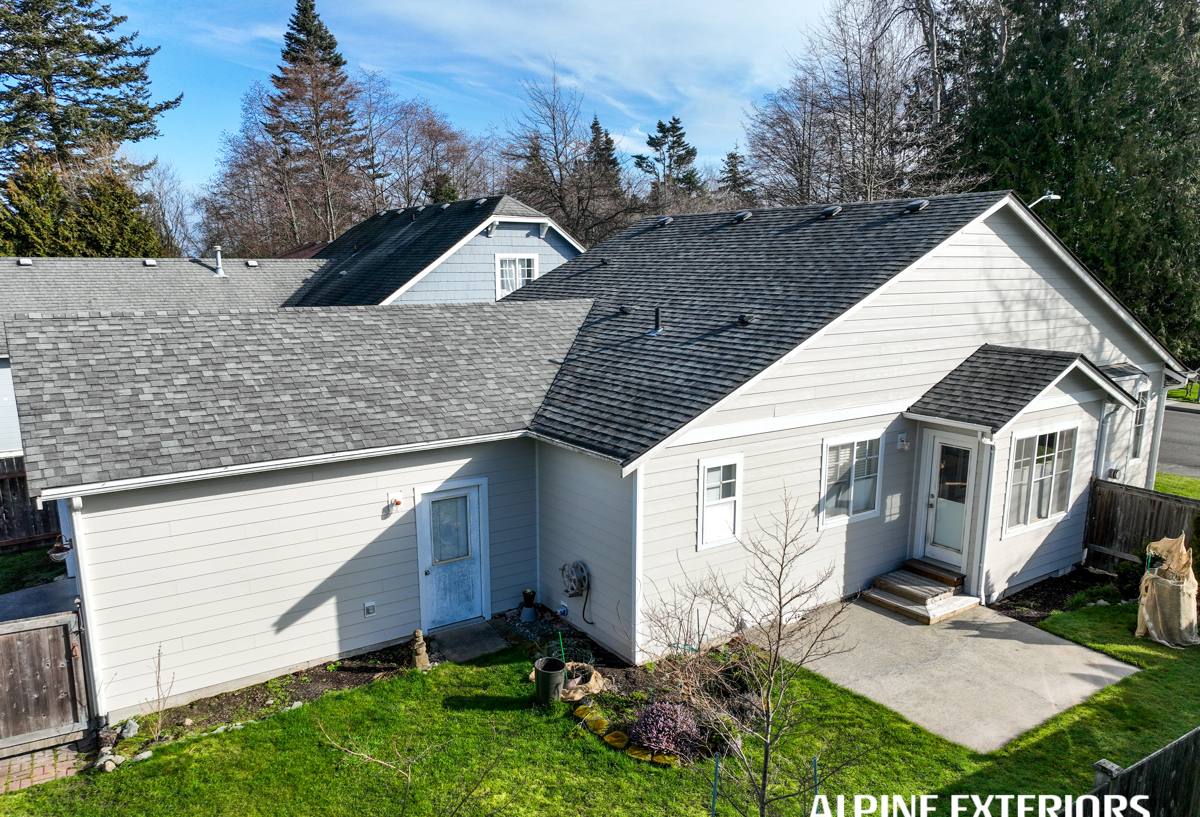
Our Position on Siding Materials
We install James Hardie fiber cement siding exclusively. We don't install vinyl, LP SmartSide, Cemplank, Allura, primed spruce, or cedar. That's not a marketing line — it's a standard we hold to because of what we've seen these products do (and not do) in exactly this kind of coastal Pacific Northwest climate over the long run.
Where Other Products Fall Short Here
- Vinyl siding expands and contracts with temperature swings and can warp or crack in cold snaps; it also can't be painted a darker color without risk of heat distortion, which limits design options.
- LP SmartSide is an engineered wood product — it performs reasonably well when detailed perfectly, but wood-based substrates are inherently more moisture-sensitive than fiber cement, and this region doesn't give installation mistakes much room for error.
- Cemplank and Allura are legitimate fiber cement competitors, but we've standardized on one manufacturer, one installation system, and one warranty structure so our crews are experts in a single product rather than generalists across several.
- Primed spruce and cedar are beautiful materials, but they require ongoing maintenance — recoating, caulking, and vigilance — that most homeowners underestimate, especially in a climate where the drying window is short.
None of these are "bad" products in every context. They're just not the right fit for the maintenance tolerance and moisture exposure we see in Whatcom County, and we'd rather install one thing well than several things at a discount.
Why James Hardie Fits This Region
James Hardie fiber cement is non-combustible, dimensionally stable, and engineered specifically for different climate zones — including an HZ5 product line built for regions with more moisture and temperature swings. It doesn't expand and contract the way vinyl or wood does, which means seams stay tighter and caulking lines hold up longer. The ColorPlus factory-applied finish is baked on under controlled conditions, which gives it better fade and chip resistance than field-applied paint, and it comes with a real, transferable warranty — something that matters if you ever sell the home.
For a place like Custer, where a house might see 60+ inches of rain a year spread across many months rather than a few intense storms, that stability is the whole point. Fiber cement doesn't feed mold or moss the way wood substrates can, and it holds paint and caulk lines the way vinyl's expansion and contraction won't allow.
| Material | Moisture Behavior | Maintenance | Typical Lifespan (installed to spec) |
|---|---|---|---|
| James Hardie Fiber Cement | Dimensionally stable, doesn't rot or swell | Low — occasional wash, repaint on ColorPlus cycle | 30-50 years |
| Vinyl | Doesn't absorb water, but seams can let water behind it | Low, but limited repair/color options | 20-30 years |
| Engineered Wood (LP SmartSide) | Moisture-sensitive at cut edges and joints | Moderate — caulk and coating checks | 25-30 years |
| Cedar / Primed Spruce | Absorbs moisture, prone to swelling and rot if unmaintained | High — regular recoating and caulking | 15-25 years depending on upkeep |
How We Approach Siding Replacement in Custer
Every project starts with a look at what's actually happening behind the existing siding, not just what it looks like from the driveway. That means checking for soft sheathing, evaluating existing flashing at windows and rooflines, and identifying any spots where water has clearly been getting in. In a climate like this, the prep work — house wrap, flashing details, proper fastening — matters as much as the siding product itself.
What Correct Installation Involves
- Removing old siding down to the sheathing to assess for hidden moisture damage
- Repairing or replacing any compromised sheathing before new material goes up
- Installing a weather-resistive barrier correctly lapped and sealed
- Flashing all windows, doors, and roof-to-wall intersections to shed water outward
- Fastening Hardie panels per manufacturer spec — proper nail spacing, gapping, and clearance from grade and roof lines
- Caulking and finishing joints in a way that accounts for the region's rain exposure
Skipping any of these steps is how a good product ends up performing poorly. It's also why we don't treat siding as a one-day cosmetic swap — it's an exterior moisture management system, and Custer's climate tests every weak point in that system eventually.
Roofing, Windows, and Decks Face the Same Exposure
Siding isn't the only part of a home dealing with salt air and constant moisture. Roofs in this area accumulate moss faster than drier inland climates, and moss holds moisture against shingles in a way that shortens roof life if it's not managed. Windows take on wind-driven rain directly, and older units with failed seals or worn flashing are a common source of the water intrusion we find when we open up a wall. Decks, especially those facing prevailing weather, deal with standing water, freeze-thaw cycling in winter, and UV combined with damp — a tough combination for untreated or poorly maintained wood.
Because we handle all four — siding, roofing, windows, and decks — we're often able to spot a problem in one area that's actually being caused by another. Water intrusion at a window, for example, sometimes traces back to a flashing detail that also affects the siding around it. Looking at the whole exterior envelope together tends to catch these connections before they turn into bigger repairs.
What to Watch For on Your Own Home
You don't need a trained eye to catch the early warning signs of exterior wear in this climate. A simple seasonal check can catch problems while they're still small and inexpensive to fix.
- Soft or spongy spots when you press on siding near the bottom of walls or below windows
- Paint that's peeling or bubbling in a localized area rather than evenly across a wall
- Visible gaps or cracked caulk at trim boards, corners, and window edges
- Moss or dark streaking building up on north-facing or shaded siding and roof sections
- Musty smell or visible staining on interior walls near exterior corners
- Warping, cupping, or discoloration on deck boards, especially in low-sun areas
Why a Local Crew Matters
A lot of exterior problems in this region come down to details that generic, out-of-area crews don't always prioritize — flashing laps oriented the wrong way, caulking used where a proper flashing detail was needed instead, or fastening patterns that don't account for the wetter conditions here compared to drier parts of the state. A crew that works in Whatcom County regularly knows what this weather does to a house over years, not just what a spec sheet says on paper. That local pattern recognition is often the difference between an install that holds up for decades and one that starts showing problems in five years.
Cost Factors Homeowners Should Understand
Every home and project is different, but a few factors consistently drive cost on siding replacement in this area: the condition of the sheathing underneath the old siding, the complexity of the home's shape (corners, dormers, and trim detail all add labor), the amount of moisture damage discovered once old material comes off, and the specific Hardie product line and finish chosen. Homes with hidden rot cost more to fix properly than homes where the sheathing turns out to be sound — which is exactly why a thorough inspection before quoting matters more than a quick estimate from the curb.
If you're noticing any of these signs on a home in Custer, or you're just planning ahead for a home in this area, we're happy to take a look and walk you through what we find. There's no pressure and no cost for a straightforward estimate — just a clear look at what your home's exterior actually needs.