 Blaine Siding
 One Product, One Standard
Most siding contractors carry a menu: vinyl for the budget jobs, LP SmartSide for the middle tier, fiber cement for the customers who ask for it by name. We don't work that way. We install James Hardie fiber cement siding, exclusively, on every job we take in Blaine and across Whatcom County. No vinyl, no LP SmartSide, no Cemplank, no Allura, no primed spruce, no cedar.
That's not a marketing position and it's not because Hardie pays us better than anyone else. It's a professional standard we settled on after years of tear-offs, service calls, and warranty claims on other products in exactly the kind of climate Blaine sits in — salt air off the water, driving rain that comes in sideways, and a moss season that barely takes a break. This page explains the reasoning in plain terms: what the product actually is, how it's engineered, and what "installed to spec" really means.
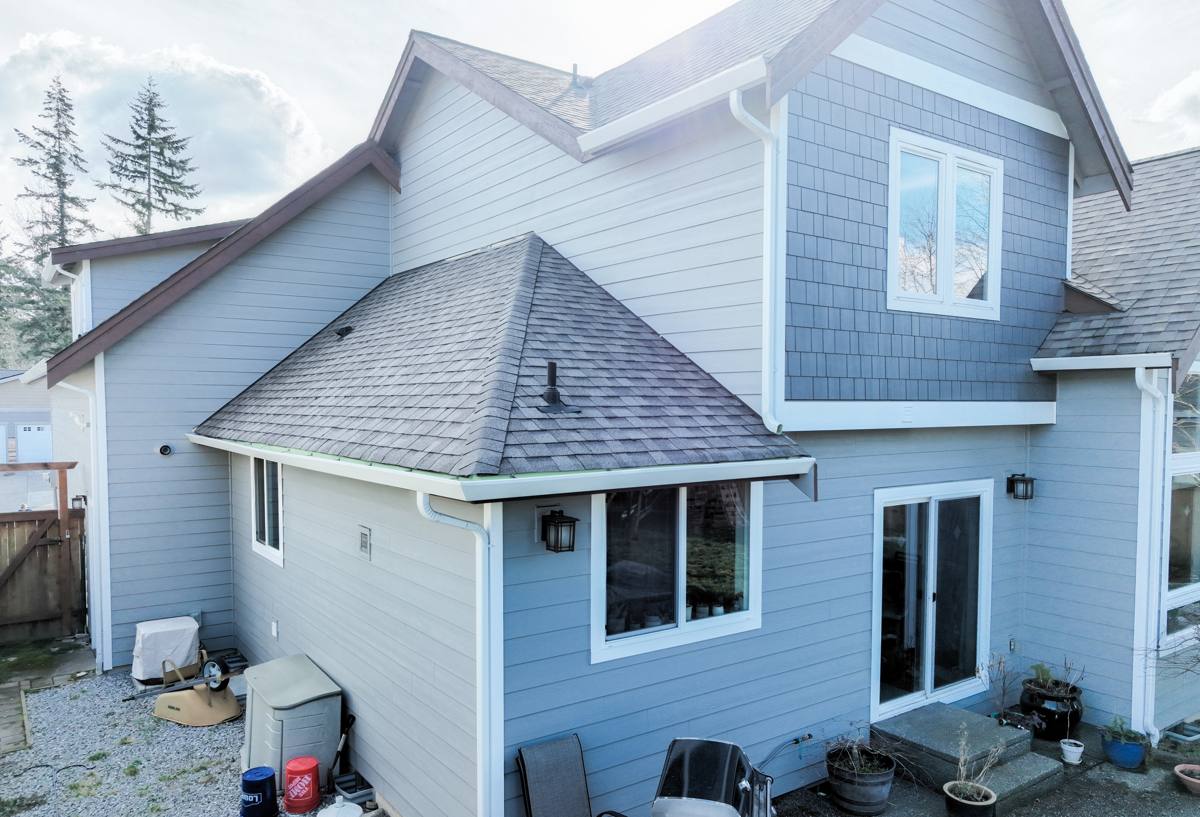
What Fiber Cement Actually Is
James Hardie siding is made from a mixture of Portland cement, sand, cellulose fiber, and water, cured under controlled factory conditions into dense, dimensionally stable boards and panels. It is not a wood product with a coating, and it is not a plastic extrusion. That distinction matters more than it sounds like it should, because most of the failure modes homeowners deal with in siding — swelling, warping, rot, melting, cracking from UV exposure — are tied to what the base material is made of, not how well it was installed.
Fiber cement doesn't absorb water and swell the way engineered wood products can. It doesn't soften or deform in heat the way vinyl can. It doesn't feed a fire the way wood-based siding can. Those are material properties, not installation outcomes, and they're the starting point for why we standardized on it.
Non-Combustibility
Fiber cement is a non-combustible material. It won't ignite and contribute fuel to a fire the way wood-based or foam-backed siding products can. In wildfire-adjacent regions this gets most of the attention, but even here on the wet side of the state it factors into insurance underwriting and building code considerations, and it's simply a safer material to have wrapped around a house full of people.
What Whatcom County's Climate Does to Siding
Blaine sits at the northern edge of Whatcom County, close to Semiahmoo Bay and Drayton Harbor, in a spot where Pacific storm systems come ashore with real force. Three conditions define what siding here has to survive:
Salt Air
Homes near the water take a steady dose of salt-laden air. Salt accelerates corrosion on fasteners, flashing, and exposed metal trim, and it breaks down lower-quality paint and coatings faster than they'd wear in a dry inland climate. Whatever goes on the wall has to tolerate that exposure for decades, not years.
Driving Rain
Storms off the water don't fall straight down. Wind drives rain sideways into wall assemblies, window flashing, and roof-to-wall joints. That lateral load finds gaps a careless installation leaves behind, and it's a harder test on a wall system than the same total rainfall would be somewhere calmer.
A Long Moss Season
Mild temperatures plus near-constant moisture add up to a moss and mildew season that runs most of the year on shaded and north-facing walls. Any siding material with surface porosity becomes a growth surface over time, especially on tree-shaded lots common around Blaine and the surrounding county.
None of these conditions are unusual for this part of Washington. But they're demanding enough that the gap between a well-suited siding product and a poorly-suited one shows up faster here than it would in a milder climate — sometimes within the first five to ten years.
Climate-Engineered HZ Product Lines
James Hardie doesn't sell one universal product for the whole country. The company engineers its fiber cement formulations by region, under what it calls the HZ (HardieZone) system, specifically because a house in the humid Southeast and a house on Puget Sound face different moisture and freeze-thaw stresses.
Western Washington, including Whatcom County, falls into the HZ5 zone — the formulation built for sustained moisture exposure and the freeze-thaw cycling that happens here in winter. That's a meaningful distinction from a generic siding product engineered for a national average climate that doesn't actually match ours. It's one of the concrete reasons we don't treat fiber cement brands as interchangeable, even though several manufacturers make a similar-sounding product.
ColorPlus Factory Finish
Most siding failures we see aren't the base material cracking or rotting outright — they're the finish giving out years before the substrate does. Field-applied paint, whether it's on primed wood, LP SmartSide, or site-painted fiber cement, is baked and cured in whatever weather happens to show up on installation day, then exposed to sun, salt, and rain from day one.
Hardie's ColorPlus finish is different: it's applied and cured in a factory under controlled conditions, in multiple coats, before the boards ever reach a job site. That process produces a harder, more UV- and moisture-resistant finish than field painting can consistently match, and it's backed by its own finish warranty separate from the product warranty. For a coastal town where UV, salt, and rain all work on a finish simultaneously, that factory cure is a real durability advantage, not a marketing detail.
The Hardie Product Lines
"James Hardie siding" isn't one product — it's a system of boards, panels, and trim designed to work together. The right mix depends on the home's architecture and the look a homeowner wants.
| Product Line | What It Is | Typical Use |
|---|---|---|
| HardiePlank | Lap siding boards, several width and texture options | The standard horizontal siding look on most homes |
| HardiePanel | Large vertical sheet siding | Modern facades, accent walls, gable ends |
| HardieShingle | Staggered or straight-edge shingle panels | Craftsman and cottage-style homes, accent sections |
| HardieTrim | Boards for corners, fascia, window and door surrounds | Finishing and detailing around openings and edges |
| HardieSoffit | Vented and non-vented panels for eaves | Attic ventilation paired with the wall system |
We spec the combination based on the home in front of us, not a one-size template. A Craftsman-style house near the harbor might get lap siding with shingle accents and heavier trim detail; a simpler ranch might just get clean lap siding and matching trim. The point of showing this as a system rather than a single board is that the parts are designed to shed water together, which matters more in a driving-rain climate than in a sheltered one.
Warranty Structure
James Hardie backs its siding with a non-prorated limited warranty — commonly 30 years on the substrate for HardiePlank, and typically 15 years on the ColorPlus finish, depending on the product line and current manufacturer terms at time of installation. Non-prorated means the coverage doesn't shrink year over year the way some prorated warranties do, and the warranty is transferable to a subsequent homeowner if the house sells, which matters for resale value in a market where buyers increasingly ask what the siding is and when it was done.
That warranty is conditioned on installation following Hardie's published spec. This is the part that gets glossed over by installers who don't want to talk about it: a manufacturer warranty on fiber cement doesn't protect a homeowner from a bad install. It protects the product. If the fastening, flashing, or clearances are wrong, water damage from that mistake is generally not a warranty claim — it's an installation failure, and it falls back on the contractor and homeowner to sort out. That's exactly why installation quality gets its own section below instead of being treated as an afterthought.
What Correct Installation Involves
Fiber cement performs the way it's engineered to only when it goes on correctly. In a coastal climate like Blaine's, these details aren't optional extras — they're the difference between siding that lasts decades and siding that starts showing moisture problems in five years.
- Rain screen gap: A drainage cavity behind the siding lets any moisture that gets past the exterior surface drain and evaporate instead of sitting against the wall sheathing.
- Correct fastener type and spacing: Hardie specifies corrosion-resistant fastener types and precise spacing; loose spacing or the wrong fastener is one of the more common causes of premature failure we find on tear-offs.
- Proper clearance from grade, decks, and roofs: Hardie's spec calls for minimum clearances so siding isn't sitting in standing water or splash-back from grade or roof runoff.
- Lapped house wrap and flashing: Every seam and penetration has to shed water downward and outward, especially on walls catching wind-driven rain directly off the water.
- Sealed butt joints and trim transitions: Open or poorly caulked joints are where salt-laden moisture finds its way behind the siding first.
- Field-cutting and painting exposed edges: Factory-cut edges come primed; field cuts need to be sealed per spec so the cut edge doesn't become the weak point in an otherwise sound wall.
None of this is exotic or proprietary. It's the manufacturer's own published installation guide, followed consistently on the parts that are easy to shortcut because they're invisible once the siding is up.
What This Costs, and What Drives the Number
We don't quote prices without seeing the house, but the factors that move a siding estimate up or down are consistent enough to explain honestly upfront.
| Cost Factor | Why It Matters |
|---|---|
| Existing siding removal | Tear-off and disposal of old material adds labor before new siding can start |
| Wall sheathing condition | Rot or water damage found underneath old siding needs repair before installation, which isn't known until removal |
| Product line mix | Lap siding, panel, shingle accents, and trim detail all price differently per square foot |
| Home complexity | Dormers, multiple gables, and cut-up wall planes take more labor than a simple rectangular elevation |
| Access and site conditions | Tight lots, steep grades, or limited staging area near the water can affect labor time |
Fiber cement generally costs more upfront than vinyl and can run comparable to or somewhat more than engineered wood products, depending on the specific product mix. We think that's the honest trade to point out rather than downplay: it's a higher material cost for a system that's engineered for this climate, backed by a stronger warranty, and doesn't carry the maintenance and replacement risk that shows up later with less durable options.
Questions Worth Asking Before You Sign a Contract
- Is the siding product specified by product line and profile, not just "fiber cement" in general?
- Does the estimate include a rain screen or drainage gap, or just direct-to-sheathing installation?
- What fastener type and spacing is specified, and does it match Hardie's published guide?
- Who handles a warranty claim if a leak traces back to flashing or fastening rather than the product itself?
- Is wall sheathing inspected and repaired as part of the job if damage is found during removal?
If a contractor can't answer these plainly, that's worth noticing before work starts, not after.
Ready When You Are
If you're weighing a siding replacement in Blaine or anywhere else in Whatcom County, we're happy to walk your home, look at what's actually happening with your current siding, and give you a straight answer on what it would take to do it right. No pressure, no upsell — just a look at the house and an honest estimate using the form below.