 Blaine Siding
 Bellingham's Exterior Climate: What Your Siding Is Actually Up Against
Bellingham sits right where the marine layer off Bellingham Bay meets the wet, moss-friendly climate of Whatcom County, and that combination is harder on exterior siding than most homeowners realize. It isn't one big dramatic weather event that wears a house down out here — it's the slow, steady grind of salt-tinged air, driving rain that comes in sideways off the water, and long stretches of gray, damp weather that never really let a house dry out between storms.
Homes closer to the water deal with airborne salt that settles on exterior surfaces and accelerates corrosion of fasteners, trim, and any siding material that isn't built to handle it. Homes further inland, tucked under tree cover near the foothills or along wooded streets, deal more with shade, humidity, and moss — organic growth that thrives anywhere sunlight and airflow are limited. Most Bellingham properties get some mix of both. The result is siding that's constantly being tested for water resistance, dimensional stability, and resistance to mold, mildew, and moss, often all at the same time.
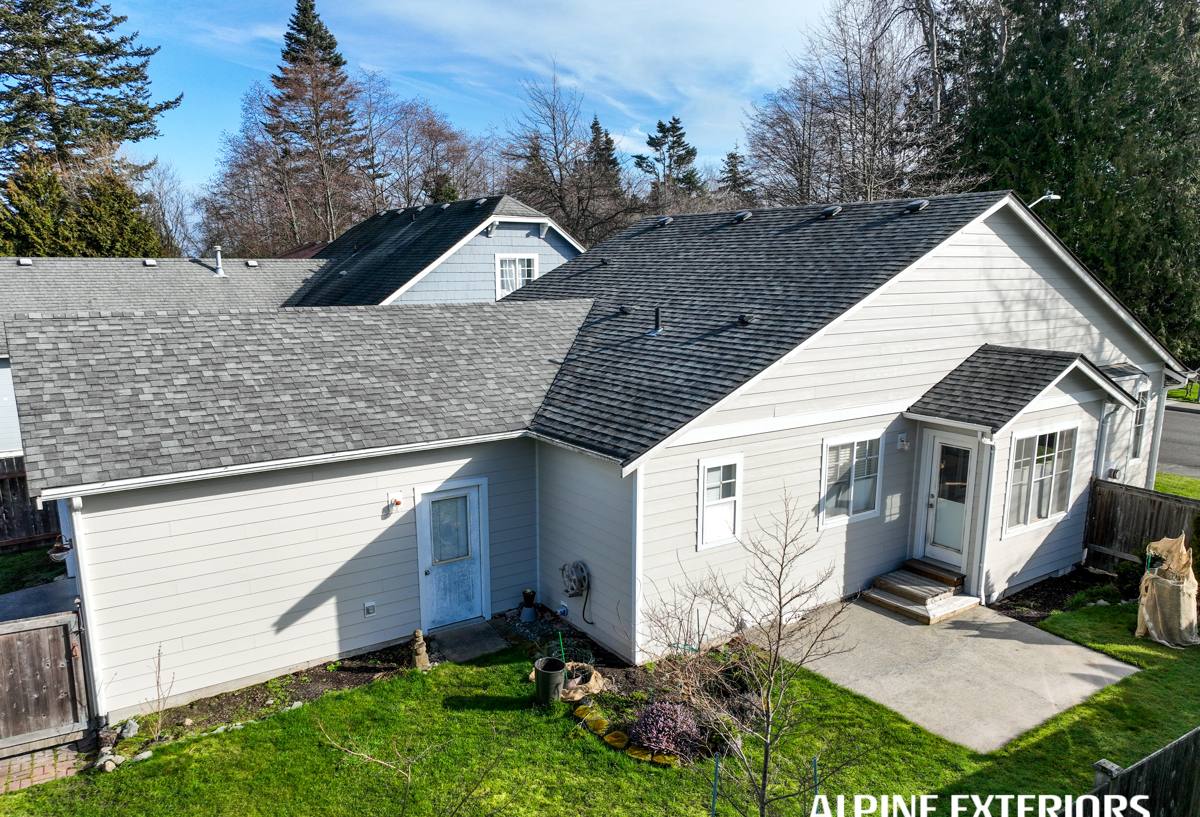
Why "Good Enough" Siding Doesn't Hold Up Here
A lot of siding products perform fine in a drier climate and struggle in ours. Wood-based products absorb moisture and swell, which leads to warping, cupping, and paint failure. Vinyl can handle rain fine but doesn't do much to resist moss and algae staining, and it becomes brittle over time in a climate with this much sustained moisture cycling. The products that hold up best in Whatcom County are the ones engineered specifically to resist water intrusion and dimensional movement — not just tolerate an occasional storm, but shrug off months of it every year.
This is the core of why we standardized our siding installs on James Hardie fiber cement. It's a non-combustible, cement-based product engineered to resist moisture absorption, hold paint and factory finish far longer than wood-based alternatives, and stay dimensionally stable through the wet-dry cycling that's constant here from fall through spring. We don't install LP SmartSide, vinyl, Cemplank, Allura, primed spruce, or cedar — not because those products have no merit anywhere, but because after years of exterior work in this specific climate, Hardie is what we trust to perform and what we're willing to stand behind with our own installation.
Salt Air and Fasteners
Salt-laden air near the bay accelerates corrosion on anything metal — nail heads, flashing, trim fasteners. Correct installation for coastal-adjacent homes means using corrosion-resistant fasteners and flashing details rated for the exposure, not just whatever's fastest to install. This is a detail that's invisible once the siding is up, but it's the difference between trim that stays tight for decades and trim that starts showing rust streaks and loosening within a few years.
Moss and the Shade Problem
Bellingham's tree cover is part of what makes the area beautiful, but shaded, damp wall sections are exactly where moss and algae take hold. Moss on siding isn't just cosmetic — it holds moisture against the surface longer than open exposure would, which shortens the life of anything underneath it. Factory-applied finishes that resist organic growth, combined with siding that doesn't wick moisture into its core, make a real difference in how much maintenance a shaded elevation needs over the years.
How We Approach a Bellingham Siding Replacement
Every siding job starts with an honest look at what's actually happening behind the existing exterior, not just what it looks like from the curb. In a climate like ours, siding failure is very often a water-management failure — bad flashing, missing house wrap, trapped moisture — more than it is a simple case of "the siding wore out." So our process is built around finding and fixing the water path first.
- Exterior assessment: we look at existing siding condition, trim, flashing, window and door transitions, and any signs of moisture intrusion at grade level, roof lines, and deck ledger connections.
- Removal and sheathing check: once old siding comes off, we inspect the sheathing and house wrap underneath. This is where hidden rot or moisture damage from years of Bellingham weather usually shows up, and it needs to be addressed before anything new goes on.
- Water-resistive barrier and flashing: correct house wrap installation and flashing detail at every penetration — windows, doors, hose bibs, vents — is what actually keeps water out long-term, more than the siding material itself.
- James Hardie installation to manufacturer spec: proper fastener spacing, clearances at grade and roofline, and joint treatment, installed by a crew that installs this product regularly rather than occasionally.
- Final trim and finish check: caulking, trim, and paint-matched details finished to a standard that holds up to the inspection of someone who lives with the result every day.
James Hardie: What's Actually in the Product Line
James Hardie fiber cement is engineered from cement, sand, and cellulose fibers, cured into a rigid board that doesn't expand and contract with moisture the way wood-based products do. For a climate like Whatcom County's, that dimensional stability matters more than almost any other single property — it's what keeps siding from cupping, gapping at seams, or failing at fastener points over years of wet-dry cycling.
Hardie's HZ5 product line is engineered specifically for climates with significant moisture and freeze-thaw exposure, which fits Bellingham's weather pattern well. The ColorPlus factory-finish system bakes color onto the board under controlled conditions before it ever reaches the jobsite, which gives a more consistent, longer-lasting finish than field-applied paint and reduces how often a homeowner needs to think about repainting.
Siding Styles Available
- Lap siding: the traditional horizontal look, available in a range of exposures and textures, from smooth to cedar-grain.
- Board and batten (vertical siding): a clean, modern vertical profile that's become popular on Pacific Northwest homes.
- Shingle-style panels: for homes wanting a shingled or cottage look without the maintenance burden of real wood shingles.
- Trim boards: matched fiber cement trim for corners, window and door surrounds, and fascia.
Comparing Siding Materials for a Whatcom County Home
| Material | Moisture Behavior | Moss/Algae Resistance | Long-Term Maintenance |
|---|---|---|---|
| James Hardie Fiber Cement | Dimensionally stable, doesn't absorb and swell | Factory finish resists organic growth well | Occasional wash; repaint intervals much longer than wood |
| Vinyl | Doesn't absorb water but can warp/flex with temperature swings | Prone to algae staining, especially in shade | Low, but staining and brittleness increase with age |
| Wood/Primed Spruce/Cedar | Absorbs moisture, prone to swelling and warping | Highly susceptible without diligent upkeep | Regular painting, sealing, and moisture monitoring required |
| LP SmartSide / Engineered Wood | Better than raw wood but still moisture-sensitive at cut edges and seams | Moderate; depends heavily on correct sealing at every edge | Ongoing attention to seams, edges, and touch-up paint |
Beyond Siding: Roofing, Windows, and Decks
Siding doesn't work in isolation — the roof line, window flashing, and deck connections all interact with how water moves around a house. We handle roofing, windows, and decks alongside siding work because a whole-exterior approach catches problems that a siding-only contractor might miss. A deck ledger board tied into the wall, for instance, is a common spot for hidden moisture intrusion in wet climates, and it's easy to overlook if nobody's looking at the whole envelope at once.
For Bellingham homes especially, coordinating siding replacement with any roofing or window work happening at the same time means fewer seams, fewer transitions where two contractors' work has to line up, and one crew accountable for how it all fits together.
What to Expect: Cost Factors and Timeline
Every home is different, so exact pricing depends on square footage, existing siding condition, how much sheathing repair is needed, trim complexity, and siding profile chosen. Broadly, the factors that move a project's cost are:
- Total square footage and number of stories
- Condition of the sheathing and water-resistive barrier once old siding is removed
- Amount of trim, corner work, and architectural detail
- Siding profile and finish selected (lap vs. board and batten vs. shingle-style)
- Access — tree cover, tight lot lines, and multi-story sections can affect labor time
A full siding replacement is a multi-week project depending on home size and weather windows, since fiber cement installation, like most exterior work, goes best in dry conditions. We plan around Bellingham's wetter months where we can, but a well-managed jobsite with proper weather protection can still move forward through much of the year.
Why a Local Crew Matters
A contractor who works Whatcom County regularly knows which details matter here — the flashing practices that hold up against driving coastal rain, the fastener choices that resist salt air corrosion, the trim details that keep moss from getting a foothold in shaded corners. That knowledge doesn't come from a manufacturer's install manual alone; it comes from doing this work, on homes like yours, in this exact climate, year after year.
We're not a national outfit rotating crews through the area for a season. We install one product system, we install it to spec, and we're around afterward if a question comes up about how it's holding up.
A Practical Checklist Before You Replace Your Siding
- Get a clear look at what's happening behind your current siding, not just its surface condition
- Ask any contractor bidding the job what water-resistive barrier and flashing approach they use
- Confirm what siding material is being proposed and why, not just a price per square foot
- Ask how fastener and flashing hardware is selected for coastal-adjacent exposure
- Check whether the same crew is handling roofing, window, or deck work that touches the same wall sections
- Get the manufacturer warranty terms in writing, along with the installer's own workmanship warranty
If your Bellingham home's siding is showing its age, or you just want an honest read on what's going on behind it, we're happy to take a look. A free, no-pressure estimate gets you a straight answer about condition, options, and cost — with no obligation attached. The form below gets that conversation started.