 Blaine Siding
 Why Peace Arch Homes Wear Out Siding Faster
Peace Arch sits right up against the international border in Blaine, close enough to open water that homes here take a steady beating from marine weather most of the year. It's not one dramatic storm that does the damage — it's the accumulation. Salt-laden air off the water works into seams and fastener heads. Driving rain, pushed sideways by wind coming off the water, finds every gap in a siding system that wasn't detailed correctly. And Whatcom County's long, damp, low-sun winters give moss and algae months at a stretch to get established on north-facing walls and anything shaded by trees or eaves.
Individually, none of these are exotic problems. Combined, and repeated year after year, they're exactly the conditions that expose weak siding installations — and weak siding materials — faster than they would in a drier, warmer part of the state. A siding job done for a home in eastern Washington doesn't need to survive what a Peace Arch wall does.
What "salt air" actually does to a wall
Airborne salt is corrosive to exposed metal — nail heads, flashing, trim fasteners — and it's mildly hygroscopic, meaning it pulls moisture out of the air and holds it against whatever surface it lands on. On a painted wood or composite product, that's a slow chemical and mechanical assault on the finish. On bare or poorly sealed cut edges, it accelerates swelling and breakdown. Materials and finishes that aren't rated for coastal exposure age visibly faster here than the same product would forty miles inland.
What "driving rain" actually does to a wall
Wind-driven rain doesn't just run down a wall — it's forced sideways and upward under laps, around penetrations, and into any joint that isn't sealed or lapped correctly. A siding system depends on gravity to shed water in calm rain; in driving rain, it depends on correct lap dimensions, proper flashing, and a drainage plane behind the cladding to get rid of the water that does get past the surface. Skip any of that, and driving rain will find the shortcut.
What "a long moss season" actually does to a wall
Moss and algae need shade, moisture, and time — Whatcom County winters supply all three for months on end. On siding, they hold moisture against the surface long after the rain has stopped, which is bad for any organic or moisture-sensitive substrate and unattractive on any finish. It's mostly a maintenance and appearance issue on a well-built wall, but on a compromised one it keeps the substrate wet exactly where it's already vulnerable.
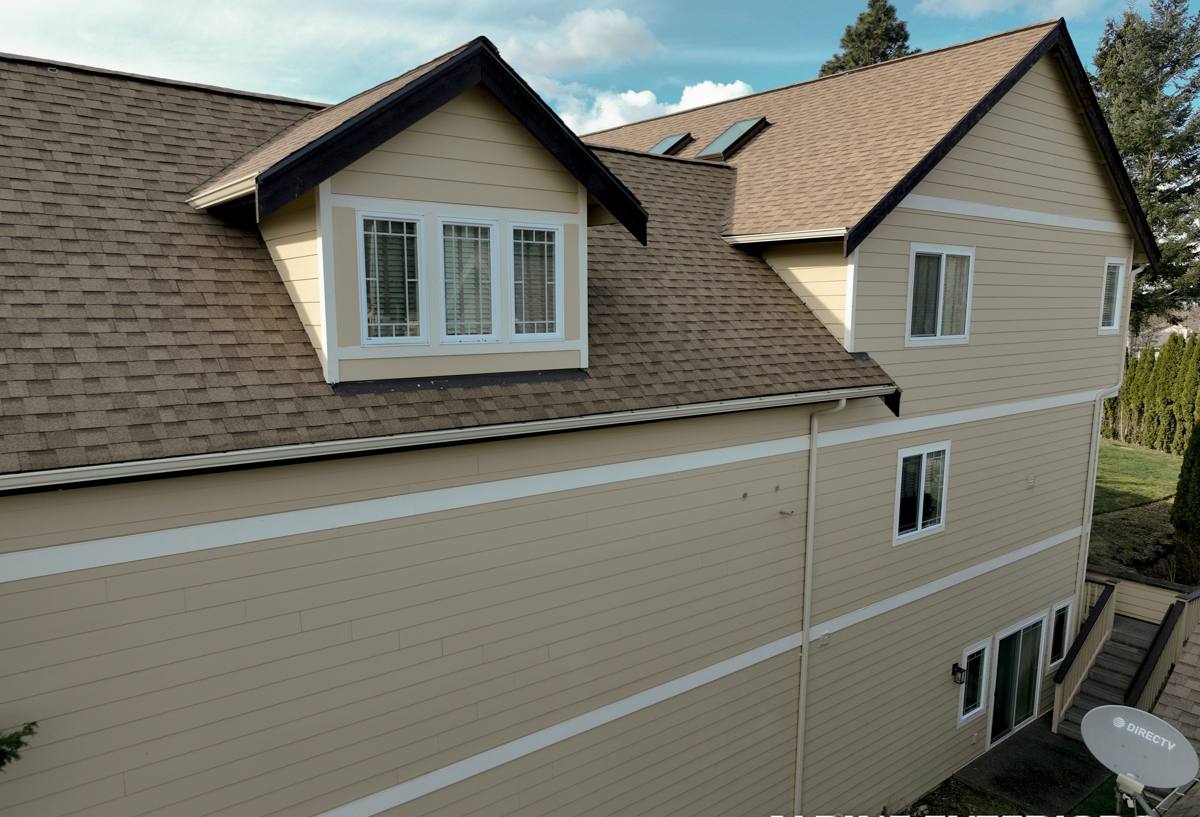
What Correct Fiber Cement Installation Requires Here
Fiber cement is a strong answer to all three of those problems, but only when it's installed to spec. The material itself doesn't rot, doesn't feed moss the way organic substrates can, and holds a factory finish far longer than field-applied paint — but a technically correct install matters more in Peace Arch's climate than it would somewhere milder, because there's less margin for error.
| Installation Detail | Why It Matters in Peace Arch's Climate |
|---|---|
| Drainage gap / rainscreen behind the panels | Gives incidental moisture from wind-driven rain a path to drain and dry instead of sitting against the sheathing |
| Correct lap and clearance dimensions | Wrong overlaps are the single most common way driving rain gets behind siding |
| Stainless or coated fasteners at the correct depth | Salt air corrodes the wrong fastener type over years, leading to staining and loosened panels |
| Factory-primed and factory-painted cut edges (ColorPlus) | Unsealed cut edges are the fastest way for a fiber cement panel to take on moisture |
| Proper flashing at windows, doors, and penetrations | These are the highest-risk points for wind-driven rain intrusion on any home near the water |
| Climate-matched HardieZone product (HZ10 for this region) | Engineered moisture and freeze-thaw performance for Pacific Northwest conditions specifically |
Every one of those line items is easy to skip and hard to spot once the wall is closed up. That's the gap between a fiber cement job that looks right at handoff and one that actually performs for its warranty period.
Why We Only Install James Hardie
We standardized on James Hardie fiber cement for every home we side, including in Peace Arch, and we don't install vinyl, LP SmartSide, or other fiber cement brands. Hardie's HZ product line is engineered specifically for regional climate zones — the version we install here is built for the wetter, cooler conditions of the Pacific Northwest rather than a one-size-fits-all formulation. Its ColorPlus factory finish is baked on under controlled conditions, which holds up to salt air and UV exposure far longer than field-applied paint typically does, and it comes backed by a real transferable warranty on both the substrate and the finish.
That doesn't mean every alternative is a bad product across the board — vinyl is inexpensive and low-maintenance in the right setting, and other fiber cement brands have their own engineering. But we'd rather install one product well, back it with one warranty structure, and know exactly how it behaves in this climate than juggle multiple systems and trade-offs. Non-combustible, dimensionally stable, and proven over decades of coastal and marine installations — that's the standard we hold every Peace Arch job to.
How We Approach a Peace Arch Siding Project
1. On-site assessment
We look at more than the visible siding condition — we check for trapped moisture, soft sheathing, existing flashing quality, and how exposed each elevation is to prevailing wind and rain. A wall facing open water needs a different level of detailing than a sheltered side of the same house.
2. Tear-off and substrate check
Old siding comes off down to the sheathing so we can actually see what's underneath. This is where moss and long-term moisture problems usually reveal themselves — soft spots, staining, or rot that wasn't visible from outside. Anything compromised gets repaired before new siding goes up; covering a bad substrate with new siding just hides the problem for a few more years.
3. Weather-resistive barrier and drainage plane
We install a proper water-resistive barrier and drainage gap before the Hardie panels go on. This is the layer that actually protects the house if any moisture gets past the cladding — and in a driving-rain climate, some always will eventually.
4. Installation to Hardie's fastening and clearance specs
Correct fastener type, correct spacing, correct clearance from grade, roofing, and decks — these specs exist because Hardie has engineered them against exactly the failure modes coastal Washington produces. We don't shortcut them.
5. Trim, flashing, and sealant detail work
This is where most driving-rain failures originate on any home, regardless of siding brand. We flash every window, door, and penetration as its own detail rather than relying on caulk alone to do the job.
6. Final walkthrough
We go over the finished job with the homeowner, including what maintenance to expect given the local climate and how to spot early warning signs down the road.
Maintenance in a Marine, Moss-Prone Climate
Fiber cement is low-maintenance, not no-maintenance. In a climate like Blaine's, a little seasonal attention goes a long way toward protecting the investment.
- Rinse down north-facing and shaded walls once or twice a year to slow moss and algae buildup before it takes hold
- Keep gutters clear so overflow doesn't run down the wall face during heavy rain events
- Trim back vegetation and tree cover that keeps siding shaded and damp longer than it needs to be
- Inspect caulking at trim and penetrations every couple of years — sealant is the first thing to wear out, long before the siding itself
- Watch for chalking, fading, or soft spots at the bottom courses closest to grade, where splash-back moisture concentrates
Signs Your Peace Arch Home's Siding Needs Attention
- Persistent moss or algae that returns quickly after cleaning
- Visible staining or streaking around nail heads or seams
- Soft, spongy, or bubbling spots anywhere on the wall
- Paint or finish that's peeling, chalking heavily, or badly faded on the weather-exposed sides
- Cracked, warped, or separated panels, especially near corners and window trim
- Rising energy bills that suggest air and moisture are getting past the exterior wall
What Drives Cost on a Job Like This
Every home is different, and we won't quote a number without seeing the house, but these are the factors that actually move the price on a Peace Arch fiber cement project.
| Factor | Why It Matters |
|---|---|
| Home size and wall complexity | More square footage and more corners, gables, and trim details mean more labor and material |
| Condition of the existing wall | Rot or moisture damage found during tear-off adds repair work before new siding can go on |
| Siding profile and color | Lap width, texture, and factory ColorPlus color selection affect material cost |
| Trim and accent work | Detailed trim, fascia, and accent bands take more time than a plain wall run |
| Site access | Tight lots, fencing, or difficult staging areas add time for setup and material handling |
| Existing flashing and drainage condition | Bringing older detailing up to current standards protects the new siding's warranty |
Why Local Experience in Peace Arch Matters
A crew that regularly works Blaine and Whatcom County homes already understands how exposed a given elevation is likely to be, what kind of moisture problems tend to show up under old siding in this area, and how to detail a job so it holds up through a full wet season rather than just looking good on installation day. That's not something a crew based elsewhere and unfamiliar with this specific coastal exposure picks up on the first try — it comes from having pulled siding off enough local homes to know exactly where problems tend to hide.
It also means straightforward answers about permitting, timelines, and what a realistic maintenance schedule looks like for a house in this climate, from a crew that will still be around locally if a warranty question comes up years down the road.
If your Peace Arch home's siding is showing its age — or you're just planning ahead — we're happy to take a look and walk you through what a correct James Hardie installation would involve for your specific house. The estimate is free, there's no pressure, and you'll get a straight answer either way.