 Blaine Siding
 Why Moisture Is the Real Enemy of Your Siding
Most siding failures don't start with a dramatic storm. They start quietly, behind the surface, where nobody's looking. Water finds a seam, a nail hole, a cracked caulk line, or a spot where paint has worn thin, and it works its way behind the cladding. From there it doesn't evaporate quickly, because the wall assembly traps it against sheathing, framing, and insulation. Weeks or months later, a soft spot shows up, or a musty smell drifts out of a closet on an exterior wall, and by then the damage is no longer cosmetic.
In Blaine, this process runs on a faster clock than it does in drier parts of the country. Whatcom County sits right on the water, and that proximity to Semiahmoo Bay and the Strait of Georgia means siding here deals with salt-laden air, wind-driven rain that hits walls sideways instead of falling straight down, and a moss season that can stretch from October through May. None of that is unusual for this stretch of the Pacific Northwest coast — but it does mean siding decisions that work fine in Spokane or Boise don't necessarily hold up the same way sixty feet from the beach in Blaine.
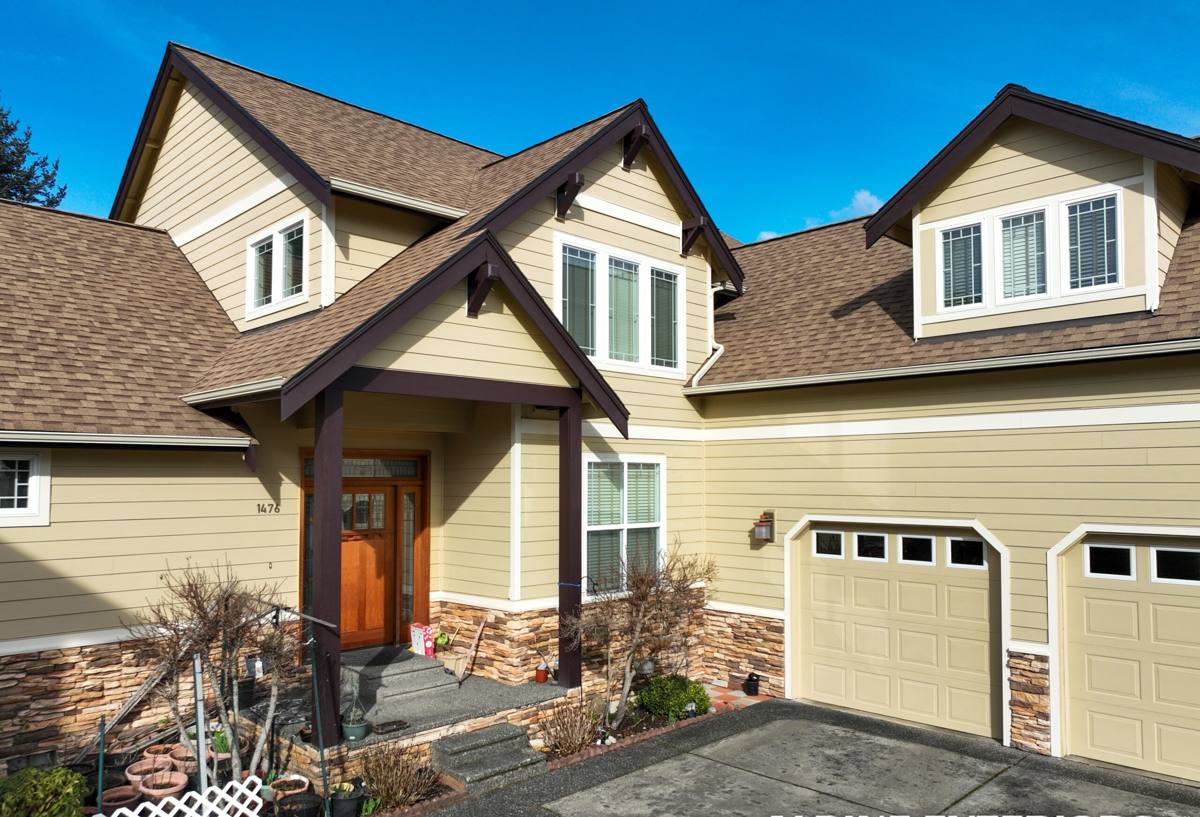
How Water Gets Behind Siding in a Coastal Climate
Driving Rain and Wind-Loaded Walls
Rain that falls straight down mostly runs off a wall. Rain that's pushed sideways by wind — which is a regular occurrence for homes exposed to weather coming off the water — gets forced up under laps, around trim, and into any gap in the siding's face. Homes on higher ground or with more open exposure toward the water see this more than sheltered lots, but very few properties in this area are fully protected from it.
Salt Air and Material Fatigue
Airborne salt accelerates the breakdown of paint films, caulk, and some fastener coatings. Once a protective coating starts to chalk or crack faster than it should, the substrate underneath is exposed to moisture sooner than the manufacturer's warranty assumptions were built around. This matters more for products that depend entirely on a surface coating for protection than for products engineered to tolerate some moisture exposure at the core.
Moss, Shade, and Standing Damp
Whatcom County's long wet season, combined with tree cover common on many lots, keeps north-facing and shaded walls damp for extended stretches. Moss and algae don't just look bad — they hold moisture against the siding surface far longer than an open, sun-exposed wall would ever experience, which extends the amount of time any weak point in the siding is under wet conditions.
What Rot Actually Looks Like Before It's Obvious
By the time siding is visibly crumbling, the damage has usually been progressing for a year or more. Earlier signs are easier to miss but worth checking for during a normal walk around the house:
- Paint that's bubbling, peeling, or alligatoring in one localized area rather than uniformly across the wall
- Siding that feels soft or spongy when pressed, especially near the bottom courses, window sills, and butt joints
- Dark staining or streaking below seams, trim, or fastener heads
- A musty odor near an exterior wall, particularly in a closet, bathroom, or corner room
- Visible gaps opening up between siding boards or between siding and trim
- Swelling or delamination at cut edges and corners
- Persistent moss or algae growth that keeps returning after cleaning
Any one of these on its own isn't necessarily an emergency, but they're worth taking seriously, because the wall assembly behind the siding — sheathing, house wrap, framing — is far more expensive to repair than the siding itself.
Not All Siding Materials Handle Moisture the Same Way
This is the part of the conversation that matters most when a homeowner is choosing what to put back on the house. Every siding material has a different relationship with water, and in a coastal, high-rainfall climate like Blaine's, those differences show up faster than they would somewhere drier.
| Material | How It Responds to Moisture | Coastal Climate Consideration |
|---|---|---|
| Primed wood / cedar | Absorbs and releases moisture readily; relies on paint film and diligent upkeep | Repainting and caulk maintenance on a shorter cycle near salt air; rot-prone if maintenance lapses |
| Vinyl | Doesn't absorb water itself, but panels aren't sealed at seams and can trap moisture behind them against the sheathing | Can hide moisture problems behind the wall longer since the face material won't show rot itself |
| LP SmartSide (engineered wood) | Wood-strand core with a resin/wax treatment and coating; performance depends heavily on caulking, flashing, and coating integrity being kept up | Cut edges and any coating breach are the vulnerable points; salt air and constant damp shorten the margin for maintenance gaps |
| Fiber cement (James Hardie) | Cement-based composition doesn't rot, swell, or support fungal growth; moisture resistance is engineered into the product line for the region | HardieZone HZ5 formulation is specifically engineered for climates like the Pacific Northwest's freeze-thaw and moisture cycles |
This table is a simplification — installation quality changes the outcome for any material — but it explains why we made the call we made as a company.
Why We Standardized on James Hardie
We don't install LP SmartSide, vinyl, Cemplank, Allura, primed spruce, or cedar. That's not because those are bad products in every application — LP SmartSide holds up fine in plenty of climates when maintained on schedule, and cedar has real aesthetic appeal that some homeowners genuinely prefer. Our decision is about what we're comfortable putting our name behind on homes that sit in wind-driven rain and salt air for decades.
Fiber cement doesn't have an organic core for moisture to feed on, so rot in the traditional sense isn't a failure mode the way it is with wood-based products. James Hardie's HZ5 line is formulated specifically for climates with the freeze-thaw and sustained moisture exposure common to the Pacific Northwest coast. It carries a factory-applied ColorPlus finish baked on under controlled conditions, which holds up better against salt air and UV than field-applied paint, and it's non-combustible, which is a separate but real advantage during dry-season wildfire smoke and ember exposure. The warranty is also transferable, which matters to homeowners who may sell before they've recouped the investment.
None of that means fiber cement is maintenance-free — it still needs proper caulking, painted cut edges, and periodic washing — but the failure mode we're trying to avoid on a coastal property is a wall assembly rotting from the inside while the siding face looks fine. That's a much lower risk with fiber cement than with a wood-based product.
Installation Details That Matter More Than the Material
Even the best siding material fails early if it's installed wrong, and moisture problems traced back to a siding job are more often an installation failure than a product failure. The details that actually keep water out include:
- Weather-resistive barrier and flashing installed and lapped correctly behind the siding, not just around windows and doors but at every horizontal transition
- Proper clearance between the bottom of the siding and grade, decks, roofs, and other horizontal surfaces, so water isn't wicking up from below
- Correct fastener placement and depth — over-driven or under-driven fasteners create entry points and can void warranty coverage
- Caulked and painted cut edges on fiber cement, since factory finish protection doesn't extend to field cuts
- A drainage plane that lets any incidental moisture that does get behind the siding find its way back out instead of sitting against the sheathing
A homeowner evaluating a contractor's bid should ask specifically how these details will be handled — not just what brand of siding is being quoted.
Repair, Recoat, or Full Replacement?
Not every sign of moisture damage means a full re-side. The right call depends on how far the damage has spread and whether it's isolated or systemic.
- Isolated soft spots or a single damaged board can sometimes be cut out and replaced without touching the rest of the wall, provided the underlying sheathing tested dry.
- Recurring paint failure or chalking across an otherwise sound wall may point to a coating or maintenance issue rather than a structural one.
- Widespread soft siding, multiple stained seams, or damage found in more than one wall section usually means the original installation had systemic flashing or drainage issues, and patching won't address the root cause.
- Any sign of damage to sheathing or framing found once siding is pulled back changes the scope regardless of what the siding material was.
A proper inspection — pulling a section of siding if there's real doubt, not just looking at the surface — is the only reliable way to tell which category a given problem falls into.
What Blaine and Whatcom County Homeowners Should Watch For Seasonally
Given the local climate, it's worth building a light seasonal habit around siding rather than waiting for a problem to announce itself. Late summer, before the wet season sets in, is a good time to check caulk lines and touch up any exposed spots. Late winter or early spring, after the heaviest rain and moss growth of the year, is the best time to look for the soft-spot and staining signs described earlier, since that's when accumulated moisture exposure would show up first.
If you're noticing any of the warning signs above, or you're simply due for a siding replacement and want to understand your material options honestly before committing, we're happy to come take a look. We offer free, no-pressure estimates and can walk you through exactly what we'd recommend for your specific exposure and budget.