 Blaine Siding
 Siding Built for Cherry Point's Coastal Exposure
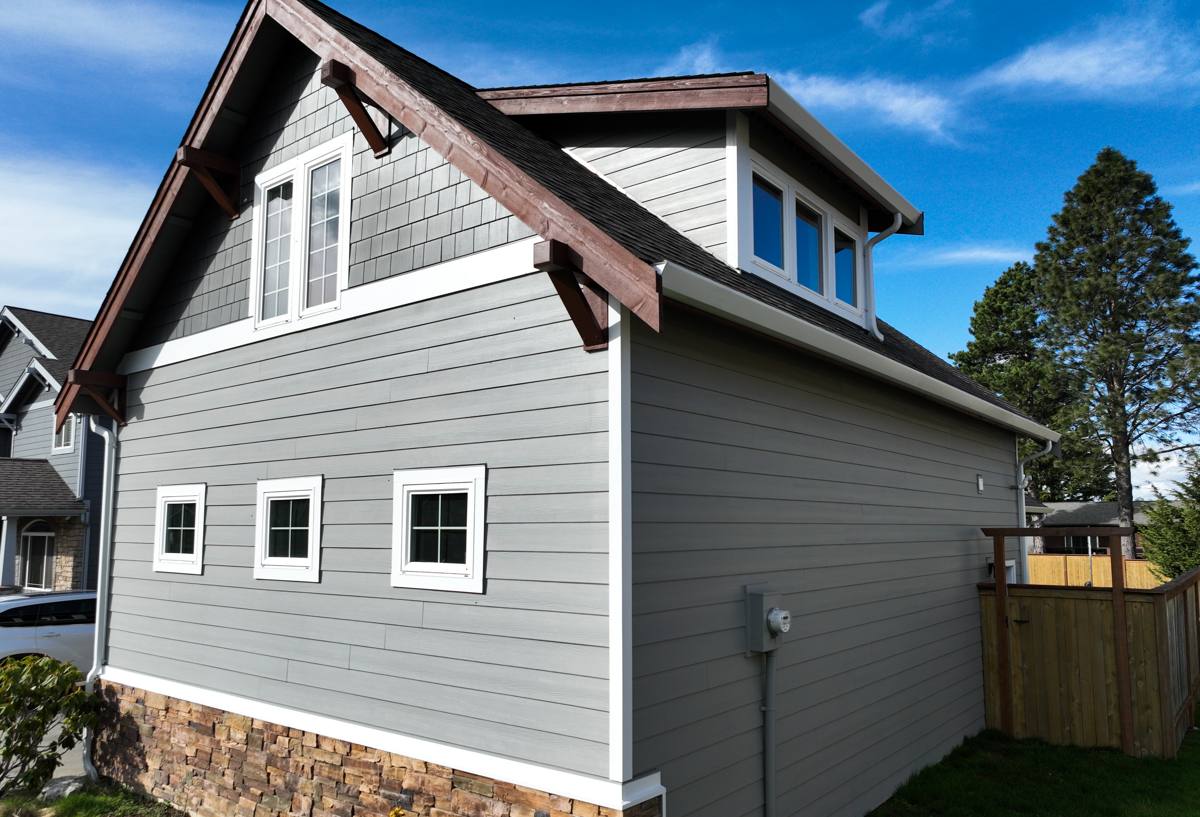
Cherry Point sits on the Salish Sea in northern Whatcom County, a few miles from Blaine, where open water meets a rural, low-density landscape with little to break the wind or the salt spray coming off the strait. Homes and outbuildings out here take a different kind of beating than a house tucked into a sheltered subdivision closer to town. The exterior envelope has to deal with salt-laden air, wind-driven rain that finds every gap in a wall system, and long stretches of damp, low-sun weather that keep surfaces wet and shaded for weeks at a time. That combination is exactly why we're selective about what we put on a wall out here, and why we only install James Hardie fiber cement siding.
What the Cherry Point Climate Actually Does to Siding
It helps to separate the individual stresses instead of lumping them together as "bad weather," because each one attacks siding differently.
Salt Air
Proximity to the water means airborne salt settles on every exterior surface, not just near the shoreline. Salt is hygroscopic — it pulls moisture out of the air and holds it against whatever it's sitting on. On wood-based products, that means longer wet cycles right at the surface where paint and coatings are already under the most stress. On metal fasteners, trim, and flashing, it accelerates corrosion if the materials aren't rated for it.
Driving Rain
Storms coming off the Salish Sea don't just fall straight down — wind pushes rain sideways into wall assemblies, especially on west- and south-facing elevations with no windbreak. That's a water-management problem as much as a materials problem: siding, flashing, and house wrap all have to work together to shed water rather than let it track behind the cladding.
Moss and Prolonged Dampness
Whatcom County's marine climate keeps humidity high for much of the year, and shaded, north-facing walls or areas under tree cover can stay damp for extended periods. That's ideal for moss and algae growth, which holds moisture against the siding surface even longer and accelerates whatever deterioration is already happening underneath.
None of these stresses are dramatic on their own. The problem is that Cherry Point gets all three at once, for months at a time, which is a harder test than most siding products were designed to pass without a lot of maintenance.
Why We Standardized on James Hardie
We used to install a broader mix of siding products. We don't anymore, and the decision came down to what actually holds up in this specific environment without turning into a maintenance project for the homeowner.
- Non-combustible core. James Hardie fiber cement is made primarily from cement, sand, and cellulose fiber — it does not burn, which matters in a region where wildfire smoke seasons have gotten longer and where insurers increasingly ask about exterior materials.
- Engineered for moisture, not just painted against it. Fiber cement doesn't absorb and swell the way wood-based products can. It handles repeated wet-dry cycling — exactly what Cherry Point delivers — far better over a 20- and 30-year timeline.
- Factory-applied ColorPlus finish. The color and protective coating are baked on in a controlled factory environment, not brushed or sprayed on site. That finish is formulated to resist salt-air fading and UV breakdown better than field-applied paint, and it comes with its own finish warranty separate from the product warranty.
- Climate-engineered product lines. Hardie makes region-specific formulations (HZ5 for our climate zone) that account for freeze-thaw and moisture exposure patterns typical of the Pacific Northwest, rather than a single one-size-fits-all formula.
- A warranty that's actually transferable. Hardie's product warranty is designed to transfer to a new owner, which matters for resale — an inspector or buyer's agent asking "what's the siding and is it warrantied" gets a straightforward answer.
We also stopped installing several other products for related reasons, which we're happy to walk through in person: vinyl siding can warp and doesn't hold up to sustained salt exposure the way fiber cement does; LP SmartSide and similar engineered-wood products are wood-based at the core and more sensitive to the kind of prolonged dampness Cherry Point sees; primed spruce and cedar require an ongoing paint/stain maintenance cycle that gets harder to keep up with in a marine climate. None of these are bad products in every setting — they're just not what we'd choose to warranty our own installation work on out here.
How a Siding Project Works in Cherry Point
Assessment First
Before we talk product or color, we look at the house: which elevations take the worst of the weather, what the current siding and trim condition tells us about how water has been moving (or not moving) through the wall assembly, and whether there's existing moss, staining, or soft spots that point to trapped moisture. A rural or semi-rural property near open water often has different exposure on each side of the house, and that changes where we pay closest attention to flashing and detailing.
Water Management Comes Before Siding
Fiber cement is only as good as the assembly behind it. On a project in this area, correct house wrap, window and door flashing, and properly lapped and sealed joints matter as much as the siding product itself — that's where driving rain either gets managed or gets in. We treat this as a system, not a cosmetic layer.
Fastening and Trim for Salt Exposure
We use corrosion-resistant fasteners and trim details appropriate for coastal exposure, because generic hardware is often the first thing to fail in a salt-air environment — long before the siding itself shows any wear.
Full-Home Exterior Perspective
Because we also handle roofing, windows, and decks, we look at siding as one piece of the whole exterior envelope rather than in isolation. A roof that's shedding water onto a wall, or window flashing that's failed, will undermine even a well-installed siding job. When it makes sense, we'll flag those connections during the estimate rather than after the fact.
Comparing Siding Options for a Coastal Whatcom County Home
| Factor | James Hardie Fiber Cement | Vinyl | Engineered Wood / Primed Wood |
|---|---|---|---|
| Salt air resistance | Strong — formulated for moisture cycling | Moderate — can become brittle over time | Weaker — wood-based core is moisture-sensitive |
| Fire resistance | Non-combustible | Combustible, can melt/deform | Combustible |
| Moss/algae impact | Low long-term degradation with normal cleaning | Low degradation, cosmetic staining | Higher risk of underlying rot if untreated |
| Maintenance cycle | Occasional wash; factory finish holds color | Low, but limited repair options if damaged | Repaint/restain every several years |
| Warranty transferability | Yes, product warranty designed to transfer | Varies by manufacturer | Varies, often shorter |
This isn't a claim that every alternative product fails in this climate — it's why, given everything we've seen installed and maintained in coastal Whatcom County over time, fiber cement is the one we're willing to put our installation warranty behind.
Signs a Cherry Point Home May Need Siding Attention
- Persistent moss or algae growth that returns quickly after cleaning
- Soft spots, bubbling, or visible warping, especially on north-facing or shaded walls
- Peeling or chalky paint that keeps recurring in the same spots
- Visible rust streaking from fasteners or trim
- Gaps opening up at seams, corners, or around window and door trim
- A noticeably higher heating bill, which can point to a compromised wall assembly letting in drafts and moisture
Any one of these on its own might just need a repair. Several showing up together, especially on a home that's been through a few decades of coastal weather, usually means it's worth a full exterior assessment rather than patchwork fixes.
Roofing, Windows, and Decks in the Same Environment
Siding doesn't work in isolation, and neither do the other parts of a home's exterior in a place like Cherry Point. A roof needs to shed the same driving rain without letting wind-driven moisture work under shingles or flashing. Windows need seals and flashing that hold up to repeated wet cycles without letting water track into the wall cavity where siding meets the frame. Decks facing open water take direct salt exposure and sun/rain cycling on every board and fastener. We handle all four because they're connected — a failure in one often shows up as a problem in another, and a crew that only sees the siding can miss that.
Why a Local Crew Matters Out Here
Cherry Point isn't a dense subdivision with identical lots — it's a mix of rural and waterfront properties with real variation in exposure, wind direction, and sun/shade patterns from one lot to the next. A crew that works Whatcom County's coastline regularly knows to check different things on a west-facing wall near open water than on a sheltered elevation a quarter mile inland. That local pattern recognition is part of what keeps a siding job from becoming a callback a few years down the road.
If you're weighing a siding project — or want a second opinion on moss, staining, or soft spots you've noticed on your home — we're happy to take a look and walk you through what we're seeing. There's no cost and no pressure to a free estimate; it's a straightforward way to find out what your exterior actually needs.