 Blaine Siding
 Why Peace Arch Siding Takes a Different Kind of Job
Peace Arch sits about as close to salt water and the international line as a Whatcom County home can get, and that combination puts real stress on exterior siding. Homes here face a mix of marine air off the nearby water, wind-driven rain rolling in off the strait, and a moss season that runs long into months other parts of the county would call dry. None of that is exotic — it's just the baseline for this stretch of Blaine — but it means a siding job that would hold up fine forty miles inland can start failing here within a few years.
Salt Air and Marine Exposure
Airborne salt doesn't just affect metal — it accelerates the breakdown of paint films, softens caulk joints faster than inland exposure would, and works into any seam or fastener hole that isn't properly sealed. Siding that depends on a surface coat of paint for its weather resistance is fighting a losing battle against salt air over a ten-to-fifteen-year span; the finish chalks, thins, and opens the door to moisture behind the boards.
Driving Rain and Wind-Driven Moisture
Blaine's rain rarely falls straight down. Wind off the water pushes it sideways into wall assemblies, which means the details that keep water out — flashing, laps, caulk lines, drainage gaps — matter more here than in a sheltered inland yard. A siding product and installation that can shrug off a light shower but lets moisture track sideways under wind-driven rain is a slow-motion problem, not a fixed one.
The Long Moss Season
Constant dampness plus shade from mature trees adds up to a moss and algae season that stretches well beyond summer. Moss holds moisture against a wall surface for weeks at a time, and on siding that swells, delaminates, or absorbs water at the edges, that's exactly the kind of prolonged wet contact that shortens its life.
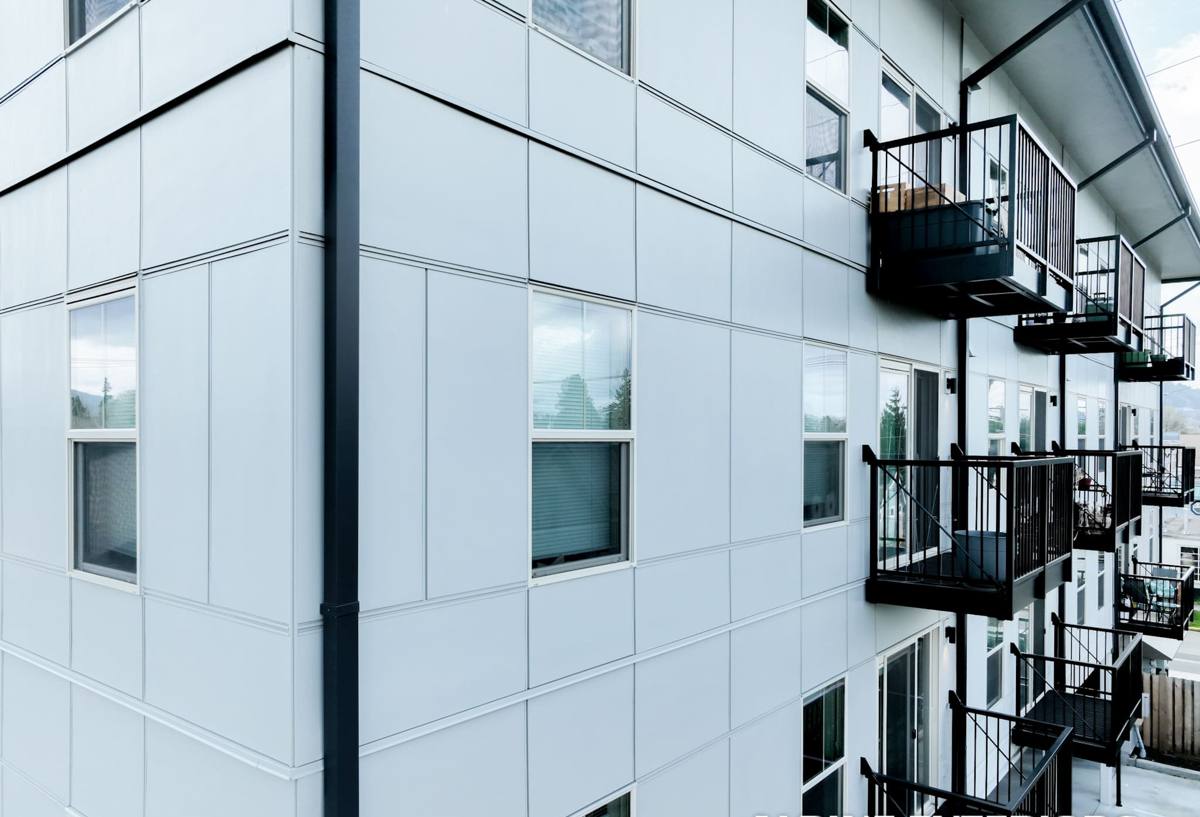
Why We Only Install James Hardie Here
We standardized on James Hardie fiber cement for every home we side, including Peace Arch, because it's engineered around the failure points that actually show up in this climate — not because it's the only decent product on the market. There are trade-offs with every siding material; Hardie's happen to line up well with what this location needs.
Non-Combustible, Dimensionally Stable Material
Fiber cement doesn't expand and contract with moisture the way wood-based products do, and it doesn't provide fuel the way vinyl or wood siding does. In a marine climate where boards are wet more often than they're bone dry, that dimensional stability is what keeps laps tight and fasteners from working loose over time.
HZ Product Engineering for Wet Climates
James Hardie makes region-specific formulations, and the HZ10 line is engineered for climates like ours — heavier moisture exposure, more freeze-thaw cycling near the water, and longer wet seasons. That's a meaningful difference from a generic fiber cement product built for a drier region and shipped everywhere.
ColorPlus Factory Finish
Rather than relying on a field-applied paint job to hold up against salt air, ColorPlus finishes are baked on in a controlled factory process, which produces a harder, more consistent finish than most site-applied coats. That matters directly here: a factory finish resists the fading and chalking that salt exposure accelerates, and it comes with its own finish warranty separate from the substrate warranty.
What Correct Installation Actually Involves
Hardie siding is only as good as the installation behind it. The material can be engineered for wet climates, but if the water management details underneath it are wrong, the same failure modes show up regardless of what's on the outside. On a Peace Arch home, we pay particular attention to:
- Correct weather-resistive barrier and a real drainage gap behind the siding, not just a barrier stapled flat against the sheathing
- Flashing integrated at every window, door, and roof-to-wall transition, lapped so water always sheds outward and downward
- Manufacturer-specified nailing patterns and fastener depth — overdriven or underdriven nails are one of the most common causes of early siding failure
- Minimum clearance from grade, decks, patios, and roof lines so splashback and standing moisture don't sit against the bottom course
- Factory-cut and factory-primed edges wherever boards are trimmed, with any field cuts sealed per Hardie's application instructions
- Caulk and sealant only at joints designed to be sealed — not as a substitute for proper flashing elsewhere
Skip any one of these and you can end up with premature paint failure, soft trim, or moisture intrusion behind boards that look fine from the street — problems that often don't surface until they're expensive to fix.
Our Process, Step by Step
The process itself isn't unique to Peace Arch, but how closely we follow it is non-negotiable given what this climate does to shortcuts.
Inspection and Scope
We start by walking the whole exterior, checking sheathing condition where old siding comes off, and looking specifically for signs of past moisture intrusion around windows, roof lines, and low-clearance areas — common trouble spots in wind-driven rain exposure.
Tear-Off and Substrate Repair
Old siding comes off down to the sheathing so we can address anything hidden underneath — soft sheathing, missed flashing, old caulk-and-hope repairs — before anything new goes up. Covering over an existing problem just relocates it under a new layer.
Water Management Layer
House wrap or building paper and a drainage gap go on next, with flashing tied in at every penetration and transition before a single piece of Hardie board is installed.
Hardie Installation
Boards are installed to manufacturer spec for fastening, lap, and clearance, with color and profile chosen up front so factory-finished pieces arrive ready to install rather than needing field touch-up.
Final Detailing and Walkthrough
Trim, caulking at designed joints, and a final walkthrough close out the job, along with registering the manufacturer warranty in the homeowner's name.
What Drives the Cost of a Peace Arch Siding Project
Every home is different, and we won't put a number on your project until we've actually looked at it, but these are the factors that move an estimate up or down most:
| Cost Factor | Why It Matters |
|---|---|
| Home size and wall complexity | More square footage and more corners, gables, and dormers mean more cutting, flashing, and labor time |
| Condition of existing sheathing | Water-damaged sheathing found during tear-off has to be repaired or replaced before new siding goes on |
| Siding profile and trim package | Lap width, panel style, and trim detail all affect material cost and installation time |
| Access and site conditions | Tight lot lines, mature landscaping, or limited staging area near the water can add labor time |
| Existing water damage repairs | Rot around windows or low-clearance areas found during removal is priced separately from the siding itself |
| Color and finish selection | Factory ColorPlus finishes and specialty colors carry different material pricing than standard options |
Why Hiring a Crew That Already Works This Neighborhood Matters
Any licensed contractor can install siding. Fewer have spent enough time on homes near this stretch of the border and the water to know where wind-driven rain actually hits hardest on a given elevation, which sides of a house see the worst moss growth, or how much clearance really matters on a lot that sits low relative to the street. That's not a marketing point — it changes where we spend extra attention on flashing and drainage before problems ever show up.
It also means more realistic scheduling. We already know what Blaine's weather windows look like through the wetter months and plan tear-off and installation around them, instead of learning it partway through your project.
Living With Hardie Siding in a Salt Air, High-Moss Climate
Correct installation gets you most of the way to long-term performance, but a little homeowner maintenance stretches it further in this environment:
- Rinse siding periodically to clear accumulated salt residue and organic buildup, especially on sides facing the water
- Keep gutters and downspouts clear so overflow doesn't run down and sit against wall surfaces
- Trim back vegetation and tree cover where practical to reduce shade-driven moss growth
- Inspect caulk joints at windows, doors, and trim annually and have any cracked or shrunk sealant redone before wet season
- Have a professional check flashing and low-clearance areas every few years, particularly after any nearby landscaping or grading changes
None of this is heavy maintenance — it's the same basic upkeep any exterior needs, just worth doing a little more consistently this close to the water.
If you're weighing a siding replacement on a Peace Arch home, we're happy to walk the exterior with you, point out what we see, and put together a straightforward, no-pressure estimate — no obligation, just a clear look at what your home actually needs.