 Blaine Siding
 Birch Point Sits Right at the Edge of the Weather
Birch Point is one of those Blaine neighborhoods where you can't talk about the house without talking about the water. Homes here sit close to Semiahmoo Bay and the open exposure of the Strait of Georgia, which means the exterior of a Birch Point house works harder than one a few miles inland in Whatcom County. Salt-laden air, wind-driven rain, and long stretches of shaded dampness under the fir and cedar canopy all show up on siding, trim, roofing, and decking faster here than almost anywhere else we work.
We've replaced enough siding on waterfront and near-waterfront properties in this area to know that a product or installation method that holds up fine in a dry, sheltered subdivision can fail early a quarter mile from the beach. That's the lens we bring to every Birch Point project, whether it's a full siding replacement, a re-roof, new windows, or a deck rebuild.
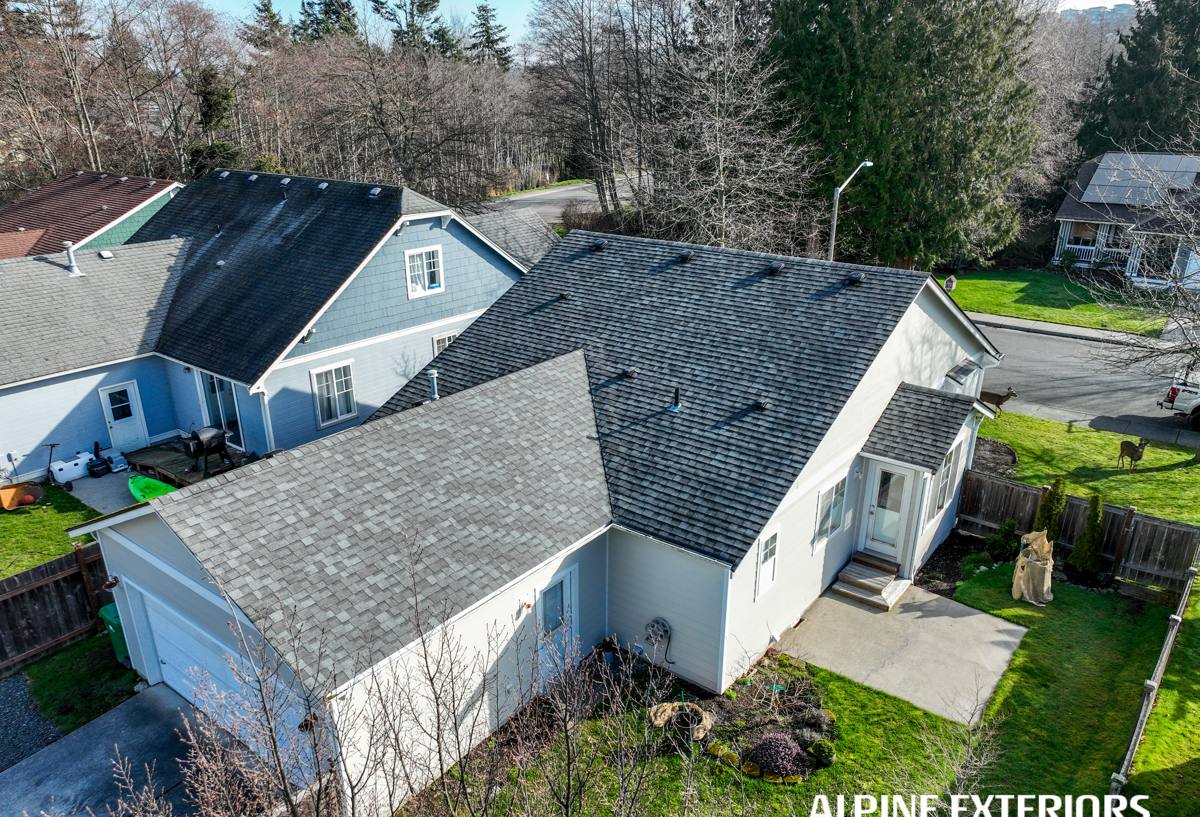
What Salt Air Actually Does to a House
Salt air isn't just a smell. It's airborne moisture carrying dissolved salts that settle on every exterior surface, then get reactivated by rain, fog, and morning dew. On a home a block or two off the water in Birch Point, that cycle repeats almost daily for much of the year.
What it targets first
- Fasteners, flashing, and any exposed metal — corrosion accelerates dramatically in salt air compared to inland exposure
- Paint and factory finishes — salt residue breaks down lower-grade coatings faster than plain weathering would
- Any wood-based siding product — salt keeps surfaces damp longer, which feeds rot and fungal growth
- Caulk and sealant joints — repeated wet-dry cycling shortens the working life of sealants at trim and window edges
None of this means a house can't hold up near the water. It means the materials and details have to be chosen with that exposure in mind, not treated the same as a build in a sheltered inland neighborhood.
Driving Rain and the Whatcom County Wet Season
Blaine and the rest of Whatcom County get their share of straightforward vertical rain, but the exposure at Birch Point adds wind-driven rain off the water — rain that hits siding at an angle and works its way behind trim, around penetrations, and into any gap in the water-resistive barrier. This is a different stress than what a lot of siding products are tested and rated for.
Wind-driven rain is also why flashing details matter as much as the siding material itself. We see plenty of older Birch Point homes where the siding looks fine from the street but the sheathing behind it has been slowly saturated for years because of a missing kick-out flashing, poor window flashing, or caulk used in place of proper metal flashing. A siding replacement is the right time to correct that, not just swap the surface material.
Moss, Shade, and the Long Damp Season
Between the marine layer, the rainfall, and the tree cover common around Birch Point lots, moss and algae growth on north-facing walls and roofing is a fact of life for much of the year. Moss holds moisture against the surface it's growing on, which is a problem for any siding material that isn't dimensionally stable or that can absorb water into its core.
This is one of the biggest reasons wood-based and engineered-wood siding products struggle in this specific microclimate. Moss doesn't just look bad — it keeps a wall wet longer than open sun exposure would, and that sustained dampness is what eventually leads to swelling, soft spots, and paint failure on products that aren't built to handle it.
Why We Install Only James Hardie Fiber Cement Siding
We made a decision as a company to install James Hardie fiber cement siding exclusively — not vinyl, not LP SmartSide, not Cemplank or Allura, not primed spruce or cedar. That's not a marketing position; it's a response to what we've seen happen to other products in exactly this kind of coastal, wet, shaded environment.
Vinyl siding
Vinyl is inexpensive and low-maintenance in mild, sheltered conditions, but it's a thin, temperature-sensitive material that can warp, buckle, or become brittle with UV and thermal cycling. In a wind-exposed location like Birch Point, vinyl's looser fit and lap-style installation also give wind-driven rain more opportunities to get behind the cladding.
Engineered wood (LP SmartSide) and wood siding
These products rely on a wood-strand or solid-wood core protected by a coating or primer. In a marine, moss-prone climate, any breach in that coating — a nail pop, a cut edge, a scuff — becomes a point where moisture can enter the wood fiber and start it swelling or rotting from the inside. Cedar and primed spruce carry the same core vulnerability without engineered strand reinforcement, and both need more frequent refinishing to keep that protective layer intact.
Cemplank and Allura
These are also fiber cement products and share fiber cement's core strengths — non-combustibility and dimensional stability. Our reason for standardizing on Hardie specifically comes down to the factory-cured ColorPlus finish, the HZ5 engineering built for wet coastal climates, and the transferable warranty structure, which we've found to be the most consistent combination for the way we install and stand behind our work.
What Hardie gets right for this location
Fiber cement doesn't have a wood core to rot and won't feed mold the way organic material can. It's non-combustible, holds paint far longer than wood-based products because of the factory-applied ColorPlus finish, and is engineered in HZ5 formulation specifically for the kind of wet, moisture-heavy climate Birch Point sits in. It isn't maintenance-free — no exterior product is — but the maintenance it needs is inspection and caulk upkeep, not refinishing a coating that's failing under salt exposure.
Cost and Trade-Off Comparison for This Climate
| Factor | Vinyl | Wood / Engineered Wood | James Hardie Fiber Cement |
|---|---|---|---|
| Behavior in salt air | Can become brittle, fading over time | Coating breach exposes wood core to rot | Non-organic core, factory finish resists fade |
| Wind-driven rain resistance | Loose lap fit, more entry points | Depends heavily on coating integrity | Rigid panel, correctly flashed and sealed |
| Moss/algae exposure | Surface growth, doesn't structurally harm panel | Sustained dampness can soften/rot substrate | Won't rot; surface can be cleaned |
| Fire exposure | Combustible | Combustible | Non-combustible |
| Upfront cost | Lowest | Mid | Higher than vinyl, competitive with quality wood |
| Long-term maintenance | Low, but limited lifespan in harsh exposure | Recurring refinishing/inspection | Periodic caulk/inspection, no refinishing needed |
What Correct Installation Looks Like on a Birch Point Home
Material choice only solves half the problem. The other half is installation detail, which matters more here than in a sheltered inland location:
- Proper weather-resistive barrier and rainscreen gap behind the siding to let incidental moisture drain and dry
- Corrosion-resistant fasteners rated for coastal/marine exposure, not standard interior-grade hardware
- Correctly lapped and sealed flashing at every window, door, and roof-to-wall transition
- Manufacturer-specified fastener spacing and clearance from grade and roof lines
- Factory-finished panels handled and cut to avoid exposing raw, unsealed edges
We follow Hardie's published installation specifications closely because that's what keeps the warranty valid and what actually determines whether the siding performs the way it's engineered to over 20 or 30 years in this environment.
Beyond Siding: Roofing, Windows, and Decks
A Birch Point exterior is a system, not a single component. We also handle roofing, window replacement, and deck construction, and we look at all of it together during an estimate:
- Roofing — the first line of defense against wind-driven rain and the surface most exposed to moss growth; roof condition also affects how water sheds around the top of the siding
- Windows — flashing integration between windows and new siding is one of the most common failure points we find on older coastal homes; replacing both together lets us get the water management right the first time
- Decks — exposed to the same salt air and rain, and built with materials and fasteners chosen for that same exposure rather than a generic inland spec
Why a Local Crew Matters in Birch Point
A contractor who only works inland in Whatcom County may not think twice about fastener grade, flashing sequence, or rainscreen detailing — because they haven't had to. Working regularly on homes exposed to Semiahmoo Bay and the open strait means we build in those details as standard practice, not as an upsell.
Questions worth asking any contractor bidding a Birch Point exterior job
- Have you installed siding on other homes in this specific waterfront or near-waterfront area?
- What fastener and flashing spec will you use, and is it rated for coastal exposure?
- Are you a manufacturer-certified installer, and can you show proof of insurance and local licensing?
- Will the installation follow the manufacturer's published requirements closely enough to keep the warranty intact?
- Can you walk me through how water sheds at the windows, roofline, and base of the wall on my specific house?
If you're weighing a siding, roofing, window, or deck project on a Birch Point home, we're happy to come take a look and talk through what your specific exposure calls for. There's no cost and no pressure to get an estimate — just a straight assessment of what your house needs.