 Blaine Siding
 Siding Replacement for Lynden Homes
Lynden sits inland from Semiahmoo Bay and the Blaine waterfront, tucked into the Nooksack River valley near the Canadian border. That geography matters for siding. Lynden doesn't take the direct salt spray that a beachfront home in Blaine does, but it sits squarely in the same marine-influenced weather system — long, wet winters, a short dry season, and enough humidity most months to keep exterior surfaces damp for days at a time. Add in the open farmland that surrounds much of the city, and Lynden homes deal with their own version of the same problem every siding material in Whatcom County eventually faces: moisture that doesn't leave in a hurry.
We install siding, roofing, windows, and decks across Whatcom County, and Lynden is a regular stop for us. This page walks through what the local climate actually does to a house here, why we standardized on one siding product instead of offering the usual menu of options, and what to expect if you're looking at a siding replacement.
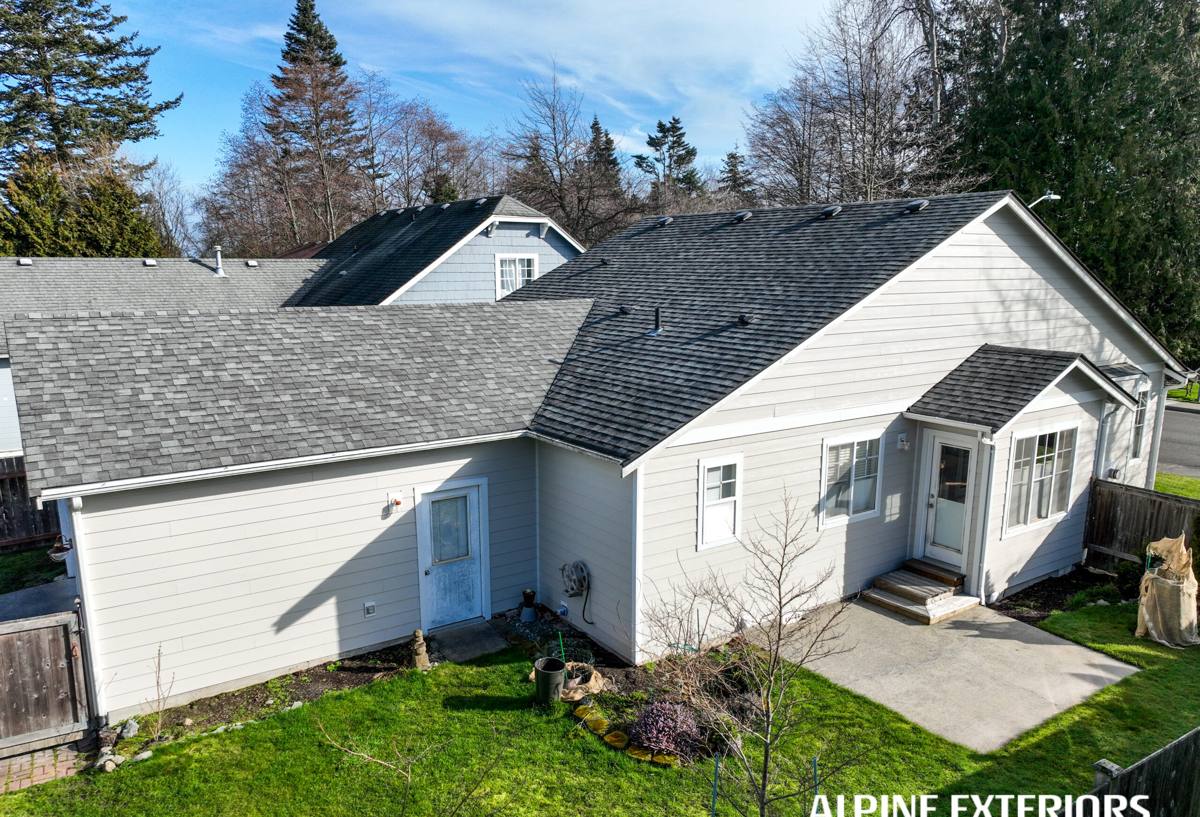
What the Whatcom County Climate Does to Siding
Every siding material sold in the Pacific Northwest is rated to handle rain. Fewer of them hold up well to what actually happens over a decade or two in a place like Lynden, where wet weather is the rule rather than the exception for half the year.
Driving Rain and Wind-Driven Moisture
Storms coming off the Strait of Georgia and Puget Sound don't always arrive as gentle vertical rain. Wind pushes water sideways into wall assemblies, and it finds every seam, lap joint, and fastener hole that wasn't detailed correctly. Over years, that's what causes swelling, delamination, and hidden rot behind siding that looks fine from the curb.
A Long Moss and Algae Season
Lynden's combination of shade from mature trees, farmland humidity, and mild temperatures gives moss and algae a long growing window — often nine or ten months of the year on north-facing walls and anywhere sun doesn't reach. Moss holds moisture directly against a wall surface, which is far worse for siding longevity than rain that simply runs off.
Freeze-Thaw and Temperature Swings
Whatcom County doesn't get brutal winters, but it does get repeated freeze-thaw cycles, especially in the colder pockets around Lynden away from the immediate coastline. Materials that absorb even small amounts of water will expand when that water freezes, and repeated cycles stress paint film, caulk joints, and the siding itself.
Agricultural and Rural Exposure
Lynden's surrounding farmland means more airborne dust, occasional agricultural dust settling on exterior surfaces, and stronger open-field wind gusts than a home tucked into a denser neighborhood. That's a smaller factor than moisture, but it adds to the maintenance load on softer or less stable siding materials.
Why We Install Only James Hardie Fiber Cement
Most siding contractors in this region will sell you whatever you ask for — vinyl, LP SmartSide, fiber cement, sometimes cedar. We don't. We install James Hardie fiber cement siding exclusively, and it's worth explaining why, because it's the whole reason this company exists in its current form.
Fiber cement is made from cement, sand, and cellulose fibers, which makes it dimensionally stable and non-combustible. That matters in a wet climate because the material doesn't swell, warp, or rot the way wood-based products can when they take on moisture. It matters more broadly because it doesn't burn the way vinyl or wood-based siding does.
What We Don't Install, and Why
We get asked regularly about vinyl, LP SmartSide, Cemplank, Allura, and primed wood siding. Each of those products has legitimate uses and a place in the market. Our decision not to install them isn't a claim that they're bad products — it's a professional standard we hold ourselves to based on what we've seen hold up over time in exactly this climate.
- Vinyl siding is inexpensive and low-maintenance, but it can warp or distort in temperature swings, fades over time with UV exposure, and offers little protection in a fire. It also can't be painted a different color without specialty products, which limits a homeowner's options down the road.
- LP SmartSide is an engineered wood product with a resin-treated strand design. It performs reasonably well when installation and maintenance are followed to the letter, but it's still wood-based, which means cut edges, fastener holes, and joints need diligent sealing to keep moisture out — and in a climate as wet as ours, that margin for error is thin.
- Other fiber cement brands (Cemplank, Allura) are chemically similar to Hardie's product, but we've standardized on one manufacturer so our crews install to one spec, one warranty structure, and one factory finish system every time, without guessing at compatibility between brands.
- Primed spruce and cedar are traditional, attractive, and locally sourced, but solid wood siding demands the most ongoing maintenance of any option — repainting, caulking, and moisture monitoring on a schedule that most homeowners don't want to keep up with for 20+ years.
The trade-off with fiber cement is real too: it's heavier, it requires specific fastening and clearance detailing, and it costs more upfront than vinyl. We think that trade-off is worth it for a house that's going to sit through decades of Whatcom County winters.
The James Hardie Product System
James Hardie makes several distinct product lines, and part of doing this job right is matching the right one to the house.
| Product Line | Typical Use | Notes |
|---|---|---|
| HardiePlank lap siding | Most common exterior wall siding | Available in multiple textures and exposure widths |
| HardiePanel vertical siding | Board-and-batten and modern facades | Often paired with trim for a distinct look |
| HardieShingle | Accent areas, gables, dormers | Mimics traditional shingle siding without the maintenance |
| HardieTrim | Window and door surrounds, corners, fascia | Matches the siding's factory finish system |
Hardie also engineers its products by climate zone under what it calls HZ5 and HZ10 formulations, adjusting the material for regions with more moisture and freeze-thaw exposure. Whatcom County falls into the range where that climate-specific engineering is relevant, and we spec accordingly.
ColorPlus Factory Finish
Most of what we install uses Hardie's ColorPlus finish, a factory-applied and baked-on coating rather than field-applied paint. It's more consistent than a job-site paint job, resists fading better over time, and comes with its own finish warranty separate from the product warranty. For a homeowner, that means fewer repaint cycles over the life of the siding — a real advantage in a climate where exterior paint takes a beating from constant moisture.
Warranty Structure
James Hardie backs its fiber cement siding with a non-prorated limited warranty that's transferable to a subsequent homeowner, which matters if you plan to sell. ColorPlus finishes carry a separate finish warranty. Warranty terms and coverage details are spelled out in Hardie's published documentation, and we walk through the specifics with every homeowner before installation, since warranty coverage depends in part on correct installation.
How a Siding Replacement Works
A siding replacement isn't just pulling off old material and nailing up new boards. Done right, it's a sequence of steps that protects the wall assembly underneath for decades.
- Inspection and assessment. We look at the current siding, the condition of the sheathing underneath, and any signs of moisture intrusion, especially around windows, doors, and roof-to-wall transitions.
- Removal. Old siding comes off, and we get an honest look at what's underneath before quoting final scope.
- Weather barrier and flashing. This is the step that determines how the house performs for the next 30 years. Proper house wrap, window and door flashing, and drainage planes go in before a single piece of siding is hung.
- Fastening and clearances. Hardie siding has specific fastener spacing, penetration depth, and ground-clearance requirements. Getting these wrong is one of the most common ways fiber cement installations fail prematurely, and it's not something that shows up until years later.
- Trim, caulking, and finish details. Corners, trim boards, and joints get sealed to manufacturer spec, using compatible sealants that won't degrade the factory finish.
- Final walkthrough. We go over the completed work with the homeowner before calling the job done.
Signs a Lynden Home May Need New Siding
- Visible warping, buckling, or separation at the seams
- Persistent moss or algae growth that returns shortly after cleaning
- Soft spots or a spongy feel when you press on the siding
- Paint that's peeling, bubbling, or failing faster than expected
- Rising energy bills that suggest the wall assembly is no longer performing
- Visible rot or staining around window and door trim
Any one of these on its own might just mean a repair. Several together, especially on a home more than 20 years old, usually means it's worth having a full inspection before deciding between patching and replacing.
What Affects the Cost of a Siding Replacement
| Factor | Why It Matters |
|---|---|
| Home size and wall complexity | More square footage and more corners, gables, and dormers mean more material and labor |
| Condition of the sheathing underneath | Hidden rot or moisture damage found during tear-off adds repair scope before new siding goes on |
| Siding profile and texture | Lap width, smooth vs. woodgrain texture, and panel vs. plank all affect material cost |
| Trim and accent work | Board-and-batten sections, shingle accents, and custom trim add labor time |
| Access and site conditions | Multi-story sections, tight lot lines, or landscaping obstacles affect scaffolding and staging |
We don't publish flat per-square-foot pricing because these variables swing the number too much to be honest about it in the abstract. A walkthrough and written estimate is the only way to get a number you can actually rely on.
Why a Local Crew Matters in Whatcom County
Siding that's installed correctly for a hot, dry climate isn't automatically installed correctly for Lynden. Flashing details, drainage planes, and clearance requirements all need to account for a place where the siding is wet more often than it's dry. A crew that works across Whatcom County regularly sees how installations from five, ten, and twenty years ago have actually held up in this specific weather, not in a manufacturer's lab or a different region's climate.
We also handle roofing, windows, and decks, which matters more than it might seem for a siding project. Siding failures often start at a roof-to-wall transition, a window flashing detail, or a deck ledger board — points where two different trades' work meets. A crew that understands all four systems catches those intersection points instead of treating siding as an isolated job.
Choosing a Contractor for Your Siding Project
- Ask what siding materials they install, and why they chose to specialize (or not) in a particular one
- Confirm they're licensed and insured to work in Washington State, and ask to see current documentation
- Ask how they handle flashing and weather barrier detailing, not just the visible siding installation
- Get a written, itemized estimate rather than a verbal ballpark
- Ask about warranty coverage on both materials and labor, and get it in writing
- Check whether they're familiar with Whatcom County's specific climate challenges, not just siding installation in general
A siding replacement is a decades-long investment in the house. It's worth taking the time to ask these questions before signing a contract, regardless of which contractor you end up choosing.
Ready to Talk About Your Home
If your Lynden home is showing signs of aging siding, or you're just planning ahead, we're happy to take a look and give you an honest read on what you're working with. There's no pressure and no obligation — just a straightforward assessment and, if it makes sense, a written estimate you can take your time with. Use the form below to request a free estimate.