 Blaine Siding
 Why Peace Arch Siding Wears Differently Than Siding Ten Miles Inland
Peace Arch sits about as close to open salt water and the international border as a Whatcom County neighborhood gets. That location is beautiful, but it's hard on exterior walls. Homes here take a steady diet of marine air off the Strait of Georgia and Boundary Bay, wind-driven rain that doesn't fall straight down, and long stretches of grey, low-sun weather that keep north and shaded walls damp for weeks at a time. None of that is exotic — it's typical Whatcom County coastal exposure — but it adds up faster here than it does for a house set back in the trees a few miles east.
Salt-laden air corrodes fasteners, trim flashing, and any metal hardware that isn't rated for it. Driving rain finds every gap in a siding system that was installed to a "good enough" standard instead of a correct one. And the long moss season — often six or seven months of the year in this microclimate — means anything that stays wet on the surface will grow something green on it, whether that's the siding itself, the trim, or the roof edge above it. A siding replacement in Peace Arch has to be planned around all three of those realities at once, not just picked from a brochure.
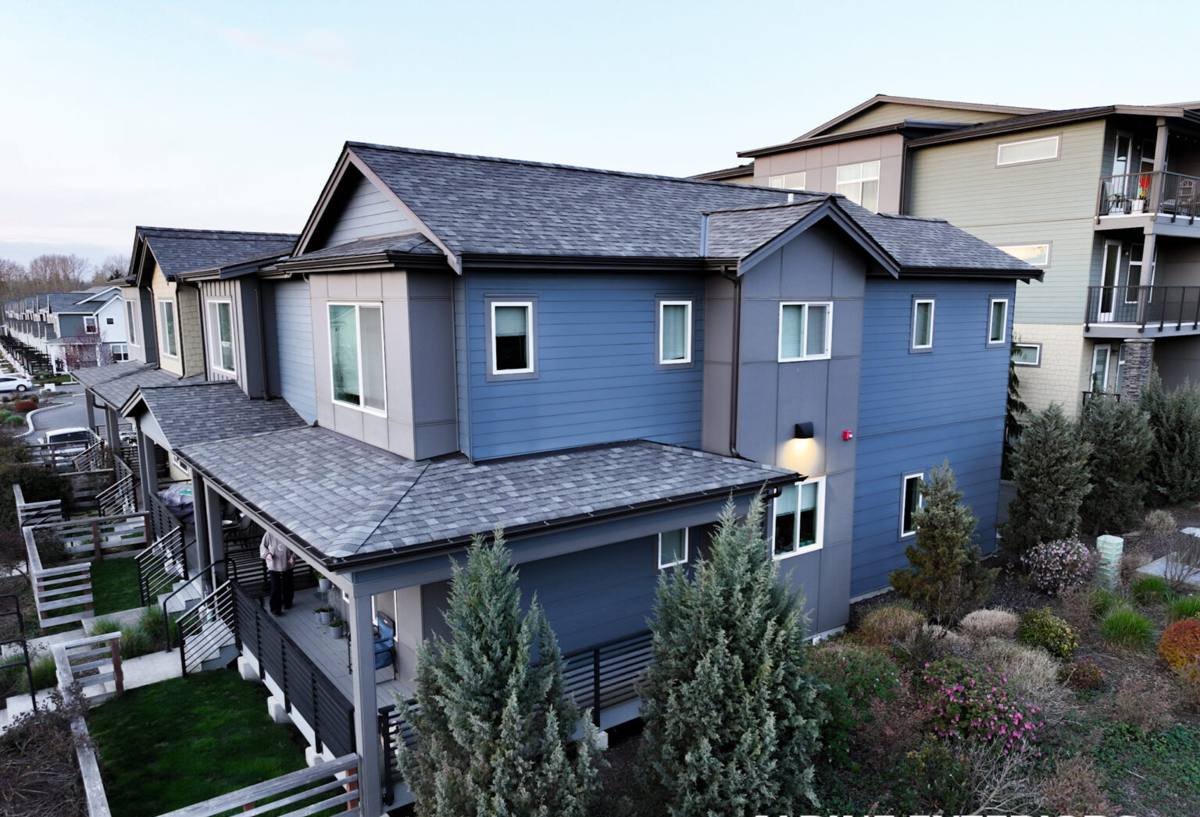
What "Correct" Actually Means for a Peace Arch Job
The Water Management Layer Matters More Than the Siding
Most siding failures we see in this part of Blaine aren't failures of the siding material itself — they're failures of what's behind it. A weather-resistive barrier (WRB) that isn't lapped correctly, flashing that dead-ends into a wall instead of directing water back out, or a missing drainage gap behind the cladding will eventually let moisture in no matter what's on the outside. In a driving-rain, high-humidity environment like Peace Arch, that gap between water management done right and water management done "close enough" shows up in years, not decades.
Ventilation Gap and Rainscreen
A rainscreen gap — a small ventilated space between the WRB and the back of the siding — lets any water that does get past the cladding drain and dry out instead of sitting against the sheathing. On a west- or south-facing wall that takes direct weather off the water, this detail alone can be the difference between siding that looks good at year 15 and siding that's showing stains and soft spots at year 8.
Flashing, Fasteners, and Trim
Every window head, door, and horizontal trim board is a place water wants to get behind the siding. Head flashing, kick-out flashing at roof-to-wall intersections, and properly bedded trim joints aren't optional details — they're the parts of the job that actually determine how the house performs in weather like this. Fasteners should be corrosion-resistant, and any exposed metal should be rated for coastal or marine exposure, not just standard galvanized.
How Salt Air and Moss Season Affect Material Choice
We install James Hardie fiber cement siding exclusively, and a neighborhood like Peace Arch is a good example of why. Fiber cement doesn't rot, doesn't feed insects, and doesn't absorb moisture the way wood-based products can — so the constant dampness of a marine climate doesn't create the same slow rot risk it does with untreated wood or engineered wood siding. Hardie's ColorPlus factory finish is baked on under controlled conditions, which matters here specifically because field-painted siding in a high-humidity coastal climate is fighting an uphill battle from day one — paint needs a real dry window to cure properly, and Peace Arch doesn't hand those out generously between October and May.
Moss and algae growth is mostly a surface and maintenance issue rather than a structural one, but it's a real quality-of-life issue for homeowners here. A smooth, factory-finished surface with proper drainage behind it sheds moss and mildew far more easily during a seasonal wash than a porous or textured surface that holds moisture against itself.
| Climate Factor | What It Does to Siding | What the Installation Needs to Address It |
|---|---|---|
| Salt-laden marine air | Corrodes fasteners, trim metal, and hardware over time | Corrosion-resistant fasteners and flashing rated for coastal exposure |
| Wind-driven rain | Pushes water sideways into laps, seams, and trim joints | Correct lap spacing, sealed joints, proper head flashing at openings |
| Long moss/algae season | Surface growth on anything that stays damp | Rainscreen drainage gap, factory-cured finish, adequate roof overhangs |
| High ambient humidity | Slows drying of field-applied paint and caulk | Factory-finished siding, careful scheduling of sealant work |
Signs a Peace Arch Home Needs Siding Replacement, Not Just a Repair
- Soft or spongy spots when you press on the siding, especially near the bottom courses or under windows
- Persistent moss or algae staining that comes back within a season of cleaning
- Visible gaps, warping, or cupping in horizontal boards
- Paint that's peeling or bubbling rather than just fading — often a sign moisture is trapped behind it
- Rust streaks below nail heads or trim fasteners
- Interior signs like musty smells, peeling interior paint, or damp drywall near exterior walls
- Siding that's original to a home built more than 20–25 years ago, especially wood or older composite products
What Our Process Looks Like on a Peace Arch Project
Assessment First
We start by pulling sections of the existing siding to look at what's actually happening behind it — not just what's visible from the curb. On homes this close to the water, we're specifically checking sheathing condition, existing flashing details, and how much moisture has already worked its way in before we scope the job.
Full Water Management Rebuild
Where the existing WRB, flashing, or sheathing has failed, we replace it rather than siding over a compromised assembly. This is the step that gets skipped on cut-rate jobs and is the single biggest predictor of how a siding replacement performs in a climate like this one over the following decade.
Installation to Hardie's Fastening and Clearance Specs
Correct nailing patterns, clearances from grade and roof lines, and gaps at butt joints all affect how the siding sheds water and expands and contracts with temperature and moisture swings. We install to the manufacturer's published specs because that's what keeps the transferable warranty intact and what actually performs in coastal weather.
Trim, Caulk, and Final Detailing
The last 10% of a siding job — trim reveals, caulk lines, touch-up paint on cut edges — is where a lot of the long-term water performance actually lives. We treat it as part of the installation, not an afterthought.
Why It Matters That We Already Work This Area
A crew that's done siding replacements in Blaine and along the Whatcom County coastline knows things about a Peace Arch project before the first board comes off the wall: how far the salt exposure typically extends inland from the water, which orientations take the worst of the driving rain, and how much drainage detail is actually needed versus overbuilt for the site. That local pattern recognition shortens the assessment phase and reduces the chance of under-building the water management layer for the exposure a given home actually has.
It also means we're not guessing at permitting or inspection expectations for the jurisdiction, and we're already familiar with how homes in this specific stretch of the county tend to be built — post-and-beam versus platform framing, typical sheathing types, common flashing shortcuts from past decades of construction — which speeds up both the estimate and the actual work.
What Drives Cost on a Job Like This
| Factor | Why It Moves the Price |
|---|---|
| Condition of the sheathing and WRB underneath | Rot or moisture damage found during tear-off requires repair before new siding goes on |
| Home size and wall complexity | More corners, dormers, and trim details mean more labor and material waste |
| Siding profile and accessories | Lap width, trim style, and corner details all affect material cost |
| Access and site conditions | Tight lots, mature landscaping, or difficult staging near the water add labor time |
| Existing paint or finish removal | Older lead-safe practices or extensive prep work add time on older homes |
We don't quote a job over the phone for exactly this reason — the condition behind the existing siding is often the biggest cost variable, and on a Peace Arch home that's been taking coastal weather for two or three decades, that's not something we're willing to guess at.
Get a Straight Answer on Your Home
If your siding is showing wear, growing moss faster than you can wash it off, or you're just planning ahead for a home this close to the water, we're happy to take a look and tell you honestly what we see — including if a repair is a reasonable option instead of a full replacement. Reach out for a free, no-pressure estimate and we'll walk the exterior with you and explain exactly what your home needs.