 Blaine Siding
 Sumas Sits at the Edge of Some Tough Weather
Sumas is a small border community at the eastern edge of Whatcom County, tucked against the Fraser Valley where the terrain funnels wind and weather down from the north in a way that flatter parts of the county don't experience. Add in the long, wet Pacific Northwest winter, and homes out this way take a steady beating from moisture, wind-driven rain, and the kind of persistent dampness that keeps moss and algae growing on siding, roofs, and decks for most of the year. It's a different exposure than a home right on Semiahmoo Bay, but the underlying problem is the same one we see across our whole Blaine-based service area: exterior materials here don't get much of a break from the weather, and cheap installation or the wrong product shows its weaknesses fast.
What Makes This Corner of the County Different
Because Sumas sits closer to the Fraser Valley gap, homes here can see stronger, gustier winter winds than communities closer to the coast — the kind of outflow events that push driving rain sideways into wall assemblies rather than straight down. Combined with the region's long moss season and frequent freeze-thaw swings in winter, siding and trim in this area need to shed water aggressively, hold paint and caulking without failing early, and resist the kind of constant low-grade moisture exposure that never really lets a house dry out completely between storms.
How That Weather Actually Wears Down a House
Most siding failures we see in Whatcom County aren't dramatic — they're slow. Moisture gets behind a seam or through a poorly sealed joint, and instead of drying out, it stays wet because the next storm arrives before the last one has fully evaporated. Over a few seasons that shows up as soft spots, swelling, peeling paint, or moss and mildew staining that keeps coming back no matter how many times it's power washed off.
- Wood-based and engineered wood siding can absorb moisture at cut edges and fastener points, leading to swelling and eventual rot if the factory coating or field sealing isn't perfect
- Vinyl siding can warp, crack, or rattle loose in sustained wind events, and it doesn't stop moisture from reaching the wall behind it
- Poorly flashed trim and window transitions are where water intrusion usually starts, regardless of the siding material layered over them
- Constant shade and dampness on north-facing walls accelerates moss and algae growth on almost any siding surface
Why We Only Install James Hardie Fiber Cement
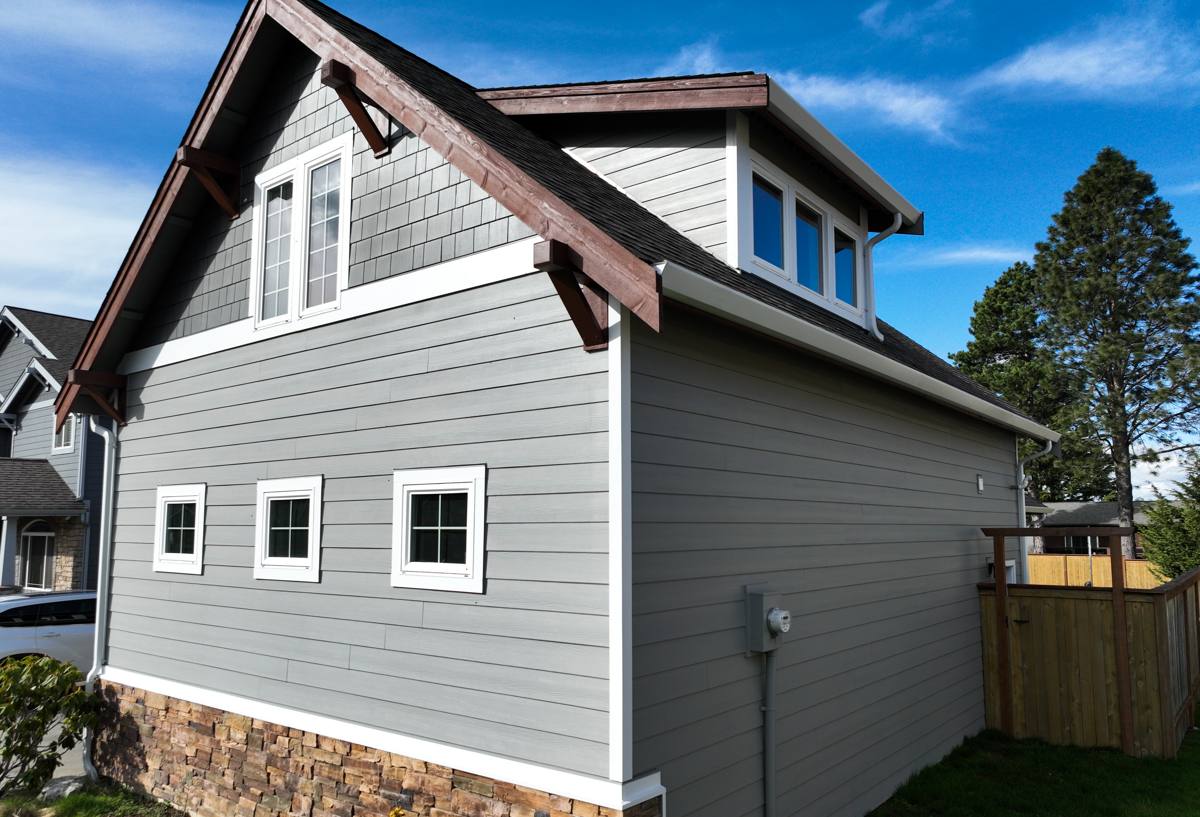
We made a decision years ago to standardize on James Hardie fiber cement siding and stop installing vinyl, LP SmartSide, Cemplank, Allura, or bare cedar and primed spruce. That's not a marketing position — it's a practical one, built around what actually holds up in this climate over the long run.
Fiber cement is made from cement, sand, and cellulose fibers, which makes it non-combustible and dimensionally stable in a way wood-based products can't match. It doesn't swell and shrink with moisture the way engineered wood or solid wood siding does, which matters enormously in a climate where the wall assembly rarely gets a long stretch of dry weather to fully recover. James Hardie also engineers specific product lines for different climate zones — the HZ5 line used in our region is formulated for the freeze-thaw cycling and sustained moisture exposure typical of the Pacific Northwest, rather than being a one-size-fits-all product.
The factory-applied ColorPlus finish is another piece of it. Field-painted siding is only as good as the paint job and the maintenance schedule behind it; ColorPlus finishes are baked on at the factory under controlled conditions, hold color longer, and come with their own finish warranty separate from the substrate warranty. Combined with Hardie's transferable product warranty, it gives homeowners a siding system where the manufacturer is standing behind both the material and the finish, not just one or the other.
None of this means other products are junk — vinyl, engineered wood, and cedar all have legitimate uses and loyal customers elsewhere. But once we started tracking which callbacks and moisture problems kept recurring in Whatcom County's specific weather pattern, fiber cement was the clear standout, and we stopped installing anything else.
What a Siding Project Looks Like for a Sumas Home
Every project starts with a walk-around of the house, not just a measurement of square footage. We're looking at how water currently moves off the roof and past the walls, where past trim or flashing work has failed, which elevations take the worst of the wind and rain, and whether there's any existing moisture damage hiding under the current siding that needs to be addressed before new material goes up.
Water Management Comes Before the Siding
Fiber cement siding is only as good as what's behind it. That means correctly lapped house wrap or weather-resistive barrier, properly flashed windows and doors, and drainage details at the bottom of the wall that let any incidental moisture escape instead of pooling. Skipping this step is the single biggest reason siding jobs fail early, regardless of the material used.
Installation to Manufacturer Spec
James Hardie publishes specific fastening, clearance, and caulking guidelines, and following them isn't optional if you want the warranty to actually apply. That includes proper nail placement, correct gaps at trim and butt joints, and keeping siding the right distance off the roofline, deck, and grade so it isn't sitting in standing water or splash-back.
Comparing Siding Options for This Climate
| Material | Moisture & Rot Resistance | Fire Resistance | Maintenance | Typical Lifespan |
|---|---|---|---|---|
| James Hardie Fiber Cement | Strong — dimensionally stable, engineered for climate zone | Non-combustible | Low — factory finish, occasional wash | Multiple decades with correct install |
| Vinyl | Moderate — doesn't rot but doesn't stop water intrusion behind it | Combustible, can warp near heat | Low, but prone to cracking/fading over time | Varies widely with quality and exposure |
| Engineered Wood (LP SmartSide, etc.) | Vulnerable at cut edges and fasteners if sealing fails | Combustible | Moderate — coating and caulking upkeep matters | Depends heavily on installation and maintenance |
| Cedar / Primed Spruce | Requires ongoing sealing and finishing to resist moisture | Combustible | High — regular refinishing needed | Shorter without consistent upkeep |
Roofing, Windows, and Decks Face the Same Fight
Siding rarely fails in isolation. A roof shedding water poorly, windows with failed flashing, or a deck holding moisture against the house all feed the same problem — water finding its way into places it shouldn't be. Because we handle roofing, windows, and decks alongside siding, we can look at a Sumas home as one connected system rather than patching one component while ignoring what's happening above or below it.
Roofs in this part of Whatcom County deal with the same long moss season as siding does, and moss holding moisture against shingles or panels shortens their life the same way it stains and softens exterior walls. Deck framing and ledger connections are another common trouble spot — wood in constant contact with moisture and shade breaks down faster, and a deck that's rotting at the house connection can be pushing water straight into the wall assembly behind your siding.
Why a Local Crew Matters Out Here
A crew that works this part of Whatcom County regularly knows which walls on a typical Sumas-area home take the worst of the wind and rain, understands the local permitting process, and can get back out to a job site quickly if something needs a second look after a storm. That local familiarity shows up in small decisions — where extra flashing attention matters most, how aggressively to plan for moss and moisture given the site's shade and drainage — that a crew unfamiliar with the area might not think to prioritize.
Planning Your Project: What to Have Ready
Costs for a siding project depend on the size of the home, how much of the existing siding and trim needs to come off, whether there's underlying moisture damage to repair, and the complexity of the roofline and window trim. Rather than quote broad numbers that don't mean much without seeing the house, we walk every property in person before giving an estimate. A few things help that conversation go faster:
- Know roughly how old your current siding is and whether it's ever been fully replaced
- Note any areas with visible staining, soft spots, or recurring moss buildup
- Have a sense of your timeline — some prep work is easier to schedule around drier stretches of the year
- Think about whether roofing, windows, or a deck are also due for attention, since bundling work can reduce disruption
- Ask any contractor you're considering directly whether they're a certified James Hardie installer and what warranty actually covers
If you're weighing a siding replacement for a home in the Sumas area, we're happy to walk the property, look at what your walls are actually dealing with, and put together a straightforward, no-pressure estimate — just fill out the form below to get started.