 Blaine Siding
 Windows Built for Where Peace Arch Actually Sits
Homes in the Peace Arch area sit close to the water and close to the border, which means they take weather from more directions than most inland Whatcom County properties. Salt-laden air off the Strait works into metal hardware and fasteners over time. Driving rain off the water finds any gap in flashing or sealant. And the long, wet moss season here isn't just a roof problem — it settles into window sills, tracks, and any horizontal surface that stays damp for weeks at a stretch. A window that was installed correctly for a drier inland lot can still underperform here if it wasn't detailed for this specific exposure.
Custom windows aren't about fancy shapes or showroom upgrades. For a Peace Arch home, "custom" mostly means matching the window's construction, frame material, and installation detailing to the actual conditions the wall assembly will face — window by window, sometimes elevation by elevation, since the water-facing side of a house often needs different attention than the side that's sheltered.
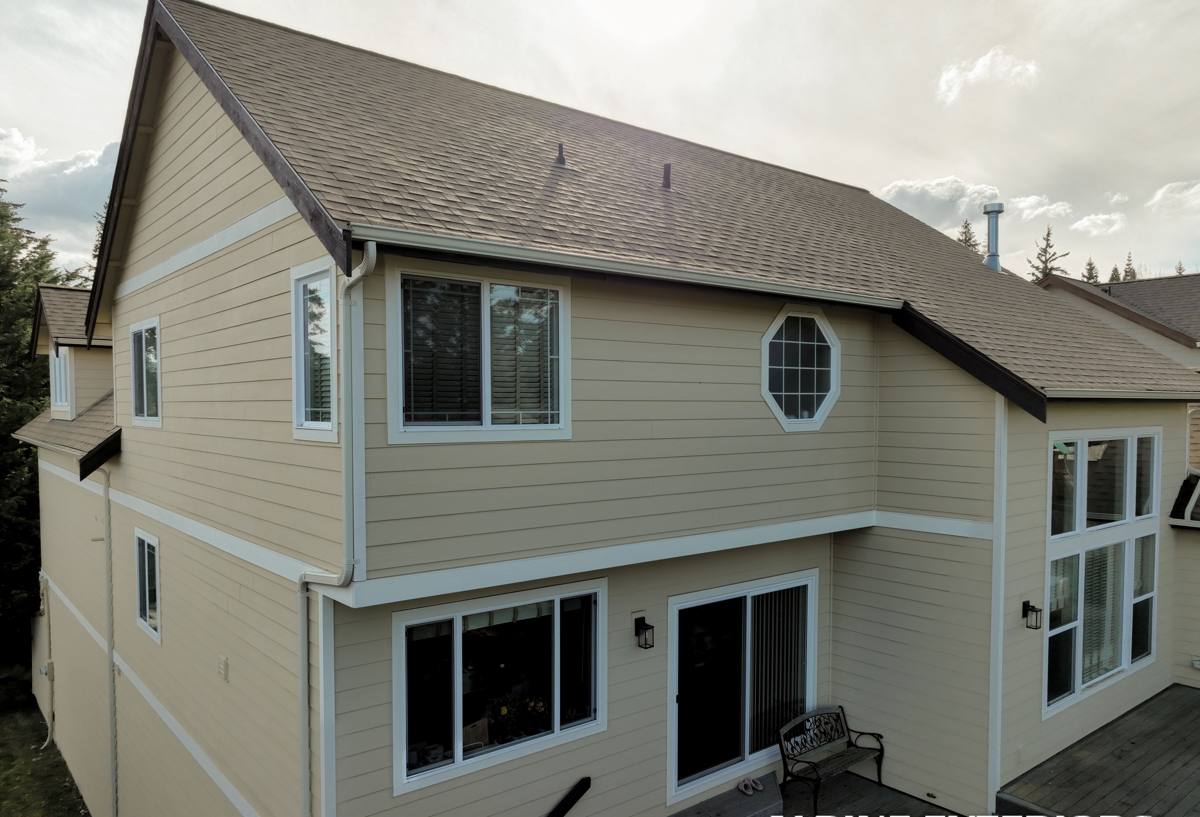
What "Custom" Should Mean on This Job
A true custom window job starts with measurements and ends with a window that fits the rough opening it's going into — not a stock size the opening gets adjusted to fit. That distinction matters more here than in a dry climate because every shim gap, every reveal, and every point where the window meets the wall is a potential path for wind-driven rain.
Sizing and Fit
Older Peace Arch homes, especially anything built before modern energy codes, often have openings that are slightly out of square or a nonstandard size from decades of settling or prior remodels. Custom-sized windows are built to the actual opening, which means less field modification, fewer shims fighting against a bad fit, and a tighter, more predictable seal.
Code and Performance Requirements
Washington's energy code sets minimum performance requirements for replacement windows, and Whatcom County enforces its own permitting on top of that. A correctly specified window meets or beats those U-factor and solar heat gain targets without you having to think about it — that's part of what you're paying for in a proper custom order versus a big-box stock unit.
Frame and Glass Options for a Marine Climate
There's no single "best" window material — every option is a set of trade-offs. In a salt-air, high-rainfall environment like Peace Arch, the trade-offs that matter most are moisture behavior, hardware corrosion resistance, and long-term maintenance.
| Material | How It Handles This Climate | Maintenance | Typical Trade-off |
|---|---|---|---|
| Vinyl | Won't rot or corrode; performs consistently in damp, salty air | Low — occasional cleaning | Frame color/style options are more limited than wood |
| Fiberglass | Very stable in temperature swings and moisture; strong resistance to warping | Low | Higher upfront cost than vinyl |
| Wood-clad | Interior wood warmth with an exterior clad shell protecting from rain | Moderate — clad seams and any exposed wood need periodic attention | Failure points concentrate at seams and cladding joints if not detailed well |
| Aluminum | Strong but conducts cold and is prone to corrosion in salt air over time | Higher — hardware and finish need monitoring | We use this selectively, not as a default near the water |
For most Peace Arch homes we lean toward vinyl or fiberglass frames precisely because they don't give salt air and standing moisture a foothold. Wood-clad is still a good option for homeowners who want that interior look, as long as the cladding and flashing details are done right — which is where a lot of window failures actually start.
Glass Packages
- Double-pane with low-E coating: standard, solid performance, the baseline we'd recommend for most rooms
- Triple-pane: better sound dampening and thermal performance, worth it for rooms facing prevailing wind and rain, or where road/border traffic noise is a factor
- Argon or krypton gas fill: improves insulation value without changing how the window looks or operates
- Tempered glass: required by code in certain locations (near doors, low sills, wet areas) — we flag these during the walkthrough so nothing gets missed on permit review
Installation Details That Actually Determine How the Window Performs
The window unit itself is maybe half the job. The other half — flashing, sealant, and how the window ties into the wall's water management system — is what determines whether that window is still performing well in ten or fifteen years, especially on a lot that takes driving rain off the water.
Flashing and Water Management
Every opening gets flashed so that any water that does get past the window sheds down and out, never into the wall cavity. This is not optional detailing — it's the difference between a window that's merely installed and one that's actually weathertight. On Peace Arch homes we pay particular attention to sill pans and head flashing, since those are the components most likely to have been skipped or done poorly in past renovations.
Sealant and Joint Detailing
Exterior sealant has a service life, and in a marine climate with constant humidity cycling, it degrades faster than it would inland. We use sealants rated for this kind of exposure and detail joints so that if the sealant does eventually fail, it fails visibly and safely rather than letting water track behind the trim unnoticed.
Moss and Debris Management
Moss season isn't just a roof and gutter issue. Horizontal sills, especially on shaded or north-facing walls, can hold moisture long enough for moss and mildew to take hold. Proper sill slope and drainage — plus material choices that don't give moss anything to grip — cut down on this considerably.
Signs Your Current Windows Are Already Losing the Fight
- Fogging or moisture between panes — the seal has failed and the insulating gas is gone
- Soft or discolored wood at the sill or lower corners of the frame
- Visible mildew or moss growth on the sill that returns no matter how often it's cleaned
- Drafts you can feel near the frame on windy, rainy days
- Hardware (locks, cranks, hinges) that's corroded, stiff, or won't latch fully
- Paint or finish peeling specifically around the window opening, not the rest of the wall
- Noticeably higher heating bills in rooms with older or original windows
Our Process, Start to Finish
We keep this straightforward because a confusing process is usually a sign of a contractor padding the job.
- Walkthrough and measurement — we look at every opening being replaced, note existing damage (rot, corrosion, past water intrusion), and take precise measurements for custom sizing.
- Material and glass recommendation — based on that specific wall's sun and rain exposure, not a one-size answer for the whole house.
- Written estimate — clear pricing, no vague allowances, and honest notes on anything that might change the scope once we open up an opening (hidden rot is the most common surprise).
- Permitting — handled on our end where Whatcom County or City of Blaine requires it, so you're not chasing paperwork.
- Removal and prep — old windows out, opening inspected and repaired if there's rot or damage underneath, before anything new goes in.
- Installation with full flashing and sealant detailing — the step most likely to get rushed elsewhere; we don't rush it.
- Final check and cleanup — operation tested on every window, site cleaned up, and a walkthrough with you before we call it done.
What Drives Cost
Every home is different, so we won't quote a number here that doesn't mean anything until we've seen your openings. What actually moves the price:
| Factor | Why It Matters |
|---|---|
| Frame material | Vinyl is generally the most affordable; fiberglass and wood-clad cost more upfront |
| Glass package | Triple-pane and specialty coatings add cost but pay back in comfort and noise reduction |
| Opening condition | Rot or water damage found once we open the wall adds repair time before the new window goes in |
| Number and size of openings | Larger or custom-shaped windows require more precise fabrication |
| Access and site conditions | Second-story or hard-to-reach windows take more time and equipment |
We'd rather walk your home and give you real numbers than guess in the abstract — a free estimate costs you nothing and commits you to nothing.
Why Local Experience in This Area Actually Matters
A crew that regularly works Peace Arch and the rest of Blaine already knows which wall orientations take the worst of the weather, what kind of rot patterns show up in homes of a certain age around here, and which flashing and sealant details actually hold up to this specific combination of salt air, driving rain, and a moss season that doesn't let up. That's not something you get from a general contractor who occasionally passes through Whatcom County — it comes from doing this work, on this coastline, repeatedly. It also means we're not learning on your house.
If your windows are drafty, fogged, showing rot, or you're just planning ahead for a home that holds up to what this stretch of coast throws at it, we'll come take a look and give you a straight, no-pressure estimate — fill out the form below to get started.