 Blaine Siding
 Ferndale's Exterior Climate Challenge
Ferndale sits close enough to the Salish Sea and the Nooksack River delta that homes here deal with a specific combination of punishment: salt-laden air rolling in off the water, long stretches of driving rain through fall and winter, and a moss and mildew season that can run eight or nine months out of the year in shaded, north-facing spots. None of these factors alone is unusual for Whatcom County. Together, over years, they wear down exterior materials faster than homeowners expect, especially siding that wasn't engineered with this kind of exposure in mind.
Salt air is corrosive to fasteners and trim metal, and it accelerates the breakdown of certain paint films and sealants. Driving rain, especially when it comes sideways off a westerly wind, tests every seam, joint, and butt edge in a siding system — not just whether water is kept out, but whether moisture that does get behind the cladding can dry out again. And moss doesn't just look bad; a sustained mat of moss or algae holds moisture against a wall surface for weeks at a time, which is exactly the condition that causes rot, paint failure, and swelling in materials that aren't built to handle it.
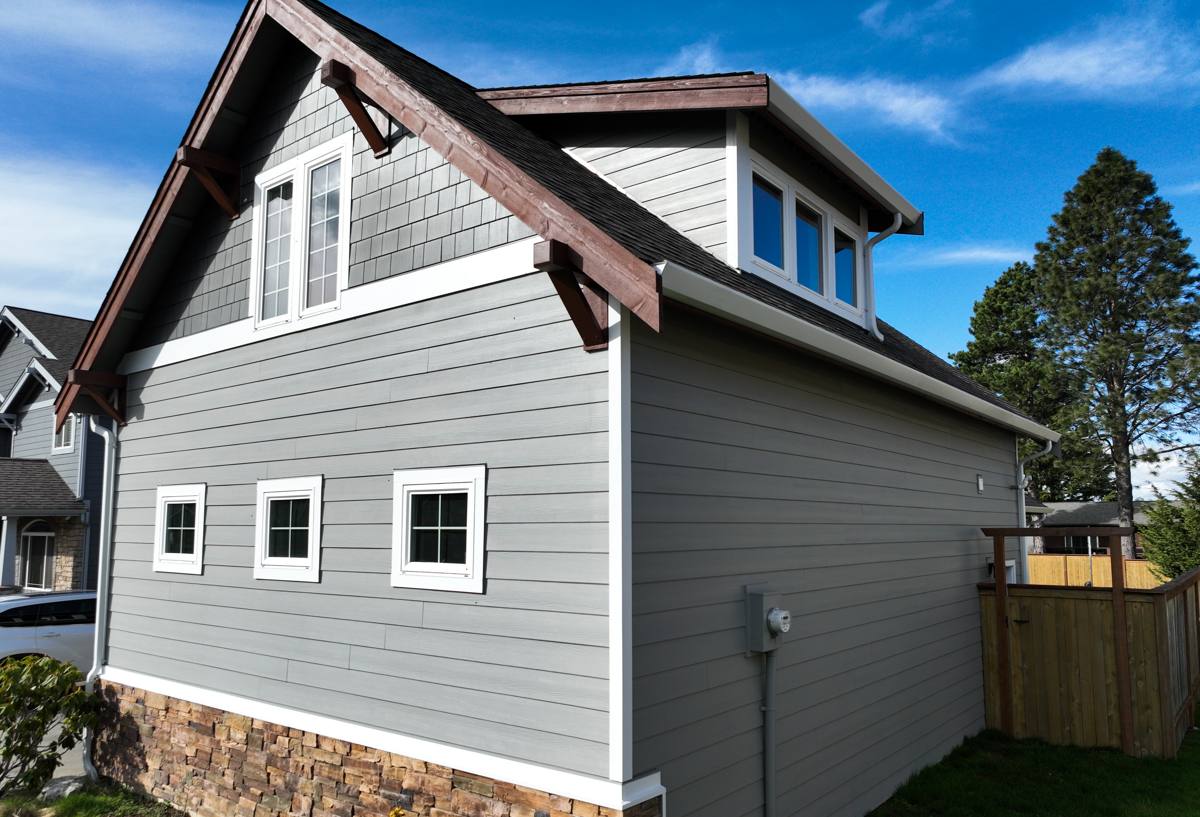
How Different Siding Materials Hold Up in This Climate
We get asked a lot why we're selective about what we'll install. The honest answer is that we've seen how different materials perform in this exact climate over time, and some hold up a lot better than others.
| Material | How it handles moisture | How it handles salt air | Long-term maintenance |
|---|---|---|---|
| Vinyl siding | Sheds surface water but panels can warp or buckle; doesn't stop moisture from tracking behind it at seams | Can fade and become brittle faster near marine air | Low upkeep but limited repair options once damaged |
| Primed wood (spruce, cedar) | Absorbs moisture readily; needs a sound paint film to stay protected | Salt accelerates paint and coating breakdown | Frequent repainting and caulking; rot risk if maintenance lapses |
| Engineered wood (LP SmartSide and similar) | Resin-treated but still wood-based; edge and cut-end sealing is critical | Performs reasonably but sensitive to installation gaps | Moderate; failure often traces back to install details, not the product itself |
| James Hardie fiber cement | Non-combustible, dimensionally stable; engineered moisture-management systems (HZ5) built for this region | Resists salt-driven fading and degradation better than wood-based products | Low; factory ColorPlus finish reduces repainting cycles significantly |
This isn't a knock on every product on that list — wood siding has real character, and engineered wood has improved a lot over the years. But when we weigh what we're willing to put our name behind in a climate like Ferndale's, fiber cement consistently comes out ahead on the things that matter most long-term: moisture stability, resistance to the freeze-thaw and wet-dry cycling this region puts materials through, and how the finish holds up under UV and salt exposure.
Why We Install Only James Hardie Fiber Cement
We don't install vinyl, LP SmartSide, Cemplank, Allura, primed spruce, or cedar siding. That's a deliberate standard, not a limitation in what we're capable of installing. We made that call after years of exterior work in this region, watching which siding systems age well under Whatcom County conditions and which ones need constant attention or premature replacement.
Non-Combustible Material
James Hardie fiber cement is made primarily from cement, sand, and cellulose fibers. It doesn't burn, which matters for insurance considerations and general peace of mind, and it holds its shape and finish without the expansion and contraction that wood-based products go through.
ColorPlus Factory Finish
Rather than relying on field-applied paint, Hardie's ColorPlus finish is baked on at the factory in a controlled process, which gives it better adhesion and color consistency than most job-site paint jobs can match. In a climate with this much rain and salt exposure, that finish durability translates directly into fewer repainting cycles.
Climate-Engineered Product Lines
Hardie makes region-specific formulations (HZ5, for example) engineered for the moisture and freeze-thaw patterns of the Pacific Northwest, rather than a one-size-fits-all national product. That's a meaningful difference from generic fiber cement or wood-based alternatives that aren't tailored to this specific exposure.
Warranty Backing
Hardie backs its products with a strong, transferable warranty on both the substrate and the ColorPlus finish. For homeowners planning to stay put or eventually sell, that transferability adds real resale value that thinner warranty structures on other products don't offer.
What Proper Siding Installation Involves Here
The product is only half the equation. In a climate that pushes wind-driven rain into every gap, correct installation is what actually keeps a home dry over the next 30 years.
Inspection Before Removal
Before old siding comes off, we look at what's underneath — sheathing condition, any existing rot or moisture staining, and how the current weather-resistive barrier is performing. Ferndale homes with north- or west-facing walls exposed to prevailing weather often show more wear at this stage than walls that are more sheltered.
Weather-Resistive Barrier and Rainscreen
A proper Hardie installation isn't just nailing panels to the wall. It includes a correctly lapped weather-resistive barrier, flashing at every window, door, and penetration, and in many cases a rainscreen gap that lets any moisture that does get behind the siding actually dry out instead of sitting against the sheathing. Skipping this step is one of the most common reasons any siding system — Hardie included — fails early.
Fastening and Joint Detail
Hardie specifies fastener type, spacing, and joint treatment for a reason. In a marine climate, corrosion-resistant fasteners and correctly sealed butt joints are what stand between a wall that stays dry for decades and one that starts showing problems in five years.
Siding Works Alongside Roofing, Windows, and Decks
Siding doesn't fail in isolation. A lot of the moisture problems we find on Ferndale homes trace back to a roofing detail, a window flashing gap, or a deck ledger connection that's been letting water into the wall assembly for years before it ever shows up on the siding itself. Because we handle siding, roofing, windows, and decks, we can look at the whole exterior envelope during an estimate rather than treating siding as a standalone project.
That matters most at transition points: where a roofline meets a wall, where a deck attaches to the house, and around every window opening. These are the spots where driving rain finds its way in, and where a siding-only contractor might not catch a roofing or window issue that's actually the root cause of what looks like a siding problem.
Signs Your Ferndale Home May Need New Siding
Some of these are obvious; others take a trained eye or a closer look to catch, especially on walls that don't get much direct sun or airflow.
- Persistent moss or dark staining that keeps returning after cleaning, particularly on north-facing walls
- Paint that's peeling, bubbling, or chalking well before its expected repaint interval
- Soft or spongy spots when you press on the siding, especially near the bottom courses or around window trim
- Visible gaps, warping, or buckling in panels or lap joints
- Rising energy bills that suggest the wall assembly isn't insulating or sealing the way it should
- Cracking or splitting at butt joints and corners, where moisture tends to concentrate first
- A musty smell near exterior walls inside the home, which can indicate moisture intrusion behind the siding
If you're seeing more than one of these, it's worth getting an inspection before small problems turn into sheathing or framing repairs.
Cost Factors for Ferndale Siding Projects
Every home is different, but a few factors consistently move the price on a Ferndale siding replacement:
| Factor | Why it matters here |
|---|---|
| Extent of moisture damage found at tear-off | Homes with long-term moisture exposure sometimes need sheathing repair before new siding goes on |
| Wall complexity | Cut-up facades with lots of corners, dormers, and trim take more labor and material than simple rectangular walls |
| Siding profile and accessories | Lap width, trim style, and corner details all affect material cost |
| Access and site conditions | Steep lots, mature landscaping, or limited staging area can add time to the job |
| Whether roofing or window work is bundled in | Addressing flashing or roofline issues at the same time can prevent repeat moisture problems and sometimes saves on overall labor |
We're not going to throw out a number without seeing the house — too many of these variables change the estimate to make a blanket figure meaningful. What we can tell you upfront is that we price the job around doing it right the first time, including the moisture-management details that matter most in this climate.
Why a Local Crew Matters
A crew that works Whatcom County exteriors regularly knows what a wall assembly here needs to survive — how much rainscreen detail is worth the extra step, which orientations take the worst weather, and how moss and algae actually behave on different wall exposures through the wet months. That's not something you get from a general contractor working from a national playbook. It's built from doing this work, on homes like yours, in this specific climate, over and over.
If you're weighing a siding replacement in Ferndale, we're happy to take a look and walk you through what we're seeing on your home, no pressure and no obligation. A free estimate gives you a clear picture of condition, options, and cost before you decide anything.