 Blaine Siding
 Siding Work Serving the Nooksack Area Near Blaine
Nooksack sits inland from the water compared to Blaine's own shoreline neighborhoods, but it's still squarely inside the weather pattern that defines siding performance across northern Whatcom County. Homes here get less of the direct salt spray that hits properties right on Semiahmoo Bay or Drayton Harbor, but they take on the same driving winter rain, the same long stretch of overcast, damp months, and — thanks to the mix of open farmland and tree cover typical of the area — often a heavier moss and mildew load than homes closer to open water where wind and sun help surfaces dry out faster.
We work this part of Whatcom County regularly, covering Blaine and the surrounding communities including Nooksack, rather than treating it as an out-of-the-way stop between bigger jobs on the coast. That matters because siding decisions that work fine in a drier inland climate don't always hold up the same way here, and a crew that's only occasionally in the area is more likely to miss the local details that make the difference over a ten- or twenty-year timeline.
We install siding, roofing, windows, and decks, because those systems age together on a home in this climate — a weak window seal or a gap in roof flashing rarely stays isolated, and shows up later as staining, softness, or rot in the siding nearby. On the siding side, we install James Hardie fiber cement exclusively. That's a professional standard we hold to, not a sales pitch, and the rest of this page explains both the climate reasoning behind it and what a project actually looks like for a home in the Nooksack area.
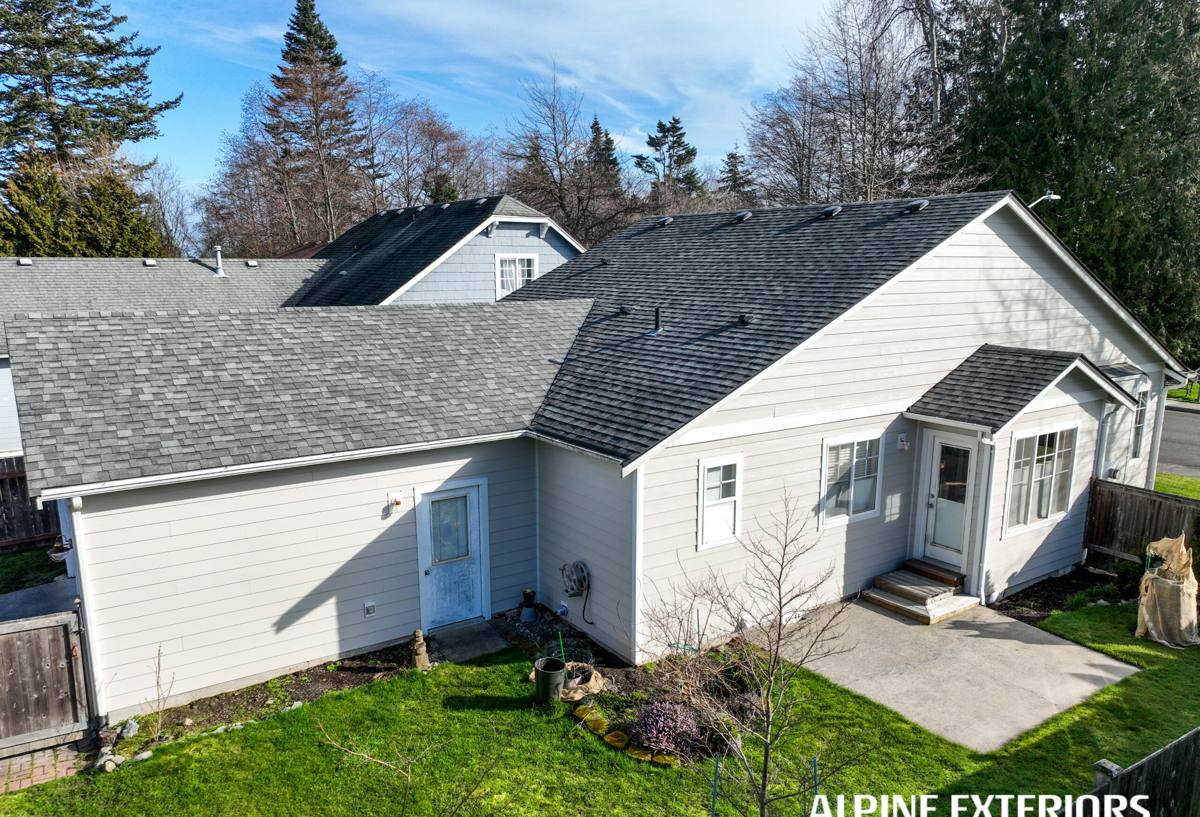
What the Climate Around Nooksack Puts Siding Through
Moisture That Doesn't Let Up
Whatcom County's wet season runs long, and inland communities like Nooksack see it as steady, soaking rain rather than the short bursts that pass through in summer. Siding that's even slightly porous, or that holds water against the substrate instead of shedding it, stays damp for extended stretches during the fall and winter months. Over years, that persistent dampness is what drives rot at seams, fastener points, and butt joints — long before most homeowners notice a problem from the curb.
Wind-Driven Rain and Exposed Walls
Storms moving through this part of the county typically bring real wind, and on a property without much windbreak — common on the more open, rural lots around Nooksack — that means rain gets pushed sideways into siding joints and trim details instead of just running down the face of the wall. That wind-driven load is often what separates a siding installation that stays tight for decades from one that starts letting moisture in behind the cladding within a handful of wet seasons, regardless of the material's rated performance.
A Long, Persistent Moss Season
Mild temperatures combined with near-constant moisture add up to a moss and mildew season that can run close to year-round on shaded or north-facing walls, and properties with tree lines or outbuildings nearby — common around Nooksack — see this more than homes with open, sun-exposed elevations. Any siding material that's porous or that traps moisture against the substrate becomes a growth surface over time, and moss growth left unaddressed holds moisture against the wall even longer, compounding the problem.
Freeze-Thaw Cycling
Inland pockets of Whatcom County see harder frosts than the immediate coastline, and the freeze-thaw cycling that comes with it is tough on any material that's absorbed even a small amount of water. Repeated freezing and thawing can crack, spall, or loosen a material that isn't dimensionally stable, which is a real factor for a home set back from the moderating effect of open water.
Why We Install Only James Hardie Fiber Cement
We narrowed our siding offering down to one system after seeing, on jobs across this part of the county, what actually holds up through sustained inland moisture and freeze-thaw cycling versus what looks good on a spec sheet and struggles on a real wall a few winters in.
- Non-combustible core: Fiber cement doesn't feed a fire the way wood-based siding products can, which matters for homeowner safety and can matter for insurance underwriting too.
- Factory-applied ColorPlus finish: Baked on in a controlled factory process rather than brushed on in the field, holding color and adhesion far longer under this area's sustained damp, low-light conditions.
- Climate-engineered HZ product lines: Hardie's HZ5 formulation targets regions with significant moisture exposure and freeze-thaw cycling — a solid match for the Nooksack and Blaine area's inland winter pattern.
- Dimensional stability: Fiber cement doesn't swell, cup, or warp the way engineered wood siding can after repeated wetting cycles.
- A strong transferable warranty: Hardie backs the product with one of the more robust warranty structures in the industry, provided installation follows their published specs.
We don't install LP SmartSide, vinyl siding, Cemplank, Allura, primed spruce, or cedar. Each has a place in the broader market, and plenty of homeowners elsewhere are satisfied with them. Our position is a professional one specific to this climate: with this much sustained moisture and moss pressure, we'd rather stand fully behind one system than offer a cheaper alternative that quietly shifts maintenance risk onto the homeowner a few years down the road.
Where Other Products Fall Short in This Climate
| Product | Common trade-off in the Nooksack/Blaine area |
|---|---|
| Vinyl siding | Can warp or become brittle under UV and temperature swings; panel seams give wind-driven rain an entry point |
| LP SmartSide / engineered wood | Wood-strand core is more moisture-sensitive at cut edges and fastener points, a concern under long inland wet seasons |
| Primed spruce or cedar | Requires ongoing paint and moisture maintenance to avoid rot; persistent moss and dampness accelerate the wear cycle on painted wood |
| Other fiber cement brands | May lack a climate-specific HZ-style formulation or the same factory-finish warranty depth as James Hardie |
How a Siding Project Runs for a Home Near Nooksack
Inspection and Estimate
Every job starts with an honest walk-through of the house — current siding condition, any signs of trapped moisture or sheathing damage, and how sun and wind exposure vary across the different walls. On rural and semi-rural properties around Nooksack, tree cover and outbuildings often mean one side of the house dries out far slower than another, and that shapes both the estimate and the installation plan.
Tear-Off and Sheathing Check
Old siding comes off wall by wall so the sheathing underneath can actually be inspected, not assumed. Damp or soft sheathing gets addressed before anything new goes up — installing fiber cement over compromised sheathing just locks a problem in behind a new, better-looking surface.
Moisture Barrier and Flashing
A correctly lapped weather-resistant barrier and properly integrated flashing at windows, doors, and roof-to-wall transitions matter as much as the siding material itself. This is where a lot of the wind-driven rain and long-term moisture problems either get solved or get built in, and it's a step that's easy to shortcut on a bid that's racing to the lowest price.
James Hardie Installation to Spec
Fastener spacing, joint treatment, and clearance from grade, decks, and roof lines all follow Hardie's published installation guidelines. Installing outside those specs is one of the more common ways a fiber cement warranty ends up voided, so we treat the manufacturer's instructions as the baseline, not a suggestion.
Final Walkthrough
We go over the finished work with the homeowner, point out anything worth knowing for ongoing care, and make sure trim, caulking, and paint lines are clean before calling the job done.
Cost Factors for a Nooksack-Area Siding Project
| Factor | Why it moves the number |
|---|---|
| Sheathing condition | Rot or moisture damage found during tear-off adds repair scope before new siding can go up |
| Home size and wall complexity | More corners, dormers, and trim detail mean more labor and material waste factor |
| Existing siding material | Vinyl removal is usually straightforward; removing old wood or masonry-adjacent siding can take longer |
| Access and lot layout | Rural lots with outbuildings, fencing, or tree cover close to the house can slow staging and scaffolding |
| Trim and accent work | Board-and-batten sections, window trim upgrades, and color-matched accents add labor beyond flat panel installation |
Windows, Roofing, and Decks: Why the Whole Exterior Matters
A new siding job on a home that still has failing window seals or aging roof flashing is only a partial fix. Water finds the weakest point in a building envelope, and if that weak point is a window or the roofline rather than the wall, new siding won't stop it — it'll just take longer to show up as a stain or soft spot. Because we handle siding, roofing, windows, and decks, we can flag those connected issues during a siding estimate instead of a homeowner discovering them separately, on a different contractor's timeline, a year or two later.
Decks see a related version of the same problem: ledger board attachment and flashing where a deck meets the house are common leak points that show up as siding or sheathing damage nearby. If a Nooksack-area home has an aging deck attached to the house, it's worth having someone look at that connection at the same time as the siding.
What to Ask Before Hiring a Siding Contractor in This Area
- Is the contractor licensed and insured in Washington state, and can they provide proof without hesitation?
- What siding product do they install, and can they explain why — in specific terms, not just brand names?
- How do they handle sheathing repair if rot or damage turns up once old siding comes off?
- Do they follow the manufacturer's published installation specs closely enough to keep the product warranty intact?
- Will they walk the property with you and point out how sun, wind, and moisture exposure differ across the home's different walls?
- What does their own workmanship warranty cover, separate from the manufacturer's material warranty?
A Local Crew Matters More Than It Sounds Like
A crew that works Blaine, Nooksack, and the rest of northern Whatcom County on a regular basis builds a working sense of which properties dry out fast and which ones stay damp longer than expected, which lots see harder frost pockets, and which older homes in the area tend to have sheathing issues once the old siding comes off. That kind of pattern recognition doesn't show up on a spec sheet — it comes from doing the work here repeatedly, season after season, rather than passing through once on a bid that could just as easily be for a job three counties away.
If you're weighing a siding project for a home in or around Nooksack, we're happy to take a look and put together a straightforward, no-pressure estimate — free, with no obligation, so you can see the actual condition of your home and what a correctly installed James Hardie system would involve before deciding anything.