 Blaine Siding
 Why Custer Roofs Wear Out Faster Than the Warranty Sticker Suggests
Custer sits inland from Blaine and Semiahmoo Bay but still close enough to the water to get a steady dose of salt-laden air, especially on west and northwest exposures. Combine that with Whatcom County's long wet season — months of low-intensity, driving rain broken up by only a handful of dry weeks — and you get a roof environment that's harder on materials than most manufacturer warranties assume. Add the moss and lichen that thrive in the shade of fir and cedar cover common on Custer lots, and a roof here is doing more work every single day than the same roof would in a drier inland climate.
None of that means Custer homes need exotic materials or constant babysitting. It means the details that don't matter much in a dry climate — underlayment quality, flashing sequencing, ventilation balance, ridge and valley detailing — matter a great deal here. A roof replacement done to a generic national standard will look fine for a year or two and then start showing this area's specific stress points: soft decking at the eaves, moss ridges holding moisture against shingles, and corrosion on fasteners and flashing that weren't rated for salt exposure.
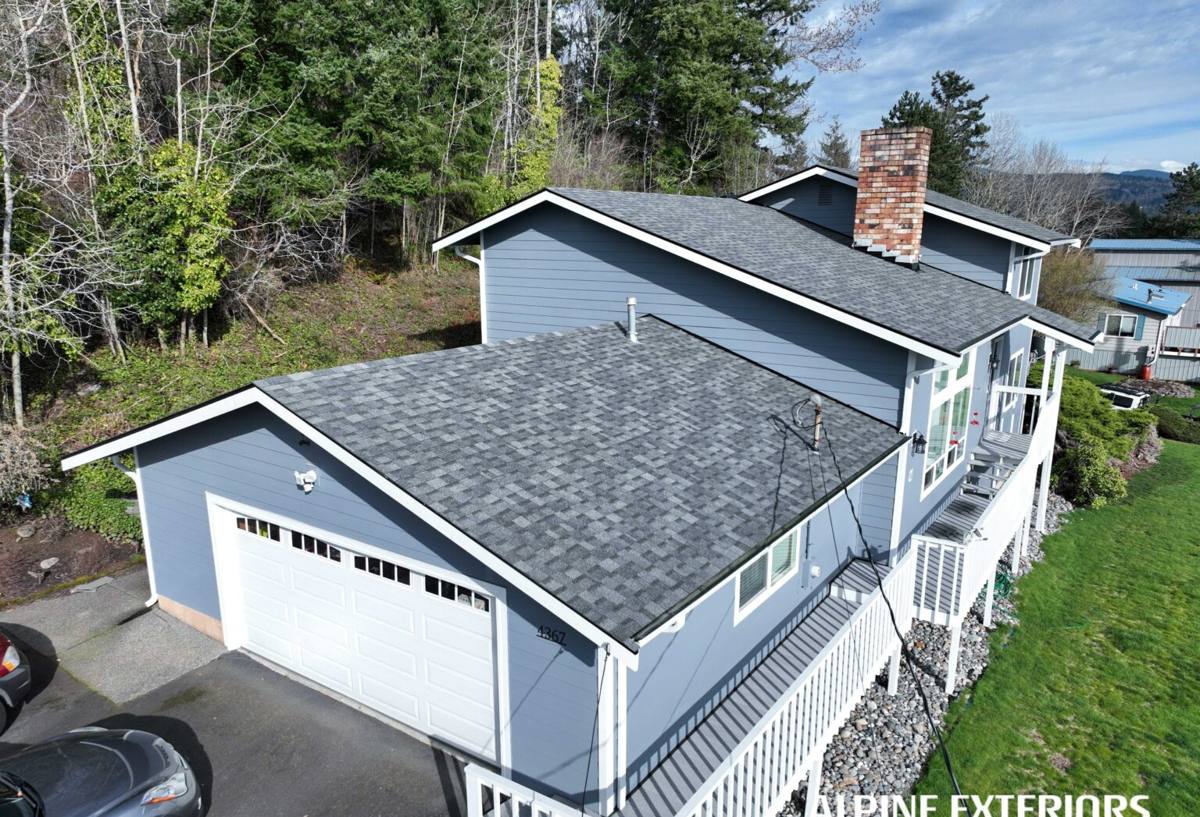
Signs a Custer Roof Needs Replacement, Not Just a Repair
What you can see from the ground or a ladder
- Shingles that are cupping, curling at the edges, or missing granules in patches (usually shows up first on south and west slopes)
- Moss buildup along ridges, valleys, and north-facing slopes that keeps coming back within months of cleaning
- Dark streaking or soft, spongy-feeling sections when walked, especially near valleys and eaves
- Rusted or lifting flashing around chimneys, skylights, and roof-to-wall transitions
- Granules collecting in gutters, or gutters overflowing during heavy rain because the roof is shedding debris faster than it should
What shows up inside first
Attic clues usually arrive before ceiling stains do: dark or damp sheathing, a musty smell, insulation that's compressed or discolored, or daylight visible at nail penetrations. If you're seeing any of this along with roof age past 20-25 years for asphalt shingle, replacement is almost always the more honest answer than another round of patch repairs — repeated repairs on an aging roof in this climate tend to cost more over a few years than one correct replacement.
Roofing Materials That Actually Hold Up in This Climate
There's no single "best" material for every Custer home — roof pitch, tree cover, budget, and how long you plan to stay in the house all factor in. Here's how the common options perform against salt air, sustained rain, and moss pressure specifically:
| Material | Moisture & rain performance | Moss resistance | Salt air / corrosion notes |
|---|---|---|---|
| Architectural asphalt shingle | Very good when installed with proper underlayment and flashing | Moderate — needs periodic cleaning, especially under tree cover | Use corrosion-resistant fasteners and flashing near the coast |
| Standard 3-tab asphalt shingle | Adequate but shorter service life in constant wet conditions | Moderate | Same fastener considerations as architectural shingle |
| Metal (standing seam or panel) | Excellent — sheds water fast, minimal seams to fail | Low moss growth on steeper pitches; can still collect on low-slope sections | Requires coated or coastal-rated metal and fasteners to avoid premature corrosion |
| Cedar shake | Attractive but higher maintenance burden in a wet climate — needs consistent airflow underneath to avoid rot | Higher moss and moss-related decay risk without diligent upkeep | Not our default recommendation here due to the ongoing maintenance load in this rainfall pattern |
| Synthetic/composite shingle | Good, consistent performance, resists moisture absorption better than wood | Moderate to low depending on product | Good option where appearance of shake or slate is wanted without the maintenance |
We install cedar shake when a homeowner specifically wants that look and understands the maintenance commitment, but we don't default to it in heavy tree-cover or low-slope situations — the moisture retention and moss risk make it a harder material to keep performing well here without regular attention. That's a maintenance and moisture-behavior tradeoff, not a knock on the product itself.
What a Correct Roof Replacement Actually Involves
Tear-off and deck inspection
Every layer of old roofing comes off, not just the top layer — you can't properly inspect or waterproof a deck you can't see. Any soft, delaminated, or water-stained sheathing gets replaced before anything new goes down. Skipping this step is the single most common shortcut that leads to early failure, and it's invisible once the new roof is on.
Underlayment and ice/water protection
Given how much sustained rain Whatcom County sees, we don't treat underlayment as a formality. Self-adhered waterproof membrane goes at eaves, valleys, and around every penetration — the places water actually finds a way in — with synthetic underlayment across the rest of the field for tear resistance and a secondary water barrier under the shingle or panel layer.
Flashing and penetrations
Chimneys, skylights, vents, and roof-to-wall transitions fail more often than open field shingle does. Flashing gets replaced, not reused, and sequenced correctly with the underlayment so water is always directed out and down, never trapped behind a joint.
Ventilation
Balanced intake and exhaust ventilation keeps the attic close to outdoor temperature and controls moisture buildup from the inside — which matters as much as what's happening on the outside of the roof in a climate this wet. Poor ventilation shortens shingle life from underneath and contributes to the damp, moss-friendly conditions we're trying to avoid in the first place.
Our Process for a Custer Roof Replacement
- On-site assessment — we walk the roof and the attic, check decking condition, ventilation, and flashing points, and take real measurements rather than estimating from the ground.
- Written estimate — material options, scope, and timeline laid out plainly, including what's driving the cost so you're not guessing at line items.
- Scheduling around the weather — we plan install windows with Whatcom County's rain patterns in mind and stage materials so the deck isn't left exposed longer than necessary.
- Tear-off, deck repair, and installation — done in the sequence above, with daily cleanup so debris and nails aren't left in the yard or driveway.
- Final walkthrough — we go over the finished roof with you, including flashing, ventilation, and any deck repairs that were made along the way.
Cost Factors for a Custer Roof Replacement
Every roof is priced on its own specifics, but these are the factors that move the number most, in roughly the order they tend to matter:
| Factor | Why it affects cost | Typical impact |
|---|---|---|
| Roof size and number of planes | More area and more valleys/hips means more material and labor | High |
| Pitch and access | Steep or hard-to-access roofs take longer and need more safety setup | Moderate to high |
| Layers to remove | Tear-off of multiple existing layers adds labor and disposal cost | Moderate |
| Decking condition | Rot or delamination found during tear-off requires replacement sheathing | Variable — depends what's found |
| Material choice | Asphalt, metal, and composite/shake carry different material costs and install labor | High |
| Ventilation and flashing upgrades | Bringing older ventilation or flashing up to current standards adds scope | Low to moderate |
We won't quote a number without seeing the roof — anyone who does is guessing, and guesses tend to grow once tear-off reveals what's actually underneath.
Why Hiring a Crew That Already Works This Area Matters
A roofing crew that's spent time on homes around Blaine and Custer already knows what to expect before the tear-off starts: which slopes take the worst of the wind-driven rain, how much moss pressure to plan for under heavy tree cover, and which fastener and flashing grades hold up against the salt air rather than corroding within a few seasons. That's not something you can fully substitute with a generic checklist — it's pattern recognition built from working this specific climate and these specific building patterns repeatedly. It also means a shorter drive for warranty callbacks or a quick look if something comes up after a big storm, instead of waiting on a crew based an hour or more away.
Keeping a New Roof Performing in Whatcom County
A correct installation gets you most of the way there, but a few habits keep it performing for its full service life in this climate:
- Clean gutters at least twice a year, more often if you're under conifers — clogged gutters back water up under the roof edge
- Have moss growth treated before it builds up into thick mats, not after — thin moss brushes off; established moss holds moisture against the roof surface
- Keep overhanging branches trimmed back to reduce shade, debris, and abrasion on the roof surface
- Walk the attic once a year (or after any major storm) and look for new staining, damp insulation, or daylight at penetrations
- Address flashing or fastener issues as soon as they're noticed — small leaks around penetrations are far cheaper to fix than the deck damage they cause if ignored
If you're weighing a repair against a full replacement, or just want an honest read on where your current roof stands, we're happy to take a look. The estimate is free, there's no pressure attached to it, and you'll get a straight answer about what your roof actually needs — use the form below to get started.