 Blaine Siding
 Why Cherry Point Punishes Ordinary Siding
Cherry Point sits right on the water along the Strait of Georgia, north of Blaine, and that open-water exposure changes what siding has to survive. Homes here take three things at once that inland Whatcom County properties mostly avoid: near-constant salt-laden air, wind-driven rain that hits siding sideways instead of running straight down it, and a moss season that can run eight or nine months out of the year under our cloud cover. Any one of those is manageable. All three together, year after year, is what separates a siding job that looks fine at the five-year mark from one that's already failing.
Salt air is corrosive to exposed metal fasteners and trim, and it accelerates the breakdown of coatings that aren't built to shed it. Driving rain off the water doesn't just wet the face of the siding — it gets pushed up under laps and around penetrations if the install wasn't detailed for that kind of exposure. And moss doesn't just grow on roofs; it takes hold on north- and west-facing wall sections that stay damp and shaded, and once it's established it holds moisture directly against the siding surface. That's a slow, steady path to rot, delamination, or paint failure, depending on what the wall is clad in.
Why We Only Install James Hardie in This Area
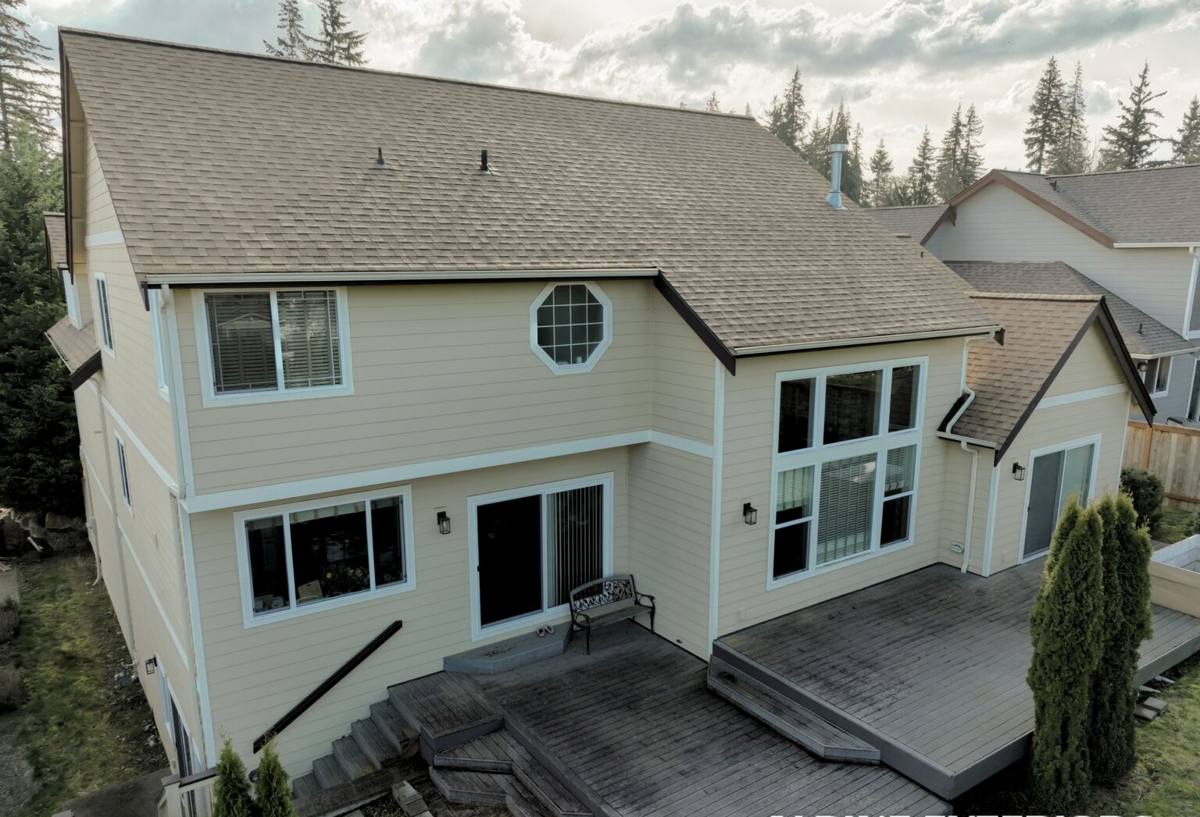
We don't install vinyl, LP SmartSide, primed wood, or cedar on Cherry Point homes, and it's not a marketing position — it's what we've settled on after years of tearing failed siding off of houses that face exactly this kind of exposure. Wood products need a maintained paint film to keep moisture out, and a maintained paint film is a hard promise to keep on a house that's getting salted and rained on sideways for most of the year. Vinyl handles moisture fine on its own but relies on caulking and lap joints that loosen and gap over time, and it doesn't hold up well to the kind of wind gusts that come off open water. Engineered wood products are moisture-resistant, not moisture-proof, and that distinction matters most exactly where you have salt air and standing damp — the two things Cherry Point has in abundance.
James Hardie fiber cement is non-combustible, doesn't rot, doesn't feed moss the way wood-based products can, and its factory-applied ColorPlus finish is baked on to resist the fading and cracking that a field-applied paint job on wood or vinyl trim will eventually show. It's not that other products can't be installed correctly — it's that fiber cement gives a house on this stretch of coastline a much wider margin for error over the next 30 years, and that margin is worth more here than almost anywhere else in the county.
What We're Not Claiming
Hardie siding isn't maintenance-free, and it isn't immune to a bad install. It still needs paint touch-ups eventually, it still needs proper flashing and clearances, and a poorly caulked or poorly fastened Hardie job will leak just like any other siding installed wrong. The product gives you a better starting point. The installation is what determines whether that advantage actually shows up ten and twenty years down the road.
The Right Hardie System for a Cherry Point Home
James Hardie makes climate-specific product lines, and the HZ5 formulation — engineered for regions with freeze-thaw cycling and sustained moisture exposure — is what we spec for homes in this part of Whatcom County. It's manufactured with a composition and coating process tuned for damp, marine-influenced climates rather than the hot, dry conditions HZ10 is built for. Getting this wrong doesn't ruin the siding overnight, but it means the product is working against its design intent for the entire time it's on the house.
- Lap siding for the classic horizontal look, in the widths that suit the home's proportions
- Board and batten or panel systems for accent walls, gables, or a more modern elevation
- HardieTrim and HardieSoffit to close out the whole envelope in matching, factory-finished material rather than mixing in painted wood trim that ages differently
- ColorPlus factory finish — baked-on color with a stronger warranty against fading and chipping than a field-applied paint job can offer
Color selection matters more here than people expect. Darker, saturated colors show salt residue and water spotting differently than lighter tones, and where a wall sits relative to prevailing wind and rain direction can influence which finish holds up best visually over time. We walk through this with homeowners against the actual exposure of their walls, not just a color chart.
What Correct Installation Actually Involves
Most of the siding failures we get called out to inspect on the water side of Whatcom County aren't product failures — they're installation shortcuts that only show their cost once wind-driven rain and salt air get a few years to work on them. This is where a Cherry Point job differs from a typical inland install.
Drainage Plane and Rain Screen
A water-resistive barrier alone isn't enough on a home that takes rain sideways off the water. We detail a drainage gap behind the siding so that any moisture that does get past the cladding has somewhere to go, and can dry out, instead of sitting against the sheathing. This is a bigger deal on west- and north-facing walls that also tend to be the ones holding moss longest.
Flashing and Penetrations
Every window, door, vent, and hose bib is a place water can get behind the siding if it's flashed wrong. We flash penetrations to shed water down and out, not just caulk over the gap — caulk is a backup, not the primary defense, especially in an environment where UV and salt exposure break down sealants faster than the manufacturer's stated lifespan.
Clearances and Fastening
James Hardie specifies minimum clearances from grade, roof lines, and decks, and specific fastener types, spacing, and depth. Skipping these doesn't show up on day one — it shows up as swelling, cracking, or fastener corrosion staining a few winters in, and salt air shortens that timeline considerably if the wrong fastener went in.
Joint Treatment
Butt joints and trim transitions get sealed with a sealant rated for the exposure, applied to a clean, primed surface, not just squeezed into a gap at the end of the day. This is one of the most commonly rushed details on a siding job, and it's one of the first to fail under sustained wind and rain.
Our Process, Start to Finish
- On-site assessment — we look at wall orientation, existing moisture damage, roofline and grade clearances, and which elevations take the worst of the wind and rain off the water.
- Tear-off and sheathing check — old siding comes off and we inspect the sheathing underneath for rot or soft spots before anything new goes up. This is where hidden moss- and moisture-related damage usually turns up.
- Weather barrier and drainage plane — installed to current best practice for a coastal, high-moisture wall assembly, not just to code minimum.
- Hardie installation to spec — correct fasteners, clearances, and flashing detail on every wall, gable, and penetration.
- Trim, caulking, and final finish — matched HardieTrim and soffit work, sealant at all joints and transitions.
- Walkthrough — we go over the finished job with the homeowner before we consider it done.
What This Runs, and What Drives the Price
Every Cherry Point property is different — square footage, number of stories, trim complexity, and how much of the old siding and sheathing needs to come off before new material goes up. Broad honest ranges only; a firm number comes from an on-site look.
| Cost Factor | Why It Matters Here |
|---|---|
| Home size and wall complexity | More corners, gables, and dormers mean more cutting, trim, and flashing detail |
| Sheathing condition | Moisture-damaged sheathing found during tear-off has to be replaced before siding goes back up |
| Siding profile and accessories | Lap width, board-and-batten accents, and trim/soffit scope all affect material and labor |
| Wall exposure | Water-facing elevations often need extra flashing and drainage detail beyond a standard wall |
| Access | Waterfront lots, slopes, or tight setbacks can affect staging and scaffolding needs |
Living With It: Salt Air and Moss Season
Correct installation is most of the battle, but a little homeowner upkeep extends the life of any siding on this stretch of coast. Rinsing salt film off the siding a couple of times a year, especially on walls facing the water, keeps residue from sitting on the surface long-term. Keeping vegetation and tree cover trimmed back from shaded walls reduces how long moss gets to establish and hold moisture against the siding. And a quick annual look at caulking around windows, doors, and trim joints catches sealant failure early, before wind-driven rain finds its way behind it. None of this is heavy maintenance — it's the kind of upkeep that's easy to skip and expensive to ignore.
Why Hiring a Crew That Already Works Cherry Point Matters
A siding crew that mostly works dry, inland jobs doesn't think about drainage planes and salt-rated fasteners by default — because most of what they install doesn't need it. A crew that regularly works this stretch of Whatcom County treats those details as standard, not upsells, because we've seen what happens on the water side when they're skipped. We also know how wind loading off open water affects panel and trim fastening, and we know what moss growth patterns on this coastline actually look like on a wall a few years after install, not just in a manufacturer's brochure.
Local experience also means fewer surprises with permitting and inspection expectations in Whatcom County, and a realistic read on how weather windows affect scheduling a tear-off-and-reside job here versus somewhere drier.
What to Ask Any Contractor Before You Hire Them
- Which James Hardie product line (HZ5 vs. HZ10) do you spec for this climate, and why?
- Do you install a drainage plane or rain screen behind the siding, or just a house wrap?
- What fastener type and spacing do you use, and is it rated for coastal/salt exposure?
- How do you flash windows, doors, and other penetrations — and will you show me the detail before it's covered up?
- Have you worked on other homes in Cherry Point or along this part of the coastline?
- What does your warranty cover versus what James Hardie's manufacturer warranty covers?
If your siding is showing moss staining, gapped caulking, or soft spots after a few winters on the water side of Blaine, it's worth getting a straight assessment before it gets worse. Reach out for a free, no-pressure estimate — we'll walk the house with you and tell you honestly what it needs.