 Blaine Siding
 Why Birch Point Siding Wears Differently Than Siding Inland
Birch Point sits close enough to the water that homes here take on a different set of problems than a house a few miles inland in Blaine or Whatcom County. Salt-laden air moves through constantly, wind-driven rain hits siding at angles that gutters and overhangs don't fully protect against, and the long, damp stretch of fall through spring gives moss and algae months to establish themselves on anything that stays wet. None of this is dramatic on its own, but stacked together over years, it's exactly the kind of exposure that separates siding that holds up for decades from siding that starts failing in five to ten years.
Salt air is corrosive to exposed metal fasteners and trim, and it accelerates the breakdown of coatings that aren't rated for coastal exposure. Driving rain finds every gap in flashing, caulk, and lap joints, pushing moisture behind the cladding instead of letting it run off the face of the wall. And moss doesn't just look bad — it holds moisture against the siding surface, which is a problem for any material that isn't dimensionally stable when wet. A siding choice that works fine in a drier, more sheltered part of the county can underperform here, which is why we treat Birch Point as its own case rather than defaulting to a one-size-fits-all spec.
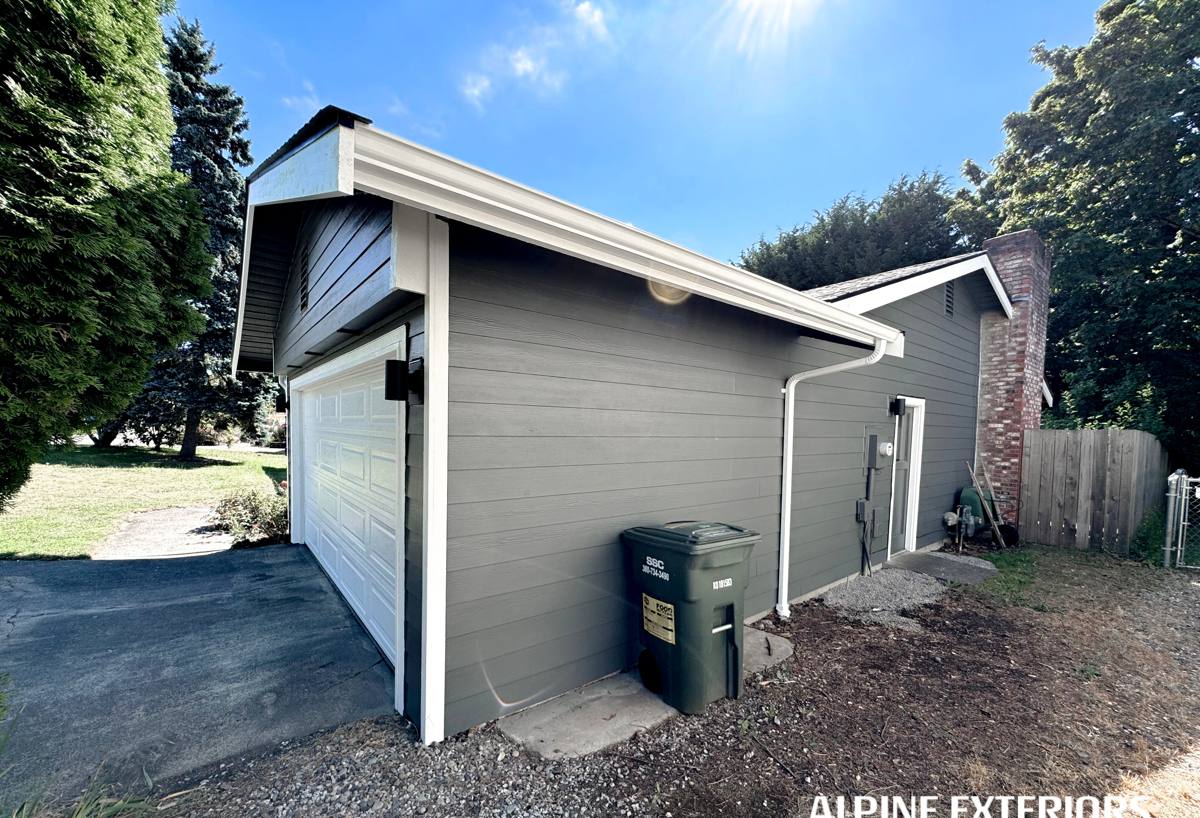
What Birch Point Homes Actually Need From Their Siding
Moisture Resistance That Doesn't Depend on a Perfect Paint Job
Any siding material can shed water when it's brand new and freshly coated. The real test is what happens at year eight or twelve, after the finish has weathered and the caulk joints have started to move. Wood-based products lose their moisture resistance as soon as the coating degrades, because the substrate itself absorbs water. That's a bad combination in a place where the substrate gets wet often and dries slowly.
Dimensional Stability in a Wet-Dry Cycle
Whatcom County's coastal stretch doesn't freeze hard most winters, but it does cycle between soaked and dry constantly. Materials that swell and shrink with moisture content put ongoing stress on paint, caulk, and fastener holes. Over time that stress is what opens up the gaps that let bulk water in behind the cladding.
A Factory Finish That Can Actually Handle Salt Air
Field-applied paint on siding near the water tends to fail early — chalking, fading, and peeling show up faster than the same paint would inland. A factory-cured finish formulated for UV and moisture exposure holds color and adhesion far longer than a job-site paint job ever will.
Why We Only Install James Hardie Fiber Cement Here
This is the core of how we operate, not just in Birch Point but everywhere we work: we install James Hardie fiber cement siding, and we don't install vinyl, LP SmartSide, Cemplank, Allura, primed spruce, or cedar. That's a deliberate standard, not a sales pitch, and it matters more in a coastal neighborhood like this than almost anywhere else in the county.
Fiber cement is cement, sand, and cellulose fiber — it doesn't absorb water the way wood-based siding does, and it doesn't soften, swell, or become a food source for moisture and rot the way engineered wood products can once a seam opens up. It's also non-combustible, which matters given how much of the Pacific Northwest has dealt with wildfire smoke and ember exposure in recent years, even in wetter coastal zones.
James Hardie's HZ product lines are engineered specifically for climate zones, and the HZ5 formulation covers the wetter, more temperate Pacific Northwest conditions that Birch Point sits in. Combined with the ColorPlus factory finish — baked on and warrantied for fade resistance — it's the combination we've found actually stands up to salt air and a long wet season instead of just surviving the first few years looking good in photos.
What We Tell Homeowners About the Alternatives
Vinyl is affordable and low-maintenance in a lot of climates, but it can warp under sustained UV and heat cycling, its seams and J-channels give wind-driven rain more paths to get behind the wall, and it's not repairable the way fiber cement is — a damaged panel gets replaced, not patched. LP SmartSide and other engineered-wood products perform reasonably well when installation and caulking are perfect and stay perfect, but the substrate is still wood fiber, and a coastal environment with constant moisture and periodic missed maintenance is where that margin for error gets tested hardest. Primed spruce and cedar are real wood, with everything that implies about long-term maintenance, repainting cycles, and vulnerability once bare wood is exposed. We're not saying any of these products are junk — we're saying that after years of installing and standing behind our work, fiber cement is what we're willing to warranty and put our name on for homes in this kind of exposure.
| Material | Behavior in Salt Air / Wet Climate | Maintenance Burden |
|---|---|---|
| James Hardie Fiber Cement | Non-combustible, dimensionally stable, factory finish rated for UV/moisture | Low — periodic wash, repaint on a long cycle |
| Vinyl | Can warp/fade with sun and heat cycling; seams are moisture entry points | Low but not repairable, panels replaced not patched |
| LP SmartSide / Engineered Wood | Wood-fiber substrate; performance depends on caulk/paint staying intact | Moderate — coating and joint upkeep is not optional here |
| Cedar / Primed Spruce | Natural wood; absorbs moisture once finish breaks down | High — regular refinishing and moisture monitoring |
What a Correct Installation Looks Like on a Coastal Home
The material is only half the equation. Fiber cement siding installed to spec and fiber cement siding installed with shortcuts perform very differently once they've been through a few wet seasons. On Birch Point projects specifically, we pay close attention to:
- A properly detailed weather-resistive barrier behind the siding, lapped correctly so water is directed out, not trapped in
- Rainscreen or drainage gap where the wall assembly calls for it, giving moisture that does get behind the cladding a path to escape and dry
- Correct fastener type and spacing per James Hardie's published fastening schedule — this is not a place to use whatever nails are on the truck
- Flashing at every window, door, and roof intersection, since these are the spots where driving rain actually gets in
- Caulking only where James Hardie's install guide calls for it, with a sealant rated for the exposure — over-caulking traps moisture just as badly as under-caulking lets it in
- Proper clearance from grade, decks, and roof lines so splash-back and standing water don't sit against the bottom course
Every one of these details is inspectable, and every one of them is something we can walk a homeowner through on their own house before, during, and after the work.
The Moss Problem, Specifically
Moss and algae growth on siding isn't just cosmetic in a climate like this. Shaded, north-facing walls and areas under tree cover near Birch Point stay damp far longer after a rain than the rest of the house, and that moisture retention is hard on any siding finish over time. Fiber cement itself doesn't feed moss the way wood does, but a factory finish still needs to be kept reasonably clean to perform for its full warranted life. Our recommendation is simple and low-effort:
- A soft wash (not high-pressure blasting, which can force water behind laps and damage caulk joints) once a year on shaded or heavily wooded elevations
- Keep vegetation and gutters trimmed back so walls get some airflow and sun
- Address any downspout or grading issue that's dumping extra water against one section of wall
Our Process for Birch Point Projects
Because we already work in this part of Whatcom County, we're not learning the area's exposure conditions on your project. Our process on a Birch Point home typically runs:
- An on-site walkaround to assess current siding condition, moisture damage, trim and flashing detail, and sun/shade/wind exposure on each elevation
- A written scope covering tear-off (where applicable), house wrap or drainage plane repair, trim, and the specific James Hardie products and ColorPlus color selected
- Installation following the manufacturer's fastening and clearance specs, with attention to the flashing and drainage details that matter most given the coastal exposure
- A final walkthrough covering what maintenance (if any) the homeowner should expect and when
What Drives Cost on a Project Like This
| Factor | Why It Matters Here |
|---|---|
| Extent of tear-off and any rot repair | Coastal homes with past moisture intrusion often need more sheathing/framing repair than expected |
| House size and elevation complexity | Water features, dormers, and multiple roof lines add flashing detail and labor time |
| Board profile and trim package | Lap width, trim style, and accent details affect both material and labor cost |
| ColorPlus color and accessory selection | Factory-finished color options carry the long-term fade warranty; some premium colors cost more |
| Site access | Waterfront and narrow-lot properties can affect staging, scaffolding, and material delivery |
We give real numbers after seeing the house — broad ranges without an on-site look aren't useful to a homeowner trying to budget accurately.
Why Hiring a Crew That Already Works Birch Point Matters
A siding contractor who mostly works drier, more sheltered parts of Whatcom County can still do competent work, but they may not default to the drainage detailing, fastener choices, and flashing attention that a coastal, salt-air, high-rainfall property actually needs. We work this stretch of the county regularly, which means we're not guessing at how wind-driven rain behaves on a water-facing wall or how long moss takes to establish on a shaded elevation here — we've seen it, repeatedly, on real houses in real conditions. That local pattern recognition is part of what you're paying for when you hire a crew that already knows the area, not just the trade.
If you're considering siding work on a Birch Point home, we're happy to take a look and give you a straightforward, no-pressure estimate — no invented urgency, just an honest read on your home's condition and what it would take to do the job right.