 Blaine Siding
 Why Decks in Birch Point Wear Out Faster Than People Expect
Birch Point sits close enough to the water that the air itself is part of the problem. Salt-laden moisture doesn't just sit on the surface of a deck — it works into fastener heads, hinges, and any spot where two pieces of wood meet. Add Whatcom County's long wet season, and you've got a structure that's rarely given the chance to fully dry out between storms. A deck that would last two decades in a drier inland climate can start showing real structural problems in half that time out here.
We've replaced enough decks in this neighborhood to know the failure pattern is predictable. It's rarely the decking boards themselves that fail first — it's what's underneath and holding it together.
Salt Air and Hardware
Standard galvanized fasteners and connectors corrode faster near the water than most homeowners assume. Once a nail or screw starts rusting, it loses grip strength long before it looks obviously bad from the top. By the time you notice rust streaks bleeding through the decking, the fastener underneath has often already lost a meaningful amount of holding power.
Driving Rain and Water Intrusion
Blaine gets its share of wind-driven rain, and a deck attached to the house is only as good as its ledger board flashing. Water pushed sideways by wind finds its way behind poorly flashed ledger boards and into the rim joist and wall framing behind it. This is usually invisible until the rot is advanced — which is why so many "deck replacements" we get called for actually start as a homeowner noticing a soft spot or a slight sag near the house.
Moss Season and Slip Risk
The long stretch of damp, low-light months lets moss and algae take hold on horizontal wood surfaces, especially in shaded corners or under overhangs. Beyond looking bad, a mossy deck surface gets genuinely slick, and repeated pressure-washing to keep it clean accelerates wear on softer woods.
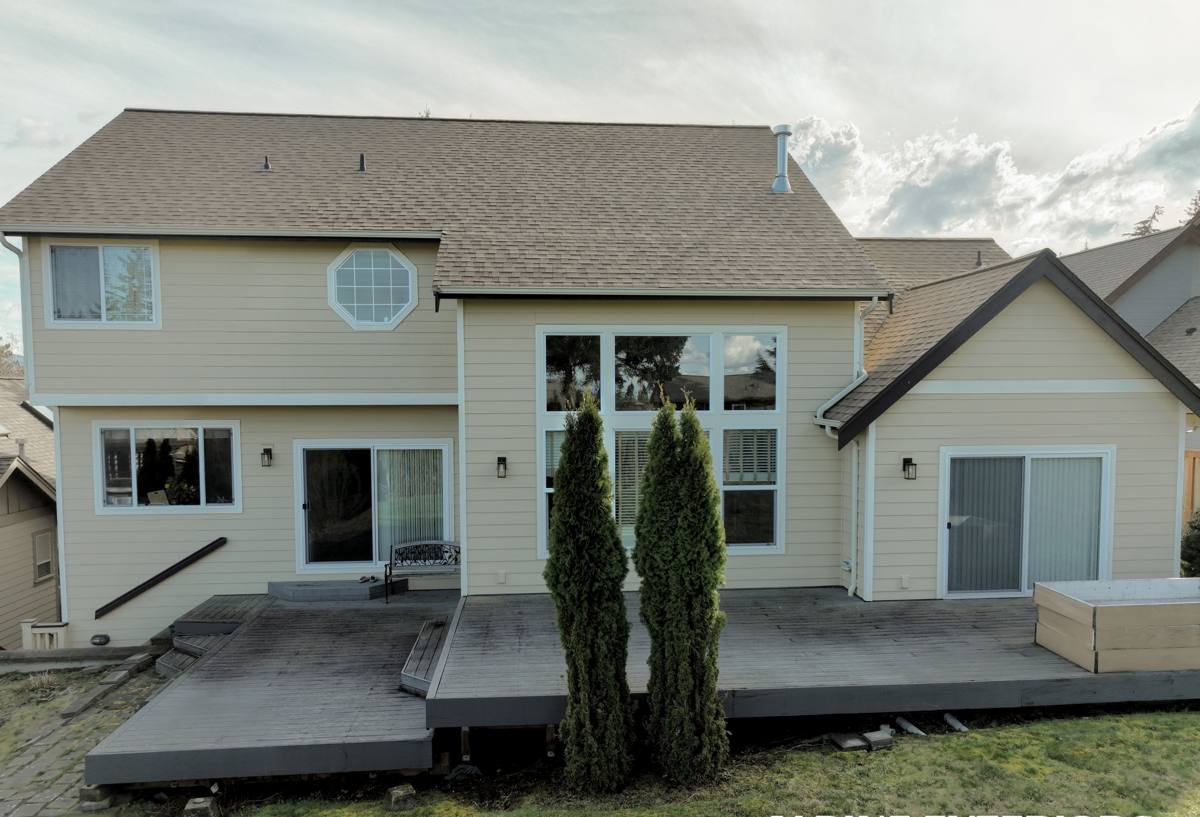
Signs Your Birch Point Deck Needs Replacement, Not Just Repair
Not every deck needs a full replacement. But there's a point where patching individual boards is just delaying a bigger job — and spending money on a deck that's going to need replacing within a couple years anyway.
- Soft, spongy, or bouncy spots when you walk across the deck
- Visible gaps or dark staining where the ledger board meets the house
- Rust stains bleeding out around fastener heads or joist hangers
- Railing posts that wiggle at the base even after tightening hardware
- Persistent moss or algae that returns within weeks of cleaning
- Wood that feels soft or crumbly when pressed with a screwdriver, especially near ground contact points
- Footings that look tilted, cracked, or undermined by drainage
If you're seeing two or more of these, it's worth getting a real inspection rather than another round of board swaps.
What a Correct Deck Replacement Involves Here
A deck replacement done right in this climate isn't just about swapping old boards for new ones. The parts you don't see are what determine whether the new deck lasts.
Ledger Board and Flashing
This is the single most important detail on an attached deck near the water. We remove the old ledger entirely, inspect the rim joist and wall sheathing behind it for hidden rot, and install proper flashing — including a drip cap and self-adhering membrane — before the new ledger ever goes back up. Skipping this step is the single biggest cause of premature deck failure we see in this area.
Framing and Fasteners
Given the salt air, we don't cut corners on hardware. Stainless steel or heavy hot-dip galvanized fasteners and structural connectors cost more up front, but standard coated fasteners simply don't hold up as long this close to the water. The same goes for joist hangers and post bases — anything embedded in the structure needs to outlast the visible decking.
Decking Material Choices
There's no single "best" decking material — it depends on your budget, how much upkeep you're willing to do, and how the deck is used. Here's how the common options actually perform in a Whatcom County coastal climate:
| Material | Moisture & Salt Air Performance | Moss/Algae Resistance | Maintenance |
|---|---|---|---|
| Pressure-treated wood | Good if sealed regularly; end grain and cuts are vulnerable | Needs regular cleaning and treatment | Annual sealing/staining recommended |
| Cedar | Naturally rot-resistant but still needs sealing near salt air | Moderate; still grows moss in shaded areas | Periodic staining or oiling |
| Composite decking | Very good; won't rot or absorb moisture like wood | Can still grow surface algae; needs occasional cleaning | Low; occasional washing |
| PVC/capped composite | Excellent; fully sealed surface resists moisture intrusion | Low; smoother caps shed algae easier | Lowest; rinse as needed |
Composite and capped-PVC products cost more per square foot than wood, but for a deck exposed to this much salt air and rain, the reduced maintenance and moisture resistance often make up the difference over the life of the deck.
Footings and Structural Considerations
Older decks in this area were sometimes built on undersized or shallow footings that were adequate decades ago but don't meet current code, and drainage patterns around a property can shift over the years as landscaping changes. As part of a full replacement, we evaluate footing size, depth, and condition rather than assuming the existing foundation is fine just because the deck has stood this long. If footings need to be re-poured to current code, that's addressed before any framing goes back up — not discovered as a surprise mid-project.
Our Process for a Birch Point Deck Replacement
- On-site inspection of the existing deck, ledger connection, framing, and footings
- Honest assessment of what can be reused versus what needs full replacement
- Written estimate covering material options, hardware grade, and scope
- Permit handling through the relevant Whatcom County or city process, when required
- Full demolition and disposal of the old structure
- Ledger flashing, framing, and footing work completed before any decking is installed
- Decking, railing, and finish work installed to your chosen material
- Final walkthrough covering care and maintenance specific to the material you chose
Cost Factors for Deck Replacement in Birch Point
Every deck is different, but the same handful of variables move the price up or down on nearly every project we quote in this area.
| Factor | Why It Matters Here |
|---|---|
| Deck size and footprint | Larger decks need more framing, footings, and decking material |
| Decking material chosen | Wood costs less upfront; composite/PVC costs more but needs less upkeep against salt air and moss |
| Ledger and flashing condition | Hidden rot behind the ledger adds framing repair before decking can begin |
| Footing condition | Undersized or damaged footings may need to be re-poured to current code |
| Height and railing complexity | Elevated decks and custom railings add labor and code requirements |
| Fastener and hardware grade | Stainless or heavy-duty galvanized hardware costs more but is worth it this close to the water |
We'd rather walk your specific deck and give you real numbers than throw out a broad range that doesn't mean much once we're standing on your actual structure.
Permits and Whatcom County Requirements
Deck replacement projects, especially those involving structural framing, footings, or elevated railings, generally require a permit. We handle that process as part of the job rather than leaving it to the homeowner to sort out, and we build to current code rather than just matching what was there before — which matters most for footing depth, railing height, and guard spacing on elevated decks.
Why Hire a Crew That Already Works in Birch Point
A contractor who's done work throughout the Blaine area already understands how this specific stretch of coastline behaves — where wind-driven rain hits hardest, which fastener grades actually hold up, and how fast moss takes over a shaded deck compared to a sunnier one a few blocks away. That's not something you get from a general contractor pulling from a one-size-fits-all spec sheet. It also means we're not learning on your project — we're applying what's already worked, and avoided problems, on decks like yours nearby.
Keeping a New Deck in Good Shape
Whatever material you choose, a little seasonal upkeep goes a long way in this climate. Clear leaves and debris out of gaps between boards so moisture doesn't sit trapped. Rinse off moss and algae buildup before it gets a foothold, especially in shaded corners. If you go with wood, plan on resealing or staining on a regular cycle rather than waiting until it visibly needs it. None of this is complicated, but skipping it is how a well-built deck ends up needing early repairs anyway.
If your deck in Birch Point is showing any of the warning signs above, or you're just ready to stop patching an old one, we're happy to come take a look. Estimates are free, there's no pressure, and you'll get a straight answer about whether you need a full replacement or something less.