 Blaine Siding
 Why Birch Point Windows Need a Different Approach
Birch Point sits close to the water on the Blaine side of Whatcom County, and that shoreline exposure changes what a window has to survive. Homes a mile inland deal with rain and cold. Homes near the water deal with rain, cold, near-constant wind off the Strait, and a fine mist of salt that settles on glass, frames, and hardware even on days when it isn't raining. Add in the long stretch of gray, damp months typical of this part of the Pacific Northwest, and you have conditions that will find every weak point in a window system — usually within a few years, not a few decades.
We don't treat a Birch Point job the same way we'd treat a job in a dry, sheltered inland lot. Product selection, flashing detail, and hardware choice all shift when salt air and driving rain are part of the daily environment.
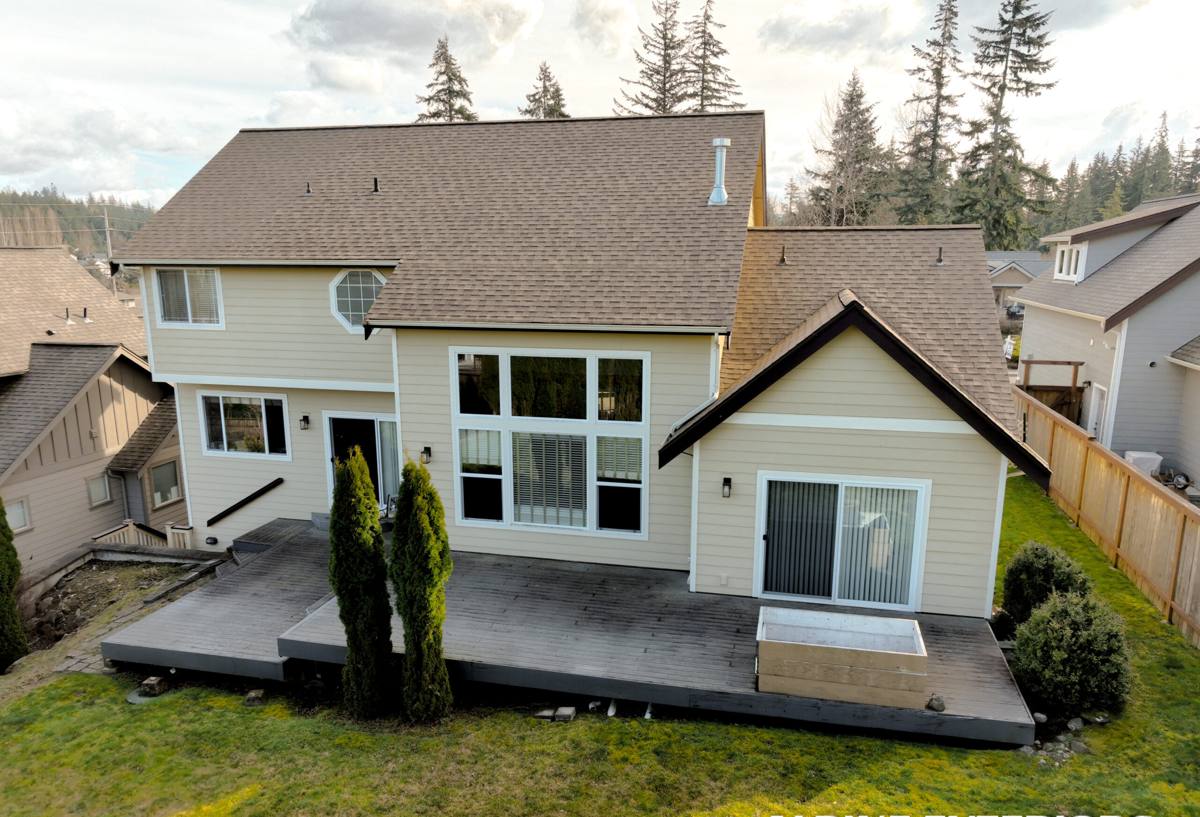
What Salt Air and Driving Rain Actually Do to a Window
It helps to understand the failure modes before talking about fixes, because most window problems we see on Birch Point homes trace back to one of these:
Hardware corrosion
Cranks, locks, hinges, and balance mechanisms are often the first thing to go near saltwater. Cheaper or unprotected hardware pits and seizes, sometimes within a handful of seasons, well before the glass or frame shows any wear.
Seal and glazing failure
Insulated glass units rely on a perimeter seal to keep the gas fill in and moisture out. Constant damp cycling — wet, dry, wet again — stresses that seal faster than it would in a drier climate. Once it fails, you get fogging between the panes that no amount of cleaning will fix.
Wood and frame degradation
Untreated or poorly finished wood components absorb moisture from driving rain that gets blown sideways into the frame joints. Combined with the region's long moss season, north- and west-facing windows in particular can develop rot and moss growth in places that never fully dry out between storms.
Wind-driven water intrusion
Standard flashing details that work fine in calmer areas can fail when rain is being pushed horizontally by wind coming off the water. Water finds gaps at the sill and jambs that would never be tested under normal rainfall.
Frame and Glass Options for a Coastal Property
There's no single "best" window for every home — it depends on exposure, budget, and how the house is built. Here's how the common options compare for a property like the ones near Birch Point:
| Frame Material | Salt Air Resistance | Maintenance | Typical Cost Tier |
|---|---|---|---|
| Vinyl | Good — won't corrode or rot | Low | Lower |
| Fiberglass | Very good — dimensionally stable, resists pitting | Low | Mid-to-higher |
| Aluminum | Fair — needs a marine-grade finish or it corrodes | Moderate | Mid |
| Wood / Wood-clad | Poor to fair without diligent upkeep | High | Higher |
For homes with direct or near-direct water exposure, we generally steer clients toward vinyl or fiberglass because neither one corrodes or rots, and both hold up to repeated wet-dry cycling with minimal upkeep. That's not a knock on wood windows — they can look great and perform well on a sheltered, inland lot — it's a matter of matching the product to how much weather it will actually take at this specific location.
Glass packages
On an exposed property, we typically recommend dual-pane glass with a low-E coating and argon fill as the baseline, not an upgrade. The extra layer of thermal performance matters more here because these homes are fighting constant wind chill off the water, and a quality low-E coating also cuts down on UV fading of interior floors and furniture, which is a bigger issue on waterfront lots with unobstructed light.
What a Correct Installation Actually Involves
The window unit itself is only part of the job. Most leaks and premature failures we get called out to fix trace back to installation shortcuts, not the product. A correct install on an exposed home includes:
- Removing the old window down to the rough opening — not just cutting out the sash and re-trimming around it
- Inspecting the sheathing and framing underneath for hidden rot or moisture damage before anything new goes in
- Installing a proper sill pan to direct any water that gets past the window back outside
- Applying flashing tape and building paper in the correct shingle-lap order so water sheds downward and outward, never into the wall
- Setting the window level, plumb, and square, with shims — not relying on the frame or fasteners to hold shape
- Insulating the gap between the window and rough opening without overpacking it, which can bow the frame
- Sealing the interior and exterior with the right sealant for the substrate, with backer rod used where gaps are too wide for sealant alone
- Reinstalling or replacing trim so the water management layer isn't interrupted
Skip any one of these steps and the window can look fine for a year or two before water intrusion or rot shows up — often inside the wall, where it's expensive to find and fix.
Our Process for Birch Point Projects
1. On-site assessment
We walk the home and look at each window's exposure individually. A window on a sheltered side of the house doesn't need the same detailing as one facing straight into prevailing wind and rain off the water.
2. Precise measurement and product selection
We measure each opening exactly rather than assuming uniformity — older homes in this area often have openings that have shifted slightly over the decades. We recommend frame material and glass package based on that window's specific exposure, not a one-size answer for the whole house.
3. Removal and structural check
Old windows come out fully so we can see the condition of the framing and sheathing behind them. If there's hidden moisture damage, we address it before the new window goes in — installing a new window over a rotten opening just hides the problem.
4. Installation with full weather detailing
Sill pans, flashing, insulation, and sealant are installed to the standard described above, every time, regardless of whether the window "looks" like it needs it.
5. Final check and cleanup
We test operation, check for square and smooth function, and confirm the seal from both inside and outside before we consider the job done.
Signs You're Dealing With Salt-Air Window Damage
If you're not sure whether your windows need attention, these are the early warning signs we see most often on Birch Point homes:
- Cranks, locks, or hardware that feel stiff, gritty, or have visible white or green corrosion
- Fogging or a hazy film between the panes that doesn't wipe away — a sign the seal has failed
- Soft or discolored wood at the sill or lower corners of the frame
- Moss or dark green growth building up in frame corners or along the sill
- Drafts or a noticeable temperature difference near the window even when it's fully closed
- Difficulty opening or closing that wasn't there a year or two ago
Any one of these on its own isn't necessarily urgent, but two or three together usually mean moisture has already gotten into the frame or wall assembly.
Why It Matters That We Already Work This Area
Whatcom County covers a lot of ground, and building conditions vary a lot between a sheltered inland lot and a shoreline property near Blaine. A crew that's spent time on Birch Point homes already knows which sides of a house take the worst of the wind and rain, which older wood-window installations tend to need full opening repair versus a straightforward swap, and how much extra detailing an exposed opening needs compared to a standard install. That familiarity means fewer surprises once we open up a wall, and it means we're not guessing at product selection — we're matching it to conditions we've already seen work and fail on similar homes nearby.
Caring for New Windows in This Climate
Even a well-installed window benefits from basic upkeep in a salt-air environment. Rinsing frames and hardware periodically with fresh water helps clear salt residue before it can pit metal components. Keeping weep holes clear of debris and moss lets the window drain the way it's designed to. And an annual look at exterior sealant — especially after a hard winter — catches small cracks before they become entry points for water. None of this is intensive, but it's a different maintenance rhythm than a window fifty miles inland would need.
If you're seeing drafts, fogged glass, sticking hardware, or moisture damage around your windows — or you're planning ahead for a home near the water — we're happy to take a look. Estimates are free, there's no pressure, and you'll get a straight answer about what your windows actually need. The form below is the easiest way to get started.