 Blaine Siding
 Building a Deck That Actually Holds Up in Birch Point
Birch Point sits right up against the water on the north edge of Whatcom County, and that location shapes everything about how a deck should be built here. A deck design that works fine ten miles inland can start failing within a few years on this stretch of coastline. Salt air corrodes hardware faster, driving rain finds every gap in flashing and fastening, and the long moss season keeps surfaces damp for months at a time. None of that means a deck can't last — it means the framing, fasteners, and finish choices have to be picked for this exact environment, not a generic one.
This page covers what a correctly built deck looks like for a Birch Point property, what usually goes wrong when it isn't, and how our process handles the details that matter here.
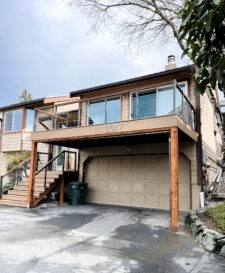
What Birch Point's Location Demands From a Deck
Salt Air and Metal Hardware
Proximity to the water means airborne salt is a constant, low-level presence on every exposed surface — including the fasteners, brackets, and connectors holding a deck together. Standard zinc-coated or electro-galvanized hardware corrodes noticeably faster this close to the water than it would a few miles inland. Once fasteners start rusting, they stain the decking around them and lose holding strength, which is a structural issue, not just a cosmetic one.
Driving Rain and Water Management
Whatcom County gets plenty of rain, but the kind that does real damage to a deck is the sideways, wind-driven rain that comes off the water. It gets pushed under railings, behind ledger boards, and into any seam that isn't properly flashed or sealed. A deck built with drainage as an afterthought will trap water in exactly the spots you can't see — framing connections, ledger attachments, post bases — until rot or corrosion has already set in.
Moss, Algae, and Extended Shade
Between the marine cloud cover and tree coverage common around Birch Point properties, many decks here stay damp longer than decks in drier, sunnier parts of the region. That extended dampness is exactly what moss and algae need to establish themselves, and once they take hold on decking boards or stair treads, they hold moisture against the wood and create a genuine slip hazard.
Decking Material Options for This Climate
There's no single "best" decking material for every project — it depends on your budget, how much upkeep you want to take on, and how close your lot sits to the water. Here's how the common options actually perform in a salt-air, high-rain environment like Birch Point:
| Material | Moisture & Salt Performance | Maintenance Needs | Typical Lifespan Here |
|---|---|---|---|
| Pressure-treated lumber | Good if fasteners and flashing are corrosion-resistant; the wood itself resists rot but surface can still take on moisture | Annual cleaning, periodic sealing or staining | 15–20 years with upkeep |
| Cedar | Naturally rot- and insect-resistant, but the surface grays and needs sealing to hold its look | Regular sealing/staining, moss removal in shaded spots | 15–20 years with upkeep |
| Composite decking | Doesn't absorb water or rot, resists salt staining well | Occasional washing; some composites need periodic moss/algae treatment in shade | 25–30+ years |
| PVC/capped polymer decking | Fully sealed surface, best resistance to moisture and salt exposure | Low — mostly rinsing | 25–30+ years |
Composite and PVC decking generally cost more up front but ask the least of you afterward, which matters a lot in a climate that punishes neglect. Wood costs less initially and can look great, but only if someone stays on top of sealing and cleaning — skip that a couple years running in this moss season and the wood shows it.
Framing and Structure — Where Decks Actually Fail
The decking surface is what you see, but the framing underneath is what determines whether the deck is safe and how long it lasts. In our experience, the failures we get called out to fix in coastal Whatcom County properties almost always trace back to one of these:
- Ledger boards attached to the house without proper flashing, letting water track into the rim joist and wall framing behind it
- Standard fasteners used in a location that needed stainless steel or heavy-duty coated hardware
- Post bases set directly on grade or in standing water instead of on proper footings above grade
- Joists without any drip edge or flashing tape, so water sits on top of the wood every time it rains
- Insufficient airflow underneath the deck, keeping the framing damp long after a storm has passed
None of these are visible once the deck is finished, which is exactly why they're so common — they don't show up as a problem until years later, and by then the fix is a lot more invasive than it would have been to do right the first time.
Railings, Fasteners, and Hardware Choices
Railings and hardware take the most direct salt and weather exposure on a deck because they're usually the least protected part of the structure. For a Birch Point build, we default to fasteners and structural connectors rated for coastal or marine-grade exposure rather than the standard hardware used further inland — the upcharge is small relative to the cost of dealing with rust stains and weakened connections down the line. For railings, the material choice matters too: powder-coated aluminum and properly finished composite or PVC rail systems hold up better against salt air than untreated wood balusters, which tend to gray and split faster this close to the water.
Our Process for a Birch Point Deck Project
Every deck project we take on in the Blaine area follows the same core steps, adjusted for the specific lot:
- Site assessment — we look at sun/shade exposure, drainage patterns, wind direction relative to the water, and how close the deck will sit to salt spray
- Design and material selection — matching decking, railing, and hardware choices to your budget and how much maintenance you actually want to do
- Permitting — decks attached to the house, elevated decks, or those over a certain size generally require a permit through the local building jurisdiction; we handle that paperwork so it doesn't fall on you
- Framing and structural work — proper flashing at the ledger, corrosion-resistant fasteners throughout, footings set correctly for the soil and drainage on your lot
- Decking, railing, and finish work — installed to shed water rather than trap it, with attention to gaps and drainage at every seam
- Final walkthrough — going over the finished deck with you, including what maintenance it will need and roughly when
Maintaining a Deck Through a Long Moss Season
A well-built deck still needs some seasonal attention in this climate — the difference is that a properly built one needs a lot less. Here's a practical checklist for keeping a Birch Point deck in good shape year-round:
- Sweep or blow off leaves and debris regularly, especially in fall — trapped organic matter holds moisture and feeds moss growth
- Rinse the surface periodically through the wetter months to keep salt residue and early moss growth from building up
- Check railings, stair treads, and any shaded corners for moss or algae buildup and treat it before it spreads
- Inspect fasteners and metal connectors once a year for rust staining or corrosion, particularly on railings and stair hardware
- Confirm gaps between boards stay clear so water can drain through rather than pooling on the surface
- Reseal or restain wood decking on the schedule appropriate to the product — don't let it go two or three seasons past due
- Keep an eye on the area where the deck meets the house for any signs of water staining or soft wood
Why Hire a Crew That Already Works in Birch Point
A lot of deck problems we see in this area come from work done by builders who don't normally build this close to salt water. The techniques that hold up fine in a drier, more sheltered part of Whatcom County — standard hardware, ledger flashing that would pass inspection inland, wood species chosen without accounting for salt exposure — don't hold up the same way out here. Working regularly in Blaine and the surrounding coastal neighborhoods means we already know which details need upgrading for this specific environment, what the local permitting process actually requires, and how a deck here needs to be built to still look and perform well a decade from now, not just at the final walkthrough.
Getting Started
If you're planning a new deck or replacing one that's showing its age, we're happy to come take a look, walk the site with you, and put together an honest estimate — no pressure, no obligation. Fill out the form below and we'll get in touch to schedule a time.