 Blaine Siding
 Why Decks in Nooksack Take More Punishment Than the Brochures Admit
Nooksack sits inside a stretch of Whatcom County where the weather doesn't do you any favors. Salt-laden air off the Strait, long stretches of driving rain, and a moss season that can run from fall clear through spring all work on an outdoor deck at the same time. Wood decking swells, checks, and grays under that kind of cycle. Even composite decking, which is marketed as low-maintenance, behaves differently here than it does in a dry inland climate. The material choice matters, but so does how the deck is built underneath — and that's the part most homeowners never see until something goes wrong.
We build and replace decks throughout Blaine and the surrounding Whatcom County area, and Nooksack's conditions are consistent enough that we plan for them from the first site visit rather than treating them as an afterthought.
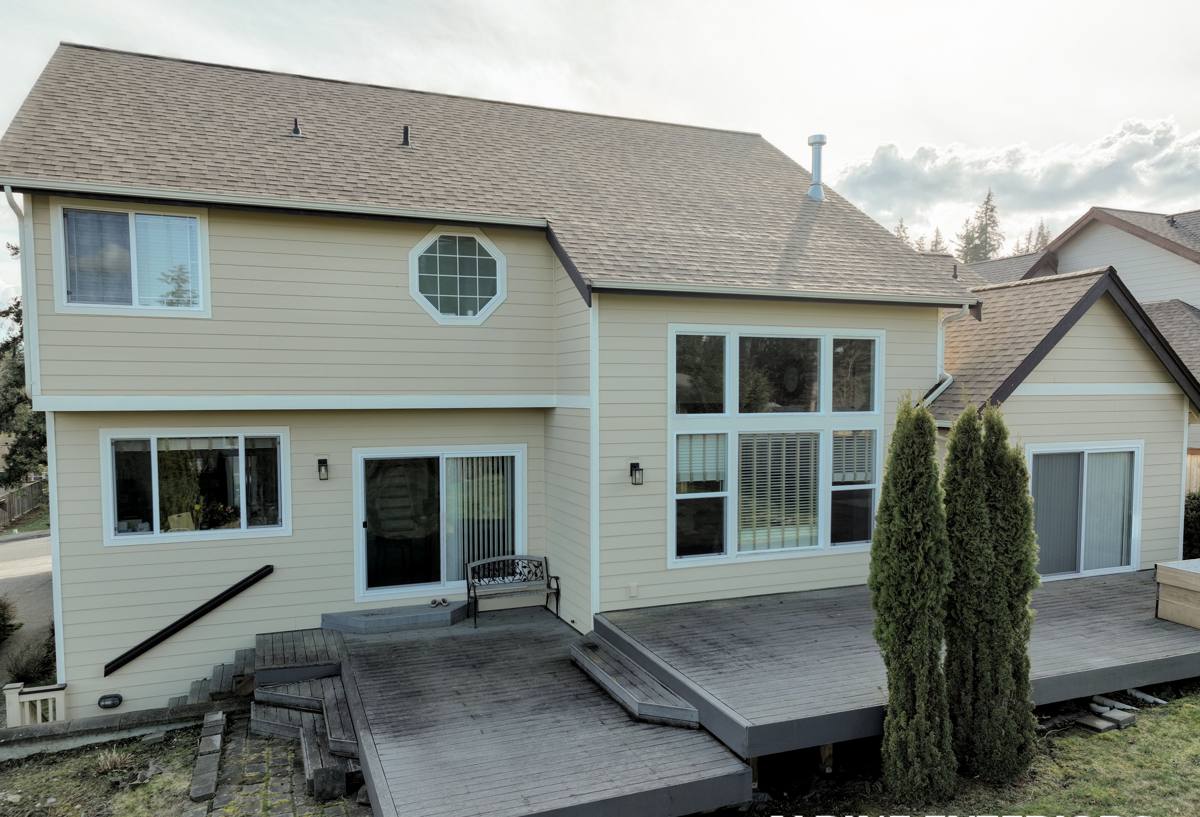
What "Composite" Actually Means — and Why the Category Isn't One Thing
"Composite decking" covers a range of products, and the differences matter more in a wet, mossy climate than they do somewhere dry. Broadly:
Capped composite
Most composite boards today are a wood-plastic core wrapped in a polymer shell (the "cap") on some or all sides. The cap is what actually resists moisture, staining, and mold. Boards that are capped on all four sides hold up better long-term in a climate like ours than boards capped only on the top and sides, because the cut ends and the underside are where moisture intrusion usually starts.
Uncapped or "first generation" composite
Older-style wood-plastic composite without a full polymer shell is more exposed to surface moisture and can be more prone to mold growth and fading. It's cheaper up front but demands more upkeep, and that upkeep matters more here than in a drier region.
PVC (cellular) decking
Fully synthetic, no wood content. It doesn't feed mold the way wood-plastic composite can, which is a real advantage during a long moss season, but it has its own installation quirks — different expansion rates, different fastening requirements — that a crew needs to actually know rather than treat like standard composite.
We'll walk you through which category fits your budget and your specific site — sun exposure, drainage, and how sheltered or exposed the deck footprint is all factor in.
What a Correct Installation Involves in This Climate
The decking board is only part of the system. In a place with this much rainfall and salt exposure, the substructure and detailing decide whether the deck performs for fifteen years or gives you problems in five.
Substructure and drainage
Composite decking is heavier than wood and doesn't flex the same way, so joist spacing has to match the manufacturer's spec for the board profile — tighter spacing is often required than what's standard for wood decking. Ground clearance and airflow underneath the deck matter just as much: a low, poorly ventilated deck in a moss-prone area traps moisture against the framing and invites rot in the structure even if the composite boards themselves are holding up fine.
Fasteners and hardware
Anywhere with salt air needs stainless steel or coated fasteners rated for coastal exposure — cheaper hardware corrodes faster and can stain composite boards around the fastener heads. Hidden fastener clip systems, when compatible with the board profile, also reduce the number of exposed penetration points where water can work its way in.
Board spacing and expansion gaps
Composite and PVC boards expand and contract with temperature more than people expect, and gap spacing has to account for both that movement and drainage. Boards installed too tight trap water between them; too loose and the deck feels sloppy underfoot and collects debris in the gaps.
Ledger and flashing details
Where the deck attaches to the house, proper flashing is what keeps rain from working its way behind siding and into wall framing over time. This is one of the most common places we find corner-cutting on decks that were built cheaply, and it's not something you can inspect from the surface once the deck is finished.
Composite vs. Other Decking Materials for This Area
| Material | Moss/mildew resistance | Salt air behavior | Maintenance |
|---|---|---|---|
| Capped composite (4-side) | Good — surface resists mold growth | Stable; hardware choice matters more than the board | Occasional wash; no staining or sealing |
| PVC/cellular | Very good — no wood fiber to feed mold | Stable, but confirm fastener compatibility | Occasional wash |
| Uncapped composite | Fair — more prone to surface mold in shaded, damp spots | Can fade and stain faster near salt exposure | Periodic cleaning, sometimes with mold-specific cleaner |
| Pressure-treated wood | Poor without regular upkeep | Hardware corrodes faster; wood grays and checks | Annual cleaning, periodic staining/sealing |
| Cedar | Fair — natural rot resistance but still needs care | Grays quickly in salt air without sealing | Regular sealing to hold color and resist moisture |
None of these materials is "bad" — the right choice depends on your budget, how much upkeep you're willing to do, and how exposed your specific deck site is to weather. What we won't do is put a low-grade, uncapped board in a shaded, damp corner of a Nooksack lot and tell you it'll look the same in five years as a fully capped board would. That's a maintenance and appearance trade-off worth knowing about before you buy, not after.
Moss, Mildew, and Salt Air: What Upkeep Actually Looks Like
Composite decking is genuinely lower-maintenance than wood, but "low-maintenance" doesn't mean "no maintenance" in a climate that grows moss on north-facing roofs and fences most of the year. Here's what actually keeps a composite deck looking right through a Whatcom County winter and spring:
- Sweep off standing leaves and debris regularly — trapped organic matter is what feeds mold and moss growth on any decking surface, composite included
- Rinse the deck surface periodically, especially shaded areas that don't get direct sun to dry out
- Clean gaps between boards where debris collects and holds moisture against the board edges
- Check fastener heads and hardware periodically for corrosion staining, particularly on decks closer to open water or exposed to wind off the Strait
- Keep gutters and downspouts clear so runoff isn't dumping directly onto the deck surface or framing below
- Trim back vegetation that shades the deck and keeps it damp longer than it needs to be
None of this is heavy labor — it's the difference between a deck that stays clean and one that develops a green film in the shaded corners by February.
How We Approach a Composite Decking Project
- Site visit and assessment. We look at sun exposure, drainage, existing framing condition (if it's a replacement), and how sheltered or exposed the site is before recommending a product tier.
- Honest product conversation. We'll lay out the real differences between capped composite, PVC, and lower-cost options for your specific budget and site — including the maintenance trade-offs, not just the upsell.
- Structural check or rebuild. If we're replacing an old deck, we evaluate the substructure independently of the surface boards. A new composite deck on a compromised frame is a short-term fix, not a long-term one.
- Installation to spec. Joist spacing, fastener selection, flashing, and expansion gaps are set to the manufacturer's requirements for our climate, not generic defaults.
- Walkthrough and care guidance. Before we leave, we go over what maintenance actually looks like for the specific product installed, so you know what to expect through the wet season.
Cost Factors Worth Understanding Before You Budget
Composite decking costs more per square foot than pressure-treated wood up front, and the total project cost depends on more than the board price alone. Broad factors that move the number:
| Factor | Why it affects cost |
|---|---|
| Board tier (uncapped vs. fully capped vs. PVC) | Material cost and expected lifespan both scale with the cap quality |
| Substructure condition | Replacing rotted or undersized framing adds labor and material before decking even starts |
| Deck size and complexity | Multiple levels, angles, or custom railing details add labor time |
| Fastening system | Hidden clip systems typically cost more in labor than face-screwing but leave a cleaner surface |
| Railing and trim material | Composite or aluminum railing to match the decking adds cost versus simpler wood rail |
We won't quote a number without seeing the site — a flat deck on solid framing and a multi-level deck with a failing substructure are not the same project, even at the same square footage.
Signs an Existing Deck Needs Replacing, Not Just Cleaning
Some homeowners call us for a "moss problem" and it turns out the moss is a symptom of a deck that's past the point of surface cleaning. Worth a closer look if you're seeing:
- Soft or spongy spots underfoot, especially near the ledger board where the deck meets the house
- Persistent green or black staining that comes back within weeks of cleaning
- Visible gaps opening up between boards, or boards cupping and no longer sitting flat
- Rust streaking around fasteners, which can indicate hardware that was never rated for this climate
- Railing posts that feel loose or move when pushed
Any of these point to a structural or moisture issue underneath, and that's a different conversation than swapping decking material.
Why It Matters That We Already Work in This Area
A crew that mostly builds decks in a dry climate and occasionally takes a job out here doesn't have the same instinct for where moisture problems actually start on a Whatcom County property. Knowing which fastener grade holds up near salt air, which board profiles drain well under a long rainy season, and where flashing tends to fail on this region's homes isn't something you pick up from a spec sheet — it comes from having done the work here repeatedly. We treat every composite deck install in Nooksack the same way we'd want it done on our own property: built to handle the actual weather, not the weather in a manufacturer's marketing photo.
If you're weighing a new composite deck or need to replace one that's past its prime, we're happy to take a look and give you a straightforward, no-pressure estimate — just fill out the form below.