 Blaine Siding
 Why Metal Roofing Fits Bellingham's Climate
Bellingham sits close enough to the water that salt-laden air reaches roofs year-round, and Whatcom County's rain doesn't fall politely — it comes sideways off Bellingham Bay and the Strait of Georgia often enough that "driving rain" is just normal weather here. Add a moss season that can stretch from fall through spring in the shaded, tree-covered lots common around this part of the county, and you have a roofing environment that punishes anything with seams, granules, or fasteners that aren't detailed correctly. Metal roofing, installed right, handles all three of those pressures better than most alternatives — but "installed right" is doing a lot of work in that sentence, and it's the part that separates a roof that lasts decades from one that leaks by year eight.
We're not here to tell you metal roofing is the only answer for every Bellingham home. It's a strong fit for the climate, but it's also a bigger upfront investment than asphalt shingles, and it only pays off if the installation is done with the right underlayment, flashing, and fastening details for this specific weather. This page walks through what that actually looks like.
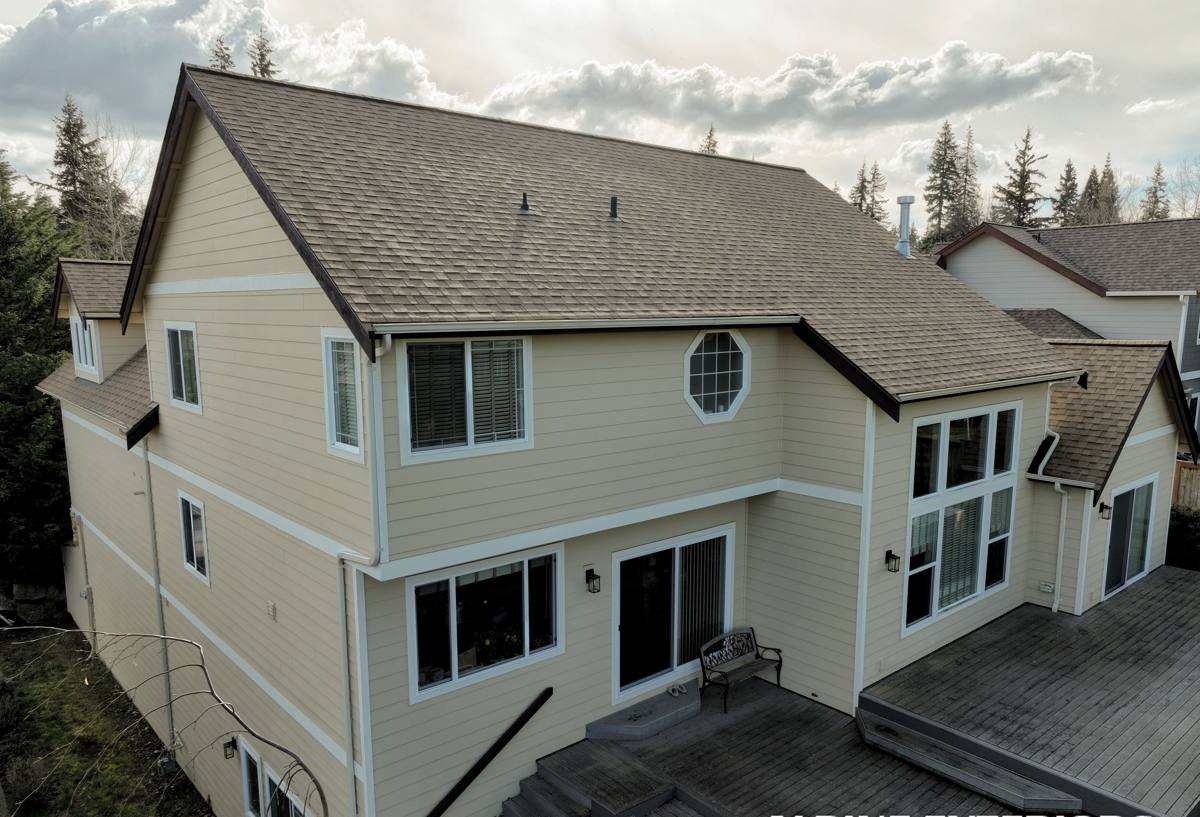
What Bellingham Weather Demands From a Roof
Salt Air and Corrosion
Homes closer to Bellingham Bay and the coastline see airborne salt settle on every exterior surface, including the roof. Over years, salt exposure accelerates corrosion on fasteners, flashing, and any metal that isn't rated for it. This is one of the most common oversights we see on roofs installed by crews unfamiliar with coastal Whatcom County — using standard fasteners or trim instead of coastal-rated hardware. The fix isn't complicated, but it has to be specified before the material order goes in, not discovered after the roof is already leaking rust streaks down the siding.
Driving Rain and Wind-Driven Moisture
Rain that comes in at an angle finds every gap a straight-down rain never would. On a metal roof, that means the underlayment, the panel overlaps, and every penetration (vents, chimneys, skylights) need to be detailed for wind-driven moisture, not just gravity drainage. A roof that would perform fine in a drier climate can still leak in Bellingham if the details assume rain only falls straight down.
Long Moss Season
Moss needs shade, moisture, and organic debris to get established, and a lot of Bellingham's tree cover provides all three for much of the year. Moss holds moisture against roofing material longer than the material would otherwise see, and on the wrong surface it can work into seams and lift edges over time. Metal roofing resists moss far better than asphalt shingles because there's no granulated surface for spores to grip, but a roof with poor drainage, debris-catching valleys, or overhanging branches close to the surface will still grow moss eventually. Panel choice and roof design both play a role in how much moss becomes a maintenance issue down the road.
Metal Roofing Systems We Install
Not all metal roofing is the same product wearing different colors. The two systems homeowners in this area choose between most often are standing seam and exposed-fastener panels, and the difference matters more in a climate like ours than it might elsewhere.
| Feature | Standing Seam | Exposed-Fastener Panel |
|---|---|---|
| How panels attach | Concealed clips under raised seams — no fasteners penetrate the panel face | Screws driven through the panel face into the roof deck or purlins |
| Weather resistance in driving rain | Very strong — no exposed penetrations for wind-driven water to find | Good, but each screw is a potential leak point if gaskets wear or fasteners back out |
| Long-term maintenance | Minimal — expansion and contraction happen without stressing fasteners | Fastener gaskets typically need inspection and occasional replacement over the roof's life |
| Upfront cost | Higher material and labor cost | More budget-friendly |
| Best fit | Primary residences, coastal or high-exposure sites, longer ownership horizons | Outbuildings, shops, budget-conscious projects, shorter ownership horizons |
For most primary homes in Bellingham, especially anything closer to the water or under heavy tree cover, we recommend standing seam. The lack of exposed fasteners removes the single most common failure point we see on older metal roofs in this climate — fastener gaskets that dried out, backed out, or corroded after years of salt air and repeated wet-dry cycles.
What a Correct Installation Actually Involves
Underlayment
A synthetic, high-temp underlayment with self-sealing capability around fasteners and penetrations is the baseline for this climate. Skipping to a lighter-duty underlayment to save on material cost is one of the more common shortcuts we see, and it's the kind of thing that doesn't show up as a problem until a decade in.
Flashing and Penetrations
Every chimney, vent, skylight, and roof-to-wall transition is a place where two materials meet, and that's where leaks start. Proper step flashing, counterflashing, and sealed penetration boots matter more here than the panel material itself — a premium metal roof with sloppy flashing will leak just as fast as a cheap one.
Fasteners and Hardware
As covered above, coastal-rated fasteners and trim are not optional for homes in the Bellingham and Whatcom County corridor. We spec hardware based on the panel manufacturer's coastal exposure guidelines rather than defaulting to standard-grade fasteners.
Ventilation
Metal roofing needs a properly vented attic or roof assembly to manage condensation. Trapped moisture under a metal roof — from an under-ventilated attic — can cause problems that have nothing to do with the roofing material itself but get blamed on it anyway. We check attic ventilation as part of every metal roofing estimate, not as an afterthought.
Signs an Existing Roof Needs Attention
- Moss buildup in valleys, along eaves, or on the north-facing slope
- Rust streaking below fastener heads or at panel seams
- Visible fastener backout or gasket cracking on exposed-fastener panels
- Granule loss or curling if the current roof is aging asphalt shingle being considered for replacement
- Water stains on interior ceilings near chimneys, skylights, or roof-to-wall transitions
- Panels or shingles lifted or creased after a windstorm
- Gutters consistently clogged with granules, moss debris, or fine grit
Any one of these is worth a look. Several together usually mean the roof is past patching and into replacement territory.
Our Process, Start to Finish
1. On-Site Assessment
We look at the existing roof, the attic ventilation, the flashing details, and the site conditions — tree cover, exposure to prevailing wind and rain, proximity to the water — before recommending a system.
2. Honest Recommendation
We'll tell you if standing seam is worth the extra cost for your situation, or if an exposed-fastener system is a reasonable fit for a detached structure or budget. We're not going to upsell a system your home doesn't need.
3. Tear-Off and Deck Inspection
Old roofing comes off, the deck gets inspected for rot or damage (common where moss has held moisture against the roof for years), and any needed repairs happen before new underlayment goes down.
4. Installation
Underlayment, flashing, panels, and trim go in following manufacturer specs and the coastal-hardware standards described above.
5. Final Walkthrough
We walk the finished roof with you, cover what maintenance (if any) it needs, and answer questions before we consider the job done.
Cost Factors to Understand
Metal roofing costs more upfront than asphalt shingles — that's true nationally and true here. What actually moves the number for a Bellingham home is a mix of factors, not just square footage.
| Factor | Why It Matters |
|---|---|
| Panel system | Standing seam runs higher than exposed-fastener due to material and labor |
| Roof complexity | More valleys, dormers, and penetrations mean more flashing work and labor hours |
| Deck condition | Rot or damage found during tear-off (common under long-standing moss growth) adds repair cost |
| Hardware spec | Coastal-rated fasteners and trim cost more than standard-grade but prevent early corrosion |
| Access and pitch | Steep or hard-to-access roofs increase labor time and safety equipment needs |
Broadly speaking, homeowners in this region should expect metal roofing to run meaningfully higher per square foot than a shingle replacement — but the gap narrows over the life of the roof once you account for how much less maintenance and how many fewer replacement cycles a well-installed metal roof needs. We'll walk through actual numbers for your specific roof during an estimate rather than quoting a generic figure that may not apply to your home.
Why a Crew That Already Works Bellingham Matters
Roofing details that work fine in a dry inland climate can fail here within a few years. A crew that already works Bellingham and the surrounding Whatcom County area knows to spec coastal-rated hardware without being asked, knows which roof designs shed moss instead of collecting it, and has already seen what happens when driving rain finds a gap that a textbook installation would have missed. That local pattern recognition is worth more than a lower bid from a crew that's never dealt with salt air rolling in off the bay or a wet season that runs longer than most manufacturers' install guides assume.
We serve Bellingham as part of our regular Whatcom County service area, working out of Blaine. We're not flying a crew in for a one-off job and leaving town — if something needs a follow-up look after a hard winter, we're close by.
Maintenance That Actually Matters
- Clear debris from valleys and gutters before fall rains set in, since trapped organic material feeds moss growth
- Trim back tree limbs that shade the roof and keep it damp longer than open sky would
- Have fastener gaskets on exposed-fastener systems checked periodically, especially after year eight to ten
- Rinse visible salt residue off the roof surface if the home is close to the water and buildup is noticeable
- Address any rust spotting early — caught early it's cosmetic, ignored it can become a fastener or flashing problem
If you're weighing a metal roof for a Bellingham home, we're happy to take a look and give you a straight assessment of what your roof actually needs — no pressure, no upsell. Use the form below to request a free estimate.