 Blaine Siding
 Why Bellingham Roofs Wear Out Differently
A roof in Bellingham doesn't fail the same way a roof does forty miles inland. The combination that defines this stretch of Whatcom County — salt-laden air off Bellingham Bay, wind-driven rain that comes in sideways instead of straight down, and a wet season that runs long enough to keep shingles damp for months at a time — puts a different kind of stress on a roof system than dry heat or hard freezes do. None of that stress shows up as one dramatic failure. It shows up as granule loss, soft decking, and moss mats that quietly work their way under shingle edges until a small problem becomes a full tear-off.
That's the frame for everything below: a roof replacement done right here isn't just "install new shingles." It's choosing materials and installation details that specifically account for salt exposure, driving rain, and moss, and then executing the parts of the job — flashing, underlayment, ventilation — that determine whether the roof actually holds up to that combination for its full expected life.
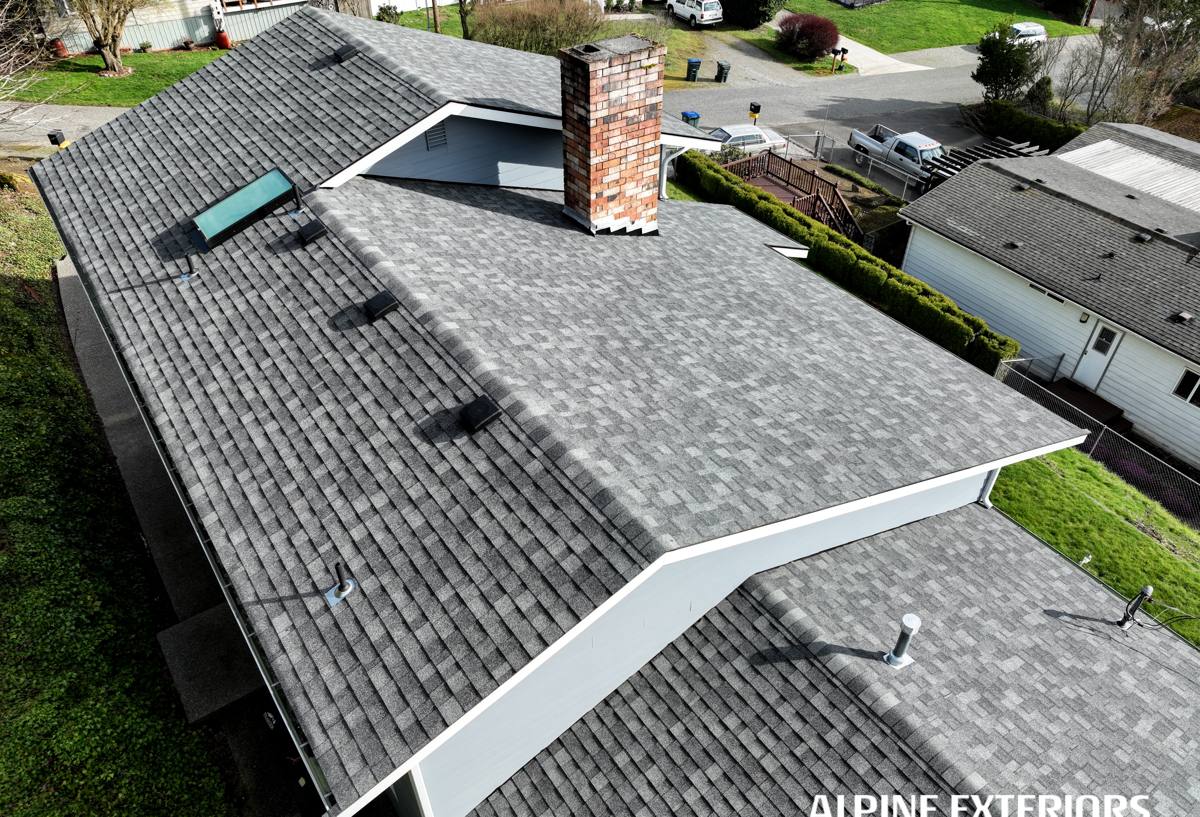
Signs a Bellingham Roof Needs Replacement, Not Another Repair
Repairs make sense when the damage is localized and the roof underneath is still sound. Replacement becomes the honest recommendation once the underlying materials are compromised or the roof is old enough that repeated patching stops being cost-effective. Common signs we look for on inspections in this area:
- Granule loss heavy enough that you can see bare, shiny patches on shingles from the ground
- Shingles that are curling, cupping, or cracking at the edges rather than lying flat
- Moss mats thick enough that brushing them off leaves the shingle surface damaged underneath
- Soft spots or spongy give when walking the roof deck, which usually means the sheathing underneath is wet or rotted
- Daylight or damp insulation visible in the attic, especially near valleys or chimney penetrations
- Repeated leaks at the same flashing point despite prior repairs
- A roof that's reached or passed the manufacturer's expected service life for its material and exposure
If you're only seeing one or two of these and the roof is otherwise young, a targeted repair is usually the right call — we'll tell you that directly rather than push a full replacement you don't need yet.
What a Correct Roof Replacement Involves Here
Full Tear-Off, Not an Overlay
Overlaying new shingles on top of old ones is sometimes offered as a cheaper shortcut, but it skips the one step that matters most in this climate: inspecting the decking underneath for moisture damage. Given how much of Whatcom County's roof damage originates as slow water intrusion rather than sudden storm damage, we tear off down to the deck on every replacement so any rotted or soft sheathing gets found and replaced, not buried under a second layer.
Underlayment and Ice-and-Water Membrane
A synthetic underlayment (or a high-quality felt, depending on the system) goes down across the full deck, with self-adhering ice-and-water shield membrane at the eaves, valleys, and around every penetration — chimneys, vents, skylights. Valleys and eaves are where driving rain and ponding water find their way under standard felt, so this is not a spot to skimp on.
Flashing Done as Metal Work, Not Caulk
Step flashing at walls and chimneys, proper counter-flashing, and correctly lapped valley metal are what actually keep water out over the long term. Caulk and roofing cement have their place as sealants, but they're not a substitute for flashing installed in the correct shingle-over-metal sequence, and salt air will degrade an exposed caulk-only seal faster than it will properly lapped metal.
Balanced Ventilation
Intake at the soffits and exhaust at the ridge need to be sized to actually balance, not just present. Too little ventilation traps humid air from the marine climate against the underside of the deck, which accelerates rot and mold. Ventilation is one of the most commonly under-specified parts of a reroof, and it's invisible until it fails.
Moss and Algae Resistance
Given how long the moss season runs here, we typically recommend shingles with algae-resistant granules and, where the budget allows, zinc or copper strip accessories near the ridge that release trace metal ions with rainfall to slow moss regrowth across the field of the roof.
Material Options for a Coastal Whatcom County Roof
There's no single "correct" material for every home — it depends on the roof's pitch, the home's style, and how much long-term maintenance the owner wants to take on. Here's an honest comparison of the three options we install most often in this area:
| Material | Typical Lifespan | Moss/Algae Resistance | Salt-Air Durability | Ongoing Maintenance |
|---|---|---|---|---|
| Architectural asphalt shingle | 25–30+ years | Good with algae-resistant granules | Good; fasteners and flashing are the weak point | Low to moderate |
| Standing-seam metal | 40–50+ years | Excellent; sheds moss more easily | Very good with proper coated fasteners and finish | Low |
| Cedar shake | 20–30 years, condition-dependent | Requires active upkeep to control moss | Moderate; needs periodic treatment | High |
We're happy to install cedar shake for homeowners who want the look and are committed to the maintenance schedule it needs, but we're upfront that in a climate with this much moss pressure, shake demands more regular attention than asphalt or metal to look and perform the way it's meant to. That's a maintenance and moisture-behavior trade-off, not a defect in the product — it's simply what a natural wood roofing material needs in a wet coastal environment.
Our Process, Start to Finish
- Free on-site inspection — we walk the roof and attic, check decking condition, flashing, and ventilation, and take photos of anything you can't easily see yourself.
- Written scope and material options — a clear estimate showing what's being replaced, which materials fit your home and budget, and why.
- Permitting — full reroofs typically require a building permit; we handle that filing so nothing holds up the job later.
- Tear-off and deck repair — old roofing comes off, decking gets inspected, and any damaged sheathing is replaced before anything new goes down.
- Underlayment, flashing, and ventilation — the parts of the job that don't show once it's finished but determine how long it lasts.
- New roofing installed — to manufacturer spec, with attention to nailing pattern and exposure, which matter more for wind and rain performance than most homeowners realize.
- Cleanup and magnetic sweep — yard and driveway cleared of debris and stray fasteners before we call the job done.
- Final walkthrough — we go over the finished roof with you and explain what to watch for going forward.
Why a Crew That Already Works Bellingham Matters
A roof replacement is only as good as the details that don't show up in a photo — flashing sequencing, ventilation balance, how the underlayment is lapped at the valleys. A crew that works Whatcom County regularly has already made the adjustments that matter here: sequencing tear-off around rain windows instead of leaving a deck exposed overnight, knowing the local permitting process instead of learning it on your job, and having supplier relationships that keep material lead times predictable. Just as important, we're not a traveling crew that finishes the job and leaves town — if a question comes up under warranty, we're the same local operation you can reach.
Keeping the Roof Performing After Installation
A correctly installed roof still needs some ongoing attention in this climate, and it's minor compared to the cost of a premature replacement:
- Have moss treated (soft wash, not pressure washing) before it builds up into thick mats
- Clear gutters before the fall rains start, since Whatcom County's wet season arrives early and stays late
- Trim back overhanging branches that keep sections of the roof shaded and damp longer than the rest
- Have flashing and roof penetrations checked yearly, ideally at the same time as gutter cleaning
Cost Factors to Understand Before You Get Quotes
We don't post specific prices because an honest number depends on an actual inspection, but the factors that move the estimate up or down are consistent from job to job:
| Factor | Effect on Cost |
|---|---|
| Roof size and number of facets/valleys | More area and more valleys mean more material and labor |
| Pitch and accessibility | Steep or hard-to-access roofs take longer and need more safety setup |
| Material chosen | Asphalt is typically the most budget-friendly; metal and cedar cost more upfront |
| Decking condition | Rotted sheathing found during tear-off adds material and labor to replace it |
| Number of existing layers | Tearing off two layers of old shingles takes longer than one |
Any estimate we give breaks these out so you can see exactly what you're paying for, not just a lump-sum number.
Permits and Timing in Whatcom County
A full roof replacement in Bellingham typically requires a building permit, and we handle that filing as part of the job rather than leaving it to the homeowner. On timing: the drier summer stretch is the easiest window for reroofing, but it's not the only one — we work through most of the year by planning tear-off days around forecasted dry windows. If you're noticing signs of wear now, it's worth getting on the schedule before the fall rains arrive rather than waiting until a leak forces the decision.
If you're weighing repair versus replacement, or just want an honest read on how much life is left in your roof, we're glad to come take a look. The estimate is free, there's no pressure attached to it, and you can use the form below to get started.