 Blaine Siding
 Why Lynden Homes Need a Different Siding Strategy Than the National Average
Lynden sits far enough inland from the Salish Sea to feel less "coastal" than Blaine or Birch Bay, but the difference is smaller than most homeowners assume. Marine air still moves up the Nooksack valley, driving rain still arrives sideways off Pacific systems most of the fall and winter, and the combination of shade, moisture, and mild temperatures that defines Whatcom County gives moss and algae a long, comfortable growing season on north- and west-facing walls. Add in the agricultural dust and occasional field burning common around Lynden, and you have a siding environment that rewards a dense, stable, factory-finished material and punishes anything porous or dimensionally unstable.
This isn't a page about siding in general. It's about what fiber cement specifically needs to do on a Lynden house, what a correct installation looks like in this climate, and why the crew you hire matters as much as the product you choose.
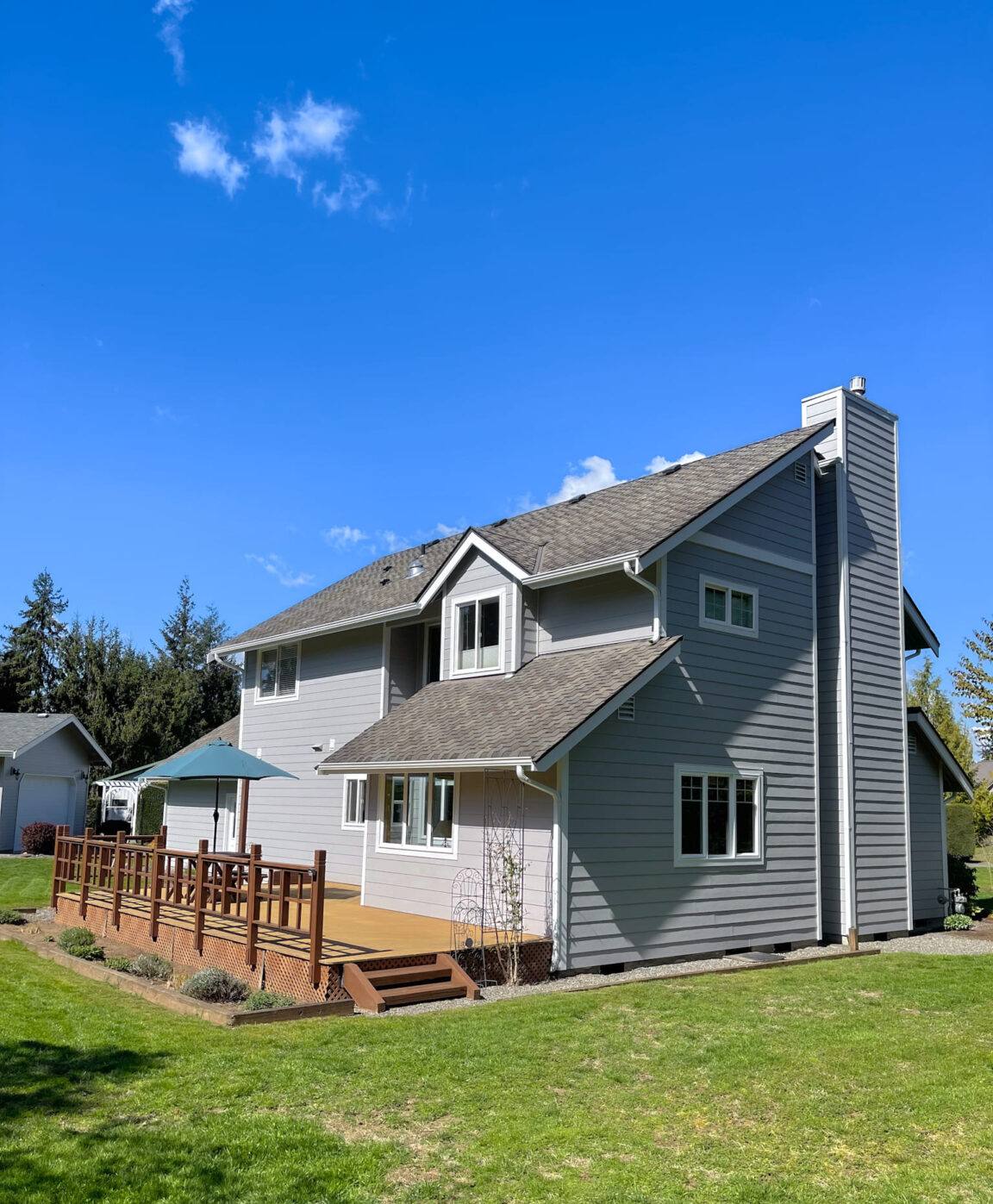
What Lynden's Climate Actually Does to Siding
Moisture load, not just rainfall totals
Whatcom County doesn't get the heaviest rainfall in Washington, but it gets a lot of low-intensity, long-duration wet weather — the kind that keeps wall surfaces damp for days at a stretch rather than a hard downpour that runs off fast. That matters more than total inches. Materials that absorb water and hold it (bare wood, some engineered wood products) stay wet longer here than they would in a climate with the same rainfall but faster drying cycles.
Moss and algae season is most of the year
Shaded elevations, mature landscaping, and the valley's humidity give moss and algae roughly nine months of viable growing conditions. Any siding that provides organic material for spores to root in — or a surface texture that traps moisture — will show green and black staining faster here than in a drier region.
Freeze-thaw cycling, though modest, still matters
Lynden sees more frost events than the immediate coastline. Materials that swell with moisture and then freeze are more prone to cracking and joint failure over years of cycling, even when the freezes themselves are short and mild.
Why Fiber Cement Is the Right Call Here — and Why It Has to Be Hardie
Fiber cement as a category solves the core problem: it's dimensionally stable, doesn't feed mold or moss the way wood-based products can, and holds paint or factory finish far longer than wood siding in a wet climate. That's why we install it as our primary product across Whatcom County.
But "fiber cement" isn't one product — formulation and manufacturing quality vary between brands, and in a climate this demanding, those differences show up faster than they would somewhere dry. We install James Hardie exclusively, for a few specific reasons that matter in Lynden:
- HZ5 engineering for the Pacific Northwest — Hardie's HZ10 climate zone product line is engineered for freeze-thaw and high-moisture regions like ours, rather than a one-size-fits-all formulation.
- ColorPlus factory finish — baked-on finish that resists fading and moisture intrusion at the surface far better than field-applied paint, which matters when a wall stays damp for days at a time.
- Non-combustible core — a real advantage during dry-season wildfire smoke events that affect this region, and it doesn't provide the organic material some products do for moss to anchor into.
- A warranty structure with a real track record — Hardie's transferable warranty is backed by decades of manufacturing history, not a newer product still building its field record.
We don't install LP SmartSide, vinyl, or other fiber cement brands. That's not a knock on every use case for those products — it's a standard we set because we're not willing to put our name on a wall in this climate with a product we don't have full confidence in over a 30-year horizon.
What a Correct Fiber Cement Job Looks Like on a Lynden House
Everything starts behind the siding
Fiber cement is only as good as the water-resistive barrier and flashing details underneath it. On Lynden homes we pay particular attention to:
- A continuous, properly lapped weather-resistive barrier with all seams taped
- Correct window and door flashing, integrated with the barrier — not just caulked
- Rainscreen or furring strips where wall orientation and shading create prolonged damp conditions, allowing the wall to dry rather than trap moisture behind the cladding
- Proper kick-out flashing at roof-to-wall intersections, a detail that's frequently missed and a leading cause of hidden rot
Installation details that matter in this climate specifically
- Clearance and gaps — Hardie specifies minimum clearances from grade, roofing, and decks; we hold those clearances even when it means adjusting trim details, because ground moisture and splash-back are real issues on Lynden lots with heavier landscaping or lower grade lines.
- Fastener pattern and type — corrosion-resistant fasteners driven to Hardie's specification, not just "close enough," since salt-influenced air corrodes standard fasteners faster here than inland climates.
- Caulking and sealant at penetrations — every penetration point is a potential moisture entry; we treat sealant as a backup to good flashing, not a substitute for it.
- Field-cut edge sealing — any cut edge of Hardie board gets sealed per manufacturer spec so the factory finish's moisture protection isn't compromised at the cuts.
Fiber Cement vs. Other Siding Options for Lynden Conditions
| Factor | James Hardie Fiber Cement | Vinyl | Untreated Wood / Primed Spruce |
|---|---|---|---|
| Moisture absorption | Very low; won't swell or rot | Doesn't absorb, but seams and warping trap water behind panels | High; prone to swelling, cupping, rot in extended damp |
| Moss/algae resistance | Factory finish sheds growth better; no organic material to root in | Smooth surface, but seams and J-channels collect debris and moisture | Grain and porosity give moss and algae an easy foothold |
| Finish longevity | ColorPlus factory finish, long fade resistance | Color molded through material but can chalk and fade over decades | Requires repainting/restaining every few years to hold up |
| Freeze-thaw stability | Dimensionally stable, engineered HZ line for this climate | Can become brittle and crack in cold snaps | Swells and contracts with moisture cycling, stressing joints |
| Fire resistance | Non-combustible core | Combustible; can melt or deform near heat sources | Combustible |
What a Lynden Fiber Cement Project Costs — And What Drives the Number
Every fiber cement project on a real house is priced from measurements and site conditions, not a flat rate — but a few factors consistently move the number more than others in this area:
- Existing wall condition — if there's rot or moisture damage behind the current siding (more common on shaded, north-facing walls here), sheathing repair adds cost but shouldn't be skipped.
- Trim and detail complexity — homes with a lot of window trim, dormers, or architectural detail take longer to flash and finish correctly than a simple rectangular wall.
- Siding profile and reveal — lap siding, board-and-batten, and panel systems all install differently and price differently.
- Access and lot conditions — mature landscaping, fencing, or tight setbacks common on Lynden properties can add labor time.
- Rainscreen installation — adding a drainage gap behind the siding is an upgrade we often recommend here given the moisture load, and it adds material and labor cost.
We'll walk your specific house and give you a real number, not a range pulled from a website.
Why Hiring a Crew That Already Works Lynden Matters
Installation quality is the single biggest variable in how long fiber cement siding actually performs — more than the product itself. A crew that already works Whatcom County knows:
- Which wall orientations on a typical Lynden lot need extra moisture management, based on shading, prevailing wind, and drainage patterns common to the area
- How local permitting and inspection processes actually run, so a project doesn't stall waiting on paperwork
- What clearance and flashing details actually get missed by crews unfamiliar with this specific rain-and-moss environment
- How to sequence a project around the wetter months so open wall sections aren't exposed longer than necessary
A crew that's installed dozens of jobs in this specific climate isn't guessing at what "should" work here — they've already seen what does and doesn't hold up.
A Simple Pre-Project Checklist for Lynden Homeowners
- Ask what's happening behind the new siding — barrier, flashing, and rainscreen details — not just what product goes on the outside
- Confirm the crew is installing to James Hardie's written specifications, not a generalized "fiber cement" approach
- Have any existing moisture or rot issues identified and addressed before new siding goes on, not covered up
- Ask about fastener type and corrosion resistance, especially if your home has any west or north wall exposure with limited sun
- Get manufacturer warranty registration in writing as part of the project close-out
Get a Straight Answer for Your House
If you're weighing a siding replacement in Lynden, we're glad to come look at the actual walls, actual exposure, and actual condition of your home before recommending anything. There's no pressure and no generic sales pitch — just an honest assessment and a real estimate for James Hardie fiber cement done right for this climate. Fill out the form below to schedule a free estimate.