 Blaine Siding
 Why Lynden's Weather Is Hard on a Roof
Lynden sits inland from Blaine in the Nooksack River valley, but it doesn't escape the same weather patterns that shape roofing decisions across Whatcom County. Marine air moves inland off the Strait of Georgia and Puget Sound for much of the year, carrying enough salt-laden moisture to accelerate corrosion on unprotected metal, fasteners, and flashing — even this far from the water. Add driving rain that comes in sideways during fall and winter storms, heavy tree cover around many Lynden properties, and a moss season that can run eight months or longer in shaded, north-facing areas, and you have a climate that punishes a roof installed with shortcuts.
None of this makes metal roofing a bad fit for Lynden — quite the opposite. Metal sheds moss and standing water better than most other materials when it's installed correctly. The issue is that "installed correctly" means something specific in this climate, and it's not the same spec you'd use in a drier part of the state.
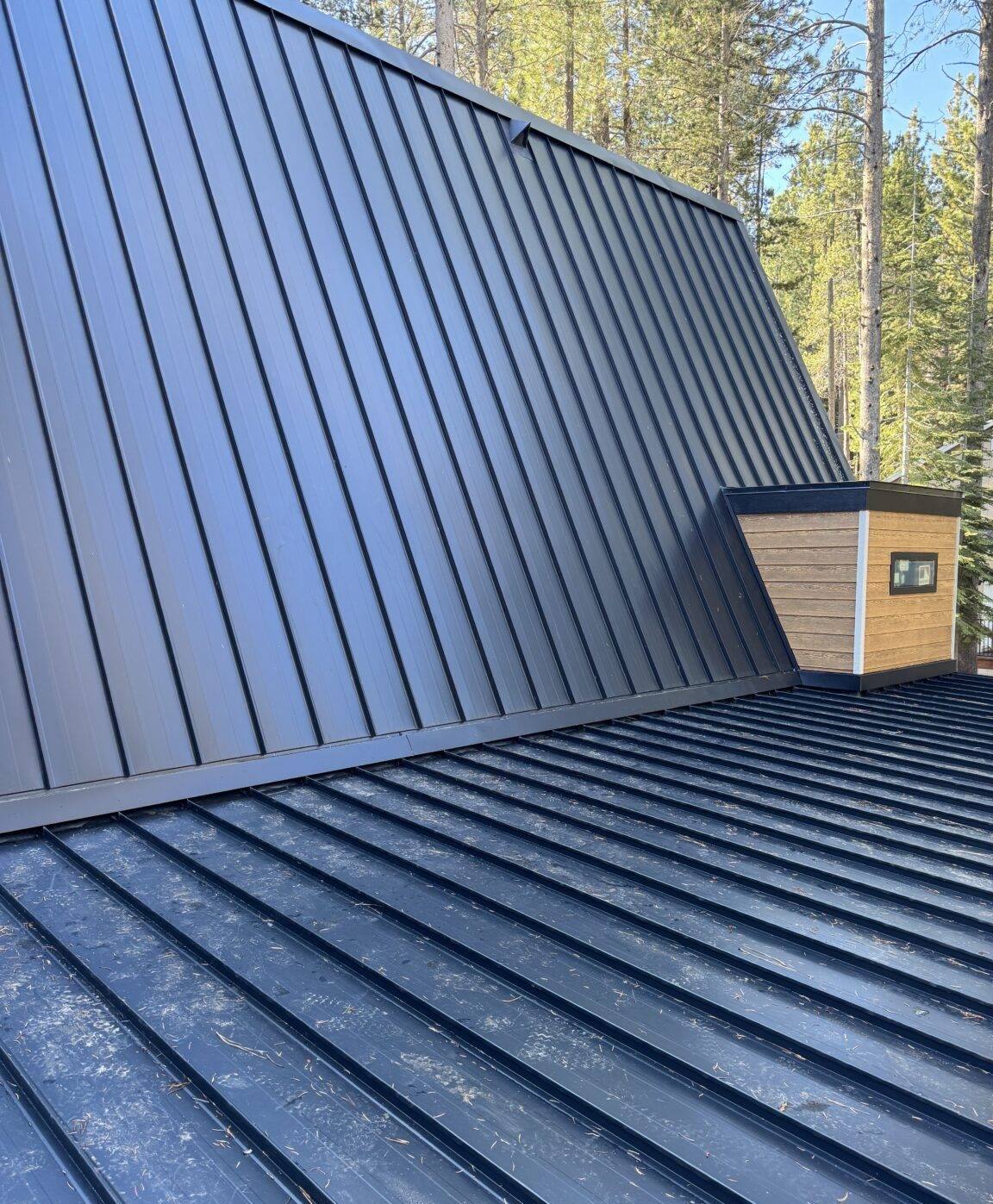
What a Correct Metal Roof Needs to Do Here
A metal roof in Lynden has three jobs beyond looking good: shed driving rain without letting it work backward under laps and flashing, resist corrosion from salt-tinged moisture over decades, and stay clean enough that moss and organic debris don't trap water against the panels. Getting all three right comes down to details that are easy to skip and expensive to fix later.
Fasteners and Corrosion Resistance
Exposed-fastener panels live or die by their screws. We use fasteners matched to the panel's metal to avoid galvanic corrosion, with EPDM-washered heads rated for the coastal-influenced moisture this region sees. Mismatched or bargain fasteners are one of the most common causes of early leaks we find when we're called out to repair someone else's install — the panel itself is usually fine, but the screws have failed years ahead of schedule.
Underlayment and Moisture Barrier
Because driving rain can push water uphill under panel laps during a hard blow, we install a synthetic underlayment rated for high wind-driven moisture exposure, not a basic felt product. In vulnerable zones — eaves, valleys, low-slope transitions — we add self-adhered membrane as a secondary barrier so the deck stays dry even if wind-driven rain gets past the panel seams.
Flashing at Valleys, Chimneys, and Penetrations
Flashing is where most metal roof failures actually start, not in the field of the panels. Valleys need to be sized for real Whatcom County rainfall volume, not a minimum-code width. Chimneys, vent stacks, and skylight curbs need step flashing and counterflashing sequenced correctly with the underlayment, not just caulked over — caulk is a maintenance item, not a waterproofing strategy, and it fails years before the metal does.
Panel Types and Finishes: What We Recommend for This Area
Not every metal roofing product performs the same way under Lynden's conditions. We steer most homeowners toward standing seam or high-quality exposed-fastener panels with a corrosion-resistant coating system, and we're upfront about the trade-offs of each.
| Panel Type | Best For | Trade-Offs in This Climate |
|---|---|---|
| Standing seam (concealed fastener) | Long-term, low-maintenance roofs; homes with steady moss/debris exposure | Higher upfront cost; requires more precise installation labor |
| Exposed-fastener panel (quality grade) | Outbuildings, additions, budget-conscious full replacements | Fasteners need periodic inspection and eventual re-torquing or replacement |
| Corrugated/lightweight panel | Sheds, agricultural structures common around Lynden properties | Not typically recommended for primary residential roofs in high-moss areas |
Finish matters as much as panel style. A baked-on paint system (Kynar/PVDF-class coatings) holds up far better against the region's marine air and UV cycling than a basic painted finish, and it resists chalking and fading over the long haul. We don't install bare or minimally coated metal on residential roofs here — the maintenance burden it creates isn't worth what it saves upfront.
Moss and Debris: A Year-Round Concern
Lynden's mix of mature trees, moisture, and mild temperatures gives moss and algae a long growing season. On asphalt shingles, moss roots into the granule surface and lifts it over time. Metal doesn't give moss anything to root into, which is a real advantage — but debris still matters. Needles, leaves, and moss spores that collect in valleys, at panel laps, and against snow guards or trim can hold moisture against the surface long enough to stain the finish and, over years, stress the coating at those contact points.
We design panel layouts and valley details to minimize debris traps where we can, and we're honest with homeowners about the areas — usually shaded, low-slope sections — that will need occasional clearing regardless of roofing material.
Ventilation and Condensation
A cold-climate marine environment like this creates a specific risk: warm, moist interior air meeting a cold metal roof deck from underneath. Without adequate ridge and soffit ventilation, that mismatch condenses inside the attic, soaking insulation and rotting sheathing from the inside — a problem that has nothing to do with the roofing material and everything to do with airflow design. Every metal roof installation we do includes a ventilation check, and we address intake and exhaust balance before the first panel goes down, not after a homeowner reports a musty attic two winters later.
Our Installation Process
- Assessment and measurement — we inspect the existing roof, deck condition, ventilation, and flashing details, and measure for an accurate material takeoff.
- Tear-off and deck inspection — old roofing comes off down to the deck so we can check for rot, soft spots, or prior water damage before anything new goes on.
- Underlayment and ice/water barrier — high-wind-rated synthetic underlayment across the field, with self-adhered membrane at eaves, valleys, and penetrations.
- Panel installation — panels are set, seamed or fastened per the manufacturer's spec, with attention to expansion allowance so panels can move with temperature swings without buckling.
- Flashing and trim — valleys, step flashing, counterflashing, and edge trim installed in the correct sequence with the underlayment, not layered on top as an afterthought.
- Final walk-through — we review the finished roof with the homeowner, point out any maintenance areas specific to the property, and confirm everything meets our own standard before we call it done.
What It Costs and What Drives the Price
Metal roofing costs more upfront than asphalt shingles, and the final number on any given Lynden home depends on a handful of factors more than on the base price per square.
| Cost Factor | Why It Matters |
|---|---|
| Roof complexity (valleys, dormers, penetrations) | More flashing detail work means more labor hours per square |
| Panel type and finish quality | Standing seam and premium coatings cost more than basic exposed-fastener panels |
| Deck condition | Rot or soft sheathing found at tear-off adds repair cost before installation can proceed |
| Existing ventilation | Adding or correcting ridge/soffit ventilation is often bundled into a reroof |
| Roof pitch and access | Steep or hard-to-access roofs take longer and require more safety setup |
What you get in return is a roof that, installed correctly, can outlast two or three asphalt roof cycles with far less maintenance — a trade-off that makes sense for a lot of homeowners planning to stay put in Lynden long-term.
Maintenance Checklist for Homeowners
Metal roofing is low-maintenance, not zero-maintenance. A short annual routine keeps a well-installed roof performing for decades:
- Clear needles, leaves, and moss debris from valleys and low-slope sections once or twice a year, especially after fall leaf-drop
- Check that gutters and downspouts are flowing freely so water isn't backing up under the eave edge
- Look for any lifted or loosened trim after major windstorms
- Watch for streaking or dark staining, which usually signals trapped organic debris rather than a material defect
- Have fastener-style panels inspected periodically for backed-out or corroding screws
- Confirm attic ventilation isn't blocked by insulation, stored items, or pest nests
Why a Crew That Already Works Lynden Matters
Metal roofing done wrong doesn't usually fail in year one — it fails in year eight or ten, after the fasteners have been quietly corroding or the flashing detail has been letting a slow trickle of water into the deck. A crew that works this specific area regularly knows which valley details need the extra membrane, how much ventilation a typical Lynden attic actually needs given the tree cover and humidity, and which finish holds up against the marine air moving through Whatcom County rather than just looking good on a spec sheet. That local pattern recognition is the difference between a roof that needs attention in a decade and one that quietly does its job for forty years.
If you're weighing metal roofing for a home in Lynden, we're glad to take a look and talk through what your specific roof needs — no pressure, no hard sell. Fill out the form below for a free estimate.