 Blaine Siding
 Siding Repair Built for Lynden's Weather, Not a Generic Climate
Homes around Lynden sit in a stretch of Whatcom County that gets hit from more than one direction. Inland toward the Nooksack valley, you're dealing with long stretches of steady, driving rain and heavy fall-through-spring humidity that keeps siding damp for days at a time. Closer to the water toward Blaine and the Salish Sea, salt-laden air adds another layer of wear — accelerating corrosion on fasteners and trim, and breaking down finishes faster than inland exposure alone would. Add a moss season that can run eight months or longer on north-facing walls and shaded elevations, and you've got a climate that punishes siding in three separate ways at once: moisture intrusion, surface staining and biological growth, and slow material fatigue.
Siding repair here isn't a one-size-fits-all patch job. A fix that holds up on a dry-side Eastern Washington home won't necessarily hold up on a Lynden property that gets soaked, dries slowly, and grows moss in the gaps. The repair has to account for how water actually moves on this specific wall, in this specific climate, not just cover the visible damage.
What Makes Whatcom County Repairs Different
- Extended wet season means water has more opportunities to find its way behind loose or damaged siding before anyone notices.
- Moss and algae hold moisture against the surface far longer than bare siding would dry on its own.
- Coastal and near-coastal air accelerates fastener corrosion, which is often the real cause of a "siding problem" that looks cosmetic at first glance.
- Temperature swings between damp mornings and warmer afternoons stress caulking and seams over time, opening small gaps that grow into bigger ones.
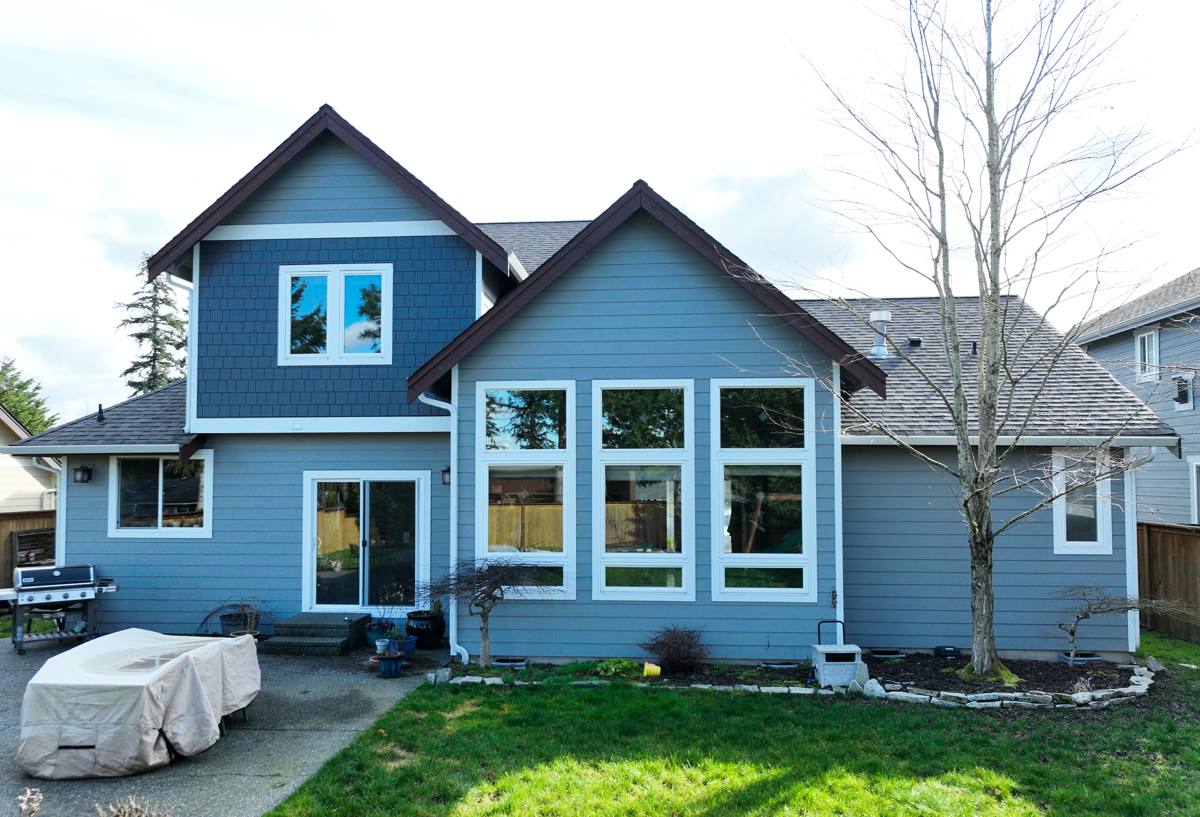
Signs a Lynden-Area Home Needs Siding Repair
Most siding repair calls we get start with something small the homeowner noticed months earlier and figured could wait. In this climate, waiting usually costs more, because moisture problems compound quietly behind the surface long before they show up as visible damage.
- Soft or spongy spots when you press on the siding, especially near the bottom courses or around windows and doors
- Persistent dark streaking or green-black growth that comes back within weeks of cleaning
- Cracked, chipped, or delaminating panels, particularly on the north and west elevations that see the least sun
- Gaps or separation at seams, corners, or trim boards where caulking has failed
- Peeling or bubbling paint, which often signals moisture trying to escape from behind the panel
- Visible rust streaks below fasteners or trim hardware
- Warping or bowing panels, a sign that moisture has already been absorbed into the material
- Musty smell or interior wall discoloration on the corresponding indoor wall
What a Correct Repair Actually Involves
A proper siding repair is not just swapping the damaged piece for a new one and moving on. Done right, it addresses why that section failed in the first place — otherwise you're just buying time before the same spot fails again.
Diagnosing the Cause, Not Just the Symptom
Before any siding comes off, the damaged area and everything around it gets inspected: the house wrap or weather-resistant barrier underneath, the flashing at windows, doors, and roof lines, and the condition of the sheathing itself. If water has been getting behind the siding, the siding is rarely the only thing that needs attention.
Matching Materials and Method
Repairs need to match the existing siding's profile, reveal, and finish closely enough that the patch doesn't stand out — and they need to use fastening and flashing details that actually shed water in this climate, not just look sealed. A repair that traps moisture behind it is worse than no repair at all.
Addressing Moss and Biological Growth at the Source
Cleaning off moss without correcting the shade, airflow, or drainage conditions that let it take hold usually means it's back within a season. Where possible, we look at whether trim, gutters, or nearby vegetation are contributing to a wall staying damp longer than it should.
Repair vs. Replacement: How We Help You Decide
Not every damaged section needs a full re-side, and not every repair call should end with just a repair. Here's how we weigh it on a Lynden-area home.
| Factor | Leans Toward Repair | Leans Toward Replacement |
|---|---|---|
| Extent of damage | Isolated to one or two sections or elevations | Spread across multiple walls or recurring in the same spots |
| Underlying sheathing | Dry, solid, no rot found on inspection | Soft, delaminated, or rotted sheathing found |
| Siding material and age | Newer material still under warranty, good overall condition | Original material near or past its service life |
| Moisture history | Single identifiable cause, now corrected | Chronic moisture intrusion with no clear single source |
| Cosmetic match | Repair section will blend acceptably | Existing siding is discontinued or too weathered to match |
We'll always tell you honestly which side of that line your home falls on. If a repair will genuinely hold up, that's what we recommend — a repair that's likely to fail again in two years isn't a service worth selling.
Why We Only Repair and Patch With James Hardie Fiber Cement
When a repair calls for new material — a full panel replacement on a damaged section, or matching an addition to existing siding — we use James Hardie fiber cement exclusively. We don't install or patch with vinyl, LP SmartSide, Cemplank, Allura, or primed wood products, and in a climate like this one, the reasoning is practical, not brand loyalty.
Fiber cement doesn't absorb water the way engineered wood siding can, which matters directly in a climate with this much sustained moisture exposure. It's non-combustible, holds paint and factory finish far longer than vinyl, and James Hardie's HZ product lines are engineered specifically for climate zones like the Pacific Northwest's — accounting for the freeze-thaw cycles, rain volume, and humidity that this region deals with every year. The ColorPlus factory finish also resists the fading and chalking that shows up faster on field-painted or lower-grade products exposed to this much UV and moisture cycling.
That consistency matters most on a repair job, where a patch that behaves differently than the surrounding siding — expanding, contracting, or absorbing moisture at a different rate — will telegraph itself over time as a visible seam, a color mismatch, or a recurring failure point. Using one material system throughout also keeps the warranty picture simple, which matters if you ever need to make a claim.
Our Repair Process for Lynden-Area Homes
- Inspection and diagnosis — We look at the damaged siding, the surrounding sections, flashing, and where accessible, the underlying barrier and sheathing.
- Honest scope recommendation — You get a clear explanation of what's causing the damage and whether repair or replacement is the right call, in plain terms.
- Material matching — For repairs using new material, we match profile, reveal, and finish as closely as the existing James Hardie product line allows.
- Correct installation — Proper flashing, fastening, and sealing details suited to this region's rain and moisture load, not just a cosmetic patch.
- Cleanup and walkthrough — We show you the completed work and explain what to watch for going forward.
Why Hiring a Crew That Already Works This Area Matters
Siding repair mistakes in this climate usually aren't visible for months. A patch that looks fine in August can fail by the following winter if it wasn't flashed correctly for how water moves on a wall that sees this much sustained rain. A crew that regularly works Whatcom County homes has already seen how moss, salt-influenced air, and long wet seasons interact with different siding systems here — that's not something you can substitute with general contracting experience from a drier region.
Local familiarity also means a faster, more accurate diagnosis. We're not guessing at what "normal wear" looks like for a Lynden-area home versus what's an actual moisture problem — we see enough of these homes to know the difference quickly.
After the Repair: Keeping It From Happening Again
- Rinse siding periodically to keep moss and algae from establishing, especially on shaded north-facing walls
- Keep gutters clear so water isn't overflowing directly onto siding below
- Trim back vegetation and tree cover that keeps a wall section shaded and damp longer than the rest of the house
- Check caulking at trim, windows, and corners annually — small gaps are cheap to reseal and expensive to ignore
- Watch the same problem areas the year after a repair, since a spot that failed once is worth a second look
If you're seeing early signs of trouble on a Lynden-area home, or you've already got a section that needs attention, we're happy to take a look and give you a straight answer on what it needs. Reach out for a free, no-pressure estimate — there's a short form below to get started.