 Blaine Siding
 Ferndale's Climate Is Harder on Roofs Than It Looks
Ferndale sits close enough to the water and low enough in tree cover that its roofs deal with a combination most inland homes never see: salt-laden air drifting off the Salish Sea, long stretches of driving rain, and a moss season that can run most of the year in shaded, north-facing sections of a roof. None of these are dramatic on their own. Together, over years, they wear down asphalt shingles faster than the manufacturer's warranty chart suggests they should.
A roof that would hold up fine in a dry, inland climate can start showing granule loss, moss mats, and soft decking years ahead of schedule here in Whatcom County if it wasn't installed with this specific climate in mind. That's the difference between a roofing job that looks right on installation day and one that's still doing its job in year fifteen.
Salt Air
Airborne salt doesn't rot asphalt shingles the way it corrodes metal, but it does accelerate the breakdown of exposed fasteners, flashing, and any unprotected metal components on the roof — ridge vents, drip edge, pipe boots with metal collars. Over time, corroded flashing is one of the more common causes of slow, hard-to-find leaks we get called out for.
Driving Rain
Wind-driven rain off the water doesn't just fall straight down — it pushes sideways and up under shingle tabs, valleys, and flashing laps. A roof detailed for calm, straight-down rain will eventually leak here. Every lap, nail pattern, and flashing detail has to account for wind-driven moisture, not just gravity.
Moss Season
Shaded roof sections, especially north- and east-facing slopes under fir and cedar cover, stay damp long after the rest of the roof has dried out. That constant moisture is exactly what moss needs to establish. Once moss gets a foothold, it lifts shingle edges, holds water against the roof deck, and speeds up granule loss in the areas around it.
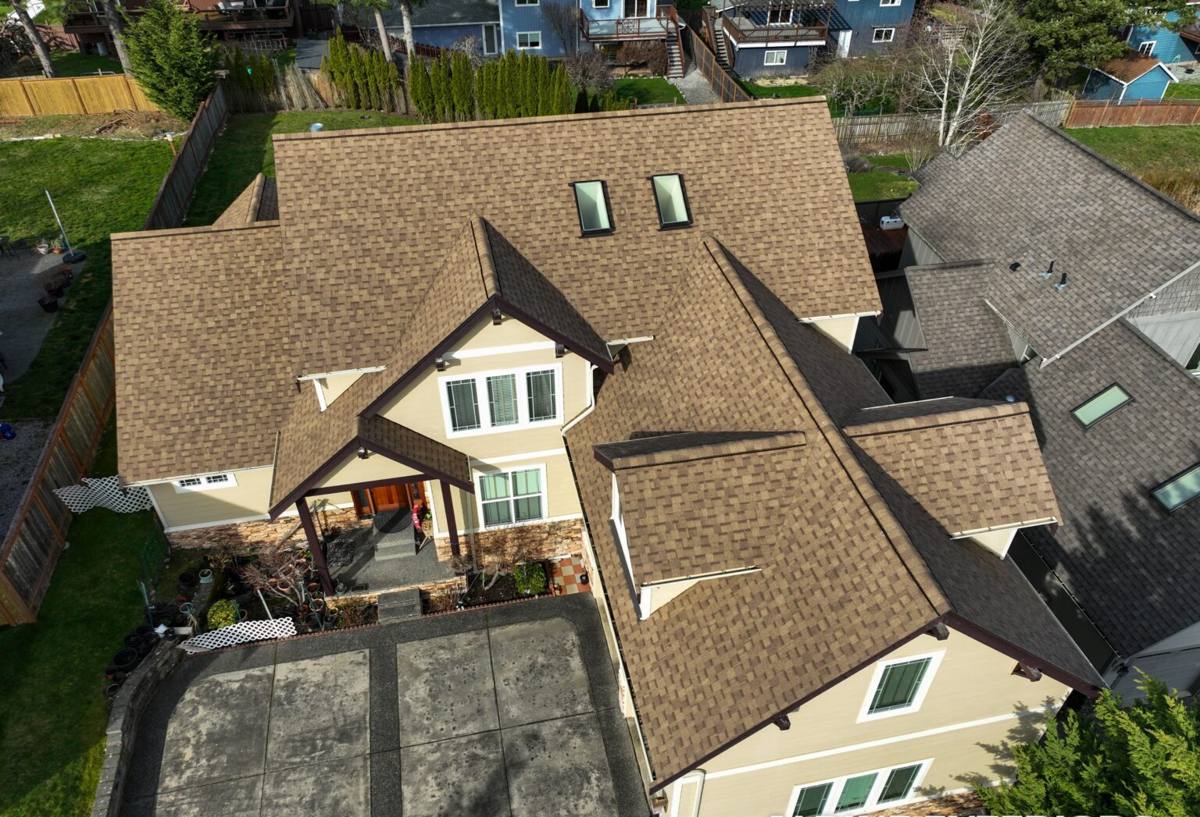
What a Correct Asphalt Shingle Roof Needs Here
"Correct" for a Ferndale roof isn't the same as "correct" for a dry-climate roof three states away. A few details matter more here than the average shingle installation guide will emphasize:
- Algae-resistant shingles with copper- or zinc-infused granules to slow the blue-green algae staining that's common in wet, mild coastal climates.
- Ice-and-water barrier at eaves, valleys, and around penetrations — not just where code requires it, but anywhere wind-driven rain is likely to get pushed uphill under the shingles.
- Corrosion-resistant flashing and fasteners rated for coastal or high-moisture exposure, so salt air doesn't shorten the life of the metal components faster than the shingles themselves.
- Balanced attic ventilation so moisture from inside the house isn't adding to what the climate is already putting on the roof from outside.
- Proper valley and flashing detail sized for sustained rain volume, not just occasional showers.
Skip any one of these and the roof will likely still pass a casual look on installation day. The gaps show up two, five, or ten years later — usually as a leak, a moss mat, or premature granule loss in exactly the spots this climate is hardest on.
Signs a Ferndale Roof Needs Attention
Most asphalt shingle roofs don't fail all at once. They give warning signs first, and in this climate those signs tend to show up in predictable places — valleys, north-facing slopes, and anywhere gutters back up.
- Moss growing in patches or streaks, especially on shaded slopes
- Dark streaking or staining that doesn't wash off with rain (algae growth)
- Granules collecting in gutters or at downspout outlets
- Shingle edges curling, cupping, or lifting
- Soft or spongy spots when walked on (a sign of deck damage underneath)
- Visible daylight or water stains in the attic near the roof deck
- Rusted or lifted flashing around chimneys, vents, or skylights
- Missing or displaced shingles after a windstorm
Any one of these on its own may not mean an urgent problem. Several together, or any sign paired with an active leak, is worth a professional look before the next heavy rain event.
Our Asphalt Shingle Roofing Process
The steps below aren't unique to us as a concept — they're the standard order of operations for a correctly installed shingle roof. What matters is how carefully each step is executed, especially the parts that are invisible once the roof is finished.
1. Inspection and Assessment
We start by getting on the roof, not just looking at it from the ground. That means checking the deck condition, existing ventilation, flashing details, and how many layers of shingles are already there. We also look at how the roof's slopes are oriented — which sections get shade and moisture longest — since that tells us where moss and algae resistance matters most.
2. Tear-Off and Deck Preparation
Old shingles come off down to the deck. This is the point where hidden problems — soft plywood, old leaks, prior repair patches — get found and fixed rather than covered over. Roofing over a compromised deck is one of the more common shortcuts that leads to early failure, and it's not something we do.
3. Underlayment, Flashing, and Ice-and-Water Barrier
This layer does more of the actual waterproofing work than the shingles themselves. We install synthetic underlayment across the field, ice-and-water barrier at eaves and valleys, and new flashing at every roof-to-wall transition, chimney, and penetration. Given how much wind-driven rain this area sees, this step gets extra attention at valleys and low-slope transitions where water is most likely to be pushed sideways or backward under the shingles.
4. Shingle Installation
Shingles go down with the nailing pattern and exposure spacing the manufacturer specifies for wind resistance — not a faster, looser pattern that saves time but voids the wind warranty. Starter strips and hip/ridge caps are installed to match, since a roof is only as wind-resistant as its weakest edge.
5. Ventilation, Ridge, and Cleanup
We confirm intake (soffit) and exhaust (ridge or roof vents) are balanced, since mismatched ventilation is a common cause of both premature shingle aging and attic moisture problems. The job finishes with a magnetic nail sweep and full site cleanup — no shingle scraps or nails left in the yard or gutters.
Choosing the Right Shingle for This Climate
Not every asphalt shingle product is built the same, and the right choice for a Ferndale roof depends more on moisture and algae resistance than it does on a slightly lower upfront cost. Here's how the common tiers compare for this specific climate:
| Shingle Type | Typical Wind Rating | Algae/Moss Resistance | Best Fit |
|---|---|---|---|
| 3-Tab | Up to about 60-70 mph | Basic or none unless specified | Budget re-roofs on low-exposure, well-shaded lots |
| Standard Architectural (Laminate) | Up to about 110-130 mph | Available as an upgrade option | Most Ferndale homes — good balance of durability and cost |
| Algae-Resistant Architectural | Up to about 110-130 mph | Built in via copper/zinc granules | Shaded or north-facing roofs prone to moss and staining |
| Premium/Designer Laminate | Up to about 130 mph+ | Built in, longest-rated | Homeowners prioritizing longevity and appearance over lowest cost |
We don't push every homeowner toward the most expensive option. For a roof with good sun exposure and light tree cover, a standard architectural shingle with an algae-resistant upgrade is often the most sensible balance of cost and performance. For roofs sitting under heavy conifer shade, the built-in algae resistance earns its keep faster.
Ventilation and Moisture: The Part You Don't See
A shingle roof's visible surface only tells half the story. Underneath, attic ventilation controls how much moisture builds up against the underside of the deck — and in a climate that's already damp for much of the year, poor ventilation compounds the problem instead of offsetting it.
Without balanced intake and exhaust airflow, moisture from daily household use (showers, cooking, laundry) collects in the attic and condenses against the cold roof deck during Whatcom County's cooler, wetter months. Over time that trapped moisture softens sheathing, feeds mold and mildew, and can shorten shingle life from the underside — the same underside a homeowner never inspects. Correcting ventilation during a re-roof, rather than leaving an outdated or undersized system in place, is one of the more overlooked ways to get real extra years out of a new roof.
Maintenance That Actually Matters in a Moss-Prone Climate
Asphalt shingle roofs aren't maintenance-free anywhere, and in a climate with this much moss pressure, a little seasonal attention goes a long way toward protecting the investment.
- Keep gutters clear so water doesn't back up under the shingle edge, especially going into fall and winter rain
- Have moss physically removed (not just chemically killed and left in place) from shaded slopes before it mats and holds moisture
- Trim back overhanging branches to reduce shade and debris buildup on north-facing slopes
- Walk the attic once a year looking for daylight, staining, or damp insulation near the roof deck
- Schedule a professional look after any major windstorm, even if nothing looks obviously wrong from the ground
None of this replaces a correctly installed roof — it extends the life of one. A roof installed without moss and moisture in mind will need this kind of maintenance more often and will still fail sooner regardless of how well it's cared for.
Why a Crew That Already Works Ferndale Matters
Roofing crews that mostly work drier, inland climates tend to default to installation standards built for those conditions — standard nailing patterns, standard underlayment, standard ventilation assumptions. None of that is wrong in general, but it's not tuned for a roof that has to handle salt air, sustained wind-driven rain, and moss pressure at the same time.
Working in Ferndale and the surrounding Whatcom County area regularly means knowing which slopes on a given lot orientation tend to hold moss longest, which flashing details actually hold up to this area's rain patterns over years rather than just on installation day, and what corrosion-resistant hardware is worth the small extra cost given the salt air. It also means being familiar with local permitting requirements and inspection expectations, so the job moves through approval without avoidable delays.
Cost Factors for an Asphalt Shingle Roof in Ferndale
Every roof is priced individually after an on-site inspection, but the factors that move the price up or down are consistent. Rather than quote broad numbers that don't apply to your specific roof, here's what actually drives the cost:
| Factor | Why It Matters | Typical Cost Impact |
|---|---|---|
| Roof size and pitch | More surface area and steeper pitch both increase material and labor time | Medium to High |
| Number of existing layers | Tear-off of multiple old layers adds disposal cost and labor | Medium |
| Deck repair needed | Rot or soft sheathing found during tear-off must be replaced before shingles go on | Variable |
| Shingle tier chosen | Algae-resistant and premium laminate shingles cost more than standard 3-tab or basic architectural | Low to Medium |
| Ventilation upgrades | Adding or correcting ridge/soffit ventilation during the re-roof | Low to Medium |
| Roof access and complexity | Steep slopes, multiple valleys, or tight lot access add labor time | Low to Medium |
We walk through these factors on-site before providing a number, so you know exactly what's driving your quote rather than getting a flat, one-size-fits-all figure.
Getting Started
If your Ferndale roof is showing moss, staining, granule loss, or you're just due for an honest look before the next wet season, we're happy to come take a look. There's no pressure and no hard sell — just a straightforward inspection and a clear explanation of what we find. Use the form below to request a free estimate.