 Blaine Siding
 Ferndale's Climate and What It Does to Siding
Ferndale sits close enough to Georgia Strait and Bellingham Bay that salt-laden air is a constant, low-grade factor in how exterior materials age here. Add Whatcom County's long wet season — steady, driving rain that comes in sideways off the water more often than it falls straight down — and you get siding conditions that are tougher than they look on paper. Then there's moss. The combination of shade, moisture, and mild temperatures that makes this area green and lush also makes north-facing walls, areas under eaves, and anything near mature trees prime real estate for moss and algae growth for a good chunk of the year.
None of this is dramatic, single-storm damage. It's cumulative. Wood-based products swell and dry out repeatedly, seams open up, paint fails early, and moisture finds its way behind panels that weren't detailed correctly the first time. By the time a homeowner notices a problem, it's usually been building for a few years.
Why James Hardie Fits This Climate
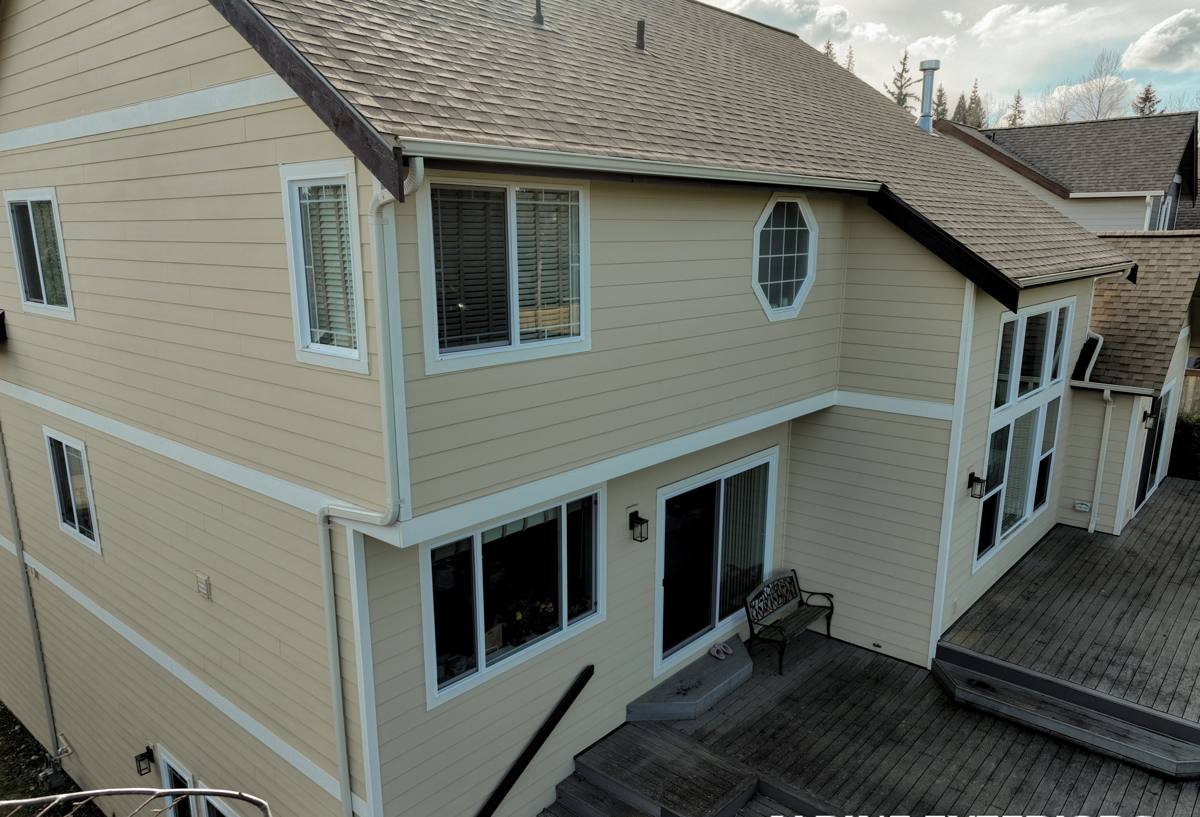
We install James Hardie fiber cement siding exclusively — not as a sales pitch, but because it's the product we trust to hold up to what Ferndale actually throws at a house. Fiber cement is non-combustible and dimensionally stable, meaning it doesn't swell and shrink with moisture the way wood-based or wood-composite products do. That stability matters a lot in a climate where the siding is rarely fully dry for long stretches of the year.
James Hardie's ColorPlus factory finish is baked on and cured under controlled conditions, which gives it better adhesion and UV resistance than field-applied paint. In a region with heavy cloud cover but real seasonal sun exposure, that finish holds color longer and resists the chalking and fading that shows up faster on repainted wood or lower-grade composite siding.
Moss and algae still land on any siding material — that's a function of shade and moisture, not the product underneath. But a hard, dense fiber cement surface doesn't hold onto organic growth or absorb moisture the way porous or fibrous materials can, which makes routine cleaning more effective and less likely to damage the surface underneath.
Where We Draw the Line
We don't install vinyl, LP SmartSide, cedar, or primed spruce, and we won't talk homeowners into them just to win a job. Each of those products has legitimate uses elsewhere, but for this climate specifically — sustained moisture exposure, salt air, and heavy moss pressure — we've made fiber cement our standard because it's the material we're comfortable standing behind long-term on a Whatcom County home.
What a Correct James Hardie Install Looks Like Here
James Hardie siding performs well when it's engineered and installed to spec — and the failures homeowners hear about almost always trace back to shortcuts in installation, not the material itself. In a wet coastal climate, a few details matter more than usual:
- Weather-resistive barrier and flashing: A correctly lapped water-resistive barrier behind the siding, with proper flashing at every window, door, and roofline intersection, is what actually keeps water out — the siding itself is the second line of defense, not the only one.
- Gap and clearance requirements: Hardie specifies minimum clearances from grade, roofing, decks, and other surfaces so panels aren't sitting in standing water or trapped moisture. Skipping these is one of the most common causes of early rot at the framing behind the siding, not the siding failing on its own.
- Caulking and joint treatment: Butt joints and trim intersections need to be sealed correctly, using compatible sealants, so water doesn't wick into seams during the kind of sustained horizontal rain this area gets.
- Fastening pattern: Correct nail placement and fastener type keep panels secure through wind-driven rain events without over-driving or under-driving fasteners, both of which create long-term problems.
- Field-cut edge sealing: Any panel cut on site needs the exposed edge back-primed or sealed before installation, since a raw cut edge is more vulnerable to moisture intrusion than the factory-finished face.
Product Line: Choosing the Right Hardie System for This Area
James Hardie makes climate-engineered product lines, and for a Puget Sound / Whatcom County property, that generally means specifying their HZ5 formulation, which is built for wetter, harsher climate zones. Beyond that, homeowners have real choices in profile and texture:
| Product Type | Look | Best Suited For |
|---|---|---|
| Lap Siding (smooth or cedar-textured) | Traditional horizontal board look | Most single-family homes; classic or modern facades |
| Board & Batten (Artisan or standard) | Vertical panel with battens | Modern builds, accent walls, gable ends |
| Shingle Siding | Staggered or straight-edge shingle look | Craftsman and cottage-style homes |
| Trim & Soffit | Matching trim boards and soffit panels | Completing the full envelope with consistent material |
Color selection matters too. Homes with heavy tree cover and shade — common on the outskirts of Ferndale — tend to show moss and streaking faster on very light colors in shaded areas, while darker ColorPlus tones can show more visible heat and UV wear on south- and west-facing exposures. We walk through both the product line and color decision with the specific lot and sun exposure in mind, not a generic recommendation.
Our Process for Ferndale Projects
- On-site assessment: We look at the existing siding and sheathing condition, sun and shade exposure by wall, drainage around the foundation, and any trouble spots — around windows, under eaves, near grade — before we talk product.
- Moisture check: Where there's any sign of past water intrusion, we check the sheathing underneath before covering it back up. Installing new siding over damaged sheathing just hides the problem.
- Detailed scope and product spec: We write up exactly what's being installed — HZ5 product line, panel type, trim package, flashing plan, and fastening schedule — so there's no ambiguity before work starts.
- Installation to Hardie's published specifications: Clearances, flashing, joint treatment, and fastening are done to spec, not to whatever's fastest.
- Final walk-through: We go over the finished job with the homeowner, including how to care for the siding going forward.
What It Costs
Every project is different, but the same handful of factors move the price on most Ferndale-area jobs:
| Cost Factor | Why It Matters |
|---|---|
| Extent of sheathing repair needed | Moisture-damaged sheathing found during tear-off adds material and labor before new siding can go on |
| Home size and wall complexity | More corners, gables, and dormers mean more cutting, flashing, and trim work |
| Product line and profile chosen | Lap, board and batten, and shingle profiles carry different material and labor costs |
| Trim and soffit scope | Replacing trim and soffit alongside siding costs more up front but keeps the whole envelope consistent |
| Access and site conditions | Sloped lots, tree cover, or tight setbacks affect staging and labor time |
We don't quote a number until we've actually looked at the house — anything given sight-unseen is a guess, and we'd rather give an honest range after an on-site walk-through.
Maintenance After Install
Fiber cement is low-maintenance, not no-maintenance. In this climate, a simple annual routine keeps a Hardie exterior looking right for the long haul:
- Rinse the siding once or twice a year, more often on shaded north-facing walls where moss and algae build up fastest.
- Keep gutters clear so water isn't sheeting down the siding face during heavy rain.
- Trim back vegetation and tree limbs that keep siding constantly shaded and damp.
- Check caulking at trim joints and penetrations every couple of years and re-caulk as needed.
- Touch up any chips or scrapes promptly using ColorPlus-matched touch-up product to protect the exposed edge.
Why a Ferndale-Experienced Crew Matters
A crew that's already worked houses in this specific stretch of Whatcom County knows which walls tend to hold moisture longest, which older homes commonly have sheathing issues under the existing siding, and how to sequence a job around this region's wetter months so materials aren't installed in poor conditions. That local pattern recognition is the difference between a job that looks good on install day and one that's still performing correctly five and ten years later.
It also means straightforward answers about permitting, realistic timelines around the local weather window, and a crew that isn't learning the area's quirks on your project.
Questions Worth Asking Any Contractor
- Are you a James Hardie-certified or preferred installer, and can you show it?
- Will you check the sheathing condition before installing new siding over it?
- What's your flashing and clearance plan at windows, doors, and grade?
- Which Hardie product line and profile do you recommend for this specific house, and why?
- What does the warranty actually cover — material, finish, and labor — and for how long?
If you're planning a siding project in the Ferndale area, we're happy to take a look and put together a clear, no-pressure estimate — no obligation, just an honest read on what your home actually needs.