 Blaine Siding
 Why Semiahmoo Roofs Take a Different Kind of Beating
Semiahmoo sits right at the edge of the water in Whatcom County, and that location comes with a roofing climate that's noticeably harder on homes than a few miles inland. Wind off the water hits roofs with more force and less warning than storms elsewhere in the county. Salt-laden air corrodes metal faster. And the long, damp, low-sun stretch of a typical Pacific Northwest winter here means moss gets a head start on roofs that would stay cleaner in a drier climate. None of that is a reason to panic about your roof — but it is a reason to treat storm damage repair in Semiahmoo as its own job, not a generic patch-and-go.
We work on homes in this specific pocket of Blaine regularly, and the damage patterns we see here are consistent: wind-lifted shingle tabs on water-facing slopes, corroded or loosened flashing around chimneys and vents, and moss-driven granule loss that weakens roofing material well before a storm ever hits it. A repair that doesn't account for all three isn't really finished — it's just deferred.
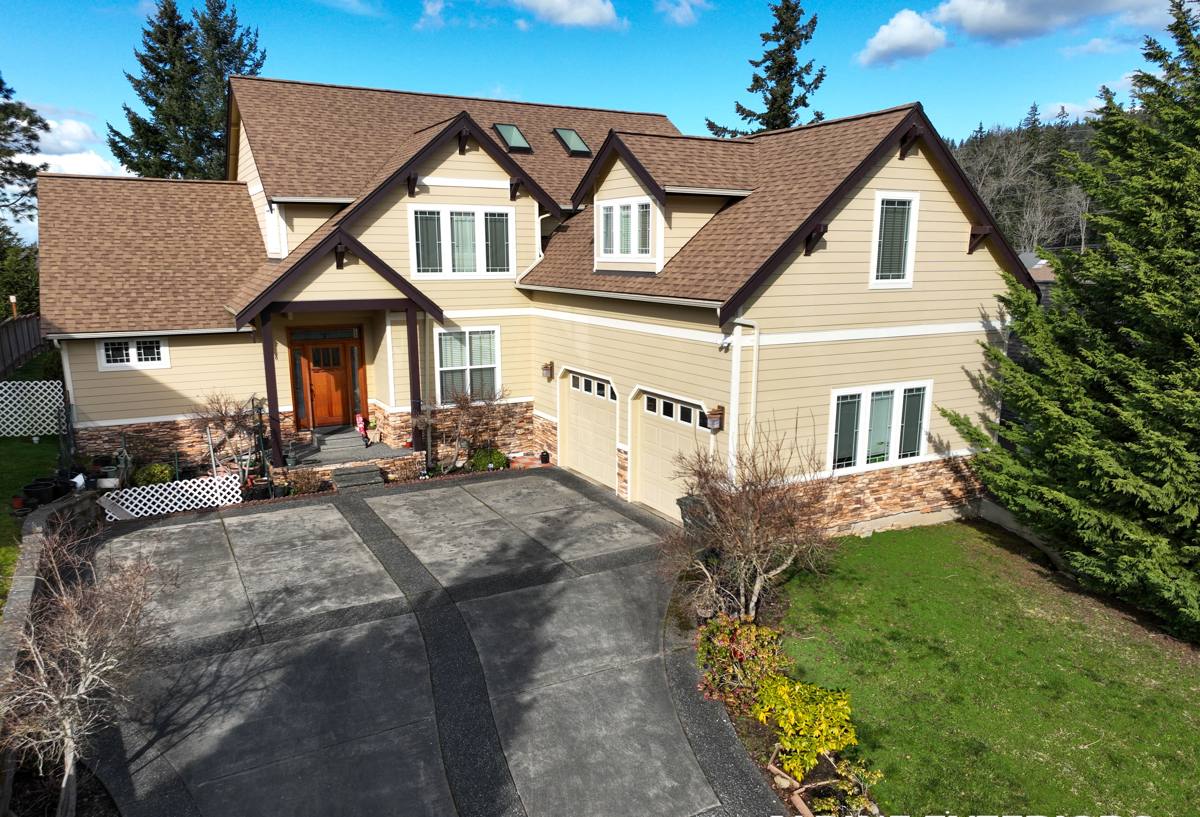
What "Storm Damage" Actually Means on a Semiahmoo Roof
Storm damage isn't always a hole or a missing shingle you can spot from the driveway. On homes exposed to wind off the water, the damage is often more subtle and more likely to leak before it's visually obvious.
Wind-Lifted and Cracked Shingles
Sustained wind and gusts pry up shingle tabs, break the factory seal strip underneath, and sometimes crack the shingle itself at the fold. A shingle that's lifted but not missing can look fine from the ground while letting wind-driven rain underneath it every time it storms.
Flashing Failures
Flashing around chimneys, skylights, vent pipes, and roof-to-wall transitions is the single most common failure point we find on storm calls. Salt air speeds up corrosion on lower-grade metal, and once flashing pulls away even slightly, wind-driven rain finds the gap.
Moss and Debris Damage
Semiahmoo's shaded, moisture-heavy winters give moss more time to establish than most inland Whatcom County roofs deal with. Moss holds water against the roofing surface, lifts shingle edges as it grows, and works its way under laps — so a storm that would be a non-event on a clean roof can push water straight into moss-softened material.
Hidden Deck and Underlayment Damage
Water that gets past the shingle layer travels — sometimes several feet from the actual entry point — before it shows up as a stain on a ceiling. By the time you see interior evidence, the underlayment and sometimes the roof deck underneath have usually been wet for a while.
What a Correct Storm Damage Repair Actually Involves
A repair that only addresses the obvious damage tends to fail again in the next storm. Here's what we consider a complete job, not just a patch.
- Full-slope inspection, not just the area you reported — wind and moss damage rarely stay contained to one spot
- Flashing check at every penetration and transition, with replacement of any flashing showing corrosion, gaps, or loose fasteners
- Underlayment and decking assessment in the affected area to confirm there's no soft or delaminated wood before new material goes down
- Matching replacement material — color, profile, and where possible, manufacturer — so the repair doesn't stand out or create a mismatched seal
- Moss removal and treatment in the repair zone and, honestly, anywhere else it's established, since it will keep undermining the new work otherwise
- Corrosion-resistant fasteners appropriate for a salt-air environment, not standard-grade hardware that will corrode again in a few seasons
- Interior check of the attic space below the repair, where accessible, to confirm no ongoing moisture is trapped behind the new work
Skipping any of these doesn't necessarily mean the repair fails immediately — it usually means it fails at the next storm instead of this one.
Our Process, From Call to Completed Repair
- Initial call and photos. If you can safely get photos of visible damage, they help us understand scope before we're on site — but we never ask anyone to get on a roof or ladder themselves.
- On-site inspection. We walk the full roof, not just the reported problem area, and check flashing, moss condition, and any signs of hidden moisture.
- Written scope and honest estimate. You get a clear explanation of what's damaged, what's precautionary, and what it will cost — with repair and, if relevant, replacement options laid out side by side.
- Temporary protection if needed. If a roof is actively leaking or has open damage, we can install temporary covering to stop water intrusion while a full repair is scheduled.
- The repair itself. Matched materials, proper flashing work, and fasteners suited to a coastal environment — done to hold up, not just to close the gap.
- Final walkthrough. We show you what was done and what to watch for, particularly if moss or corrosion elsewhere on the roof is heading toward becoming its own future problem.
Repair or Replacement? How We Make the Call
Not every storm-damaged roof needs to be replaced, and not every roof that looks rough from the ground is actually a repair candidate. The honest answer depends on a few concrete factors.
| Factor | Leans Toward Repair | Leans Toward Replacement |
|---|---|---|
| Extent of damage | Localized to one slope or penetration | Multiple slopes or widespread moss/granule loss |
| Roof age | Well within expected lifespan | Already near or past typical service life |
| Decking condition | Dry, solid wood under the damaged area | Soft, delaminated, or rotted decking found |
| Flashing condition elsewhere | Sound and corrosion-free | Widespread corrosion from long-term salt exposure |
| Moss history | Isolated growth, manageable with treatment | Long-established moss with visible shingle lifting across the roof |
We'll always tell you plainly which category your roof falls into. A repair that's genuinely sufficient is the right call — we're not in the business of selling a full roof to someone who needs a flashing fix.
Materials and Fasteners Built for a Salt-Air Environment
Standard-grade fasteners and flashing that hold up fine a few miles inland can corrode noticeably faster this close to the water. On storm repairs in Semiahmoo, we default to corrosion-resistant fastener and flashing options suited to coastal exposure, because using standard hardware here is a false economy — it just means doing the same repair again sooner. We also match shingle or roofing material as closely as possible to what's already on the roof, both for appearance and because mismatched materials can age and shed water differently, creating a new weak point right at the seam between old and new.
Insurance and Storm Claims: What Homeowners Should Know
If your damage is significant enough that you're considering a homeowner's insurance claim, a few things are worth knowing before an adjuster is involved:
- Photo documentation of damage as soon as it's safely possible strengthens any claim
- An independent inspection report from your contractor, separate from the adjuster's, gives you a second, unbiased assessment to compare against
- Temporary protective measures (like tarping an active leak) are usually reimbursable and expected — waiting and letting damage spread is not looked on favorably
- Storm damage and pre-existing wear (like long-term moss damage) can look similar to an adjuster; a clear, honest inspection report helps separate the two
We provide inspection findings in writing and can walk through what we found with you before you talk to your insurer — we're not a public adjuster and won't pretend to be one, but a clear paper trail helps regardless of who's paying for the repair.
Why a Crew That Already Works Semiahmoo Matters
Roofing crews that mostly work inland can get caught off guard by how differently coastal exposure ages a roof — flashing that looks fine on an inland inspection checklist can already be compromised here, and moss that would be a minor cosmetic issue elsewhere can be actively lifting shingles. Working Semiahmoo and the rest of Blaine's waterfront regularly means we're not learning this roof's climate on your dime. We know which flashing details tend to fail first in this wind exposure, how aggressively moss needs to be managed on shaded, water-adjacent lots, and what fastener and material choices are worth the extra durability out here versus a few miles inland in less exposed parts of Whatcom County.
Simple Maintenance Checklist Between Storms
A few habits go a long way toward keeping storm damage minor instead of major:
- Have moss treated or removed before it establishes heavily — early treatment is far cheaper than repairing shingle damage moss has already caused
- Keep gutters and downspouts clear so storm water actually drains instead of backing up under roof edges
- After any significant windstorm, do a visual check from the ground for lifted or missing shingles rather than waiting for an interior leak to show up
- Have flashing inspected periodically, especially around chimneys and skylights — it's the first thing to fail in salt air and the easiest to catch early
- Don't ignore small ceiling stains — by the time water shows up inside, it's usually been traveling under the roof for a while
If your roof has taken storm damage — or you're just not sure whether what you're seeing needs attention — we're happy to take a look and give you a straight answer. Reach out for a free, no-pressure estimate using the form below.