 Blaine Siding
 Building Decks for Semiahmoo's Coastal Conditions
Semiahmoo sits right on the water at the edge of Blaine, and that location is exactly what makes deck-building here different from a typical inland project in Whatcom County. Homes on or near the spit and the surrounding shoreline face a steady mix of salt-laden air, wind-driven rain coming off the bay, and long stretches of gray, damp weather that keep wood and hardware wet for days at a time. A deck built to a generic spec sheet, without accounting for that environment, tends to show its age fast — corroding fasteners, cupped boards, slick moss growth, and soft spots where water sits instead of running off.
We build custom decks for homeowners in this area with those conditions treated as the starting point, not an afterthought. That means specific choices in fastener type, board spacing, substructure protection, and drainage detailing that hold up to salt air and rain rather than just tolerating them for a season or two.
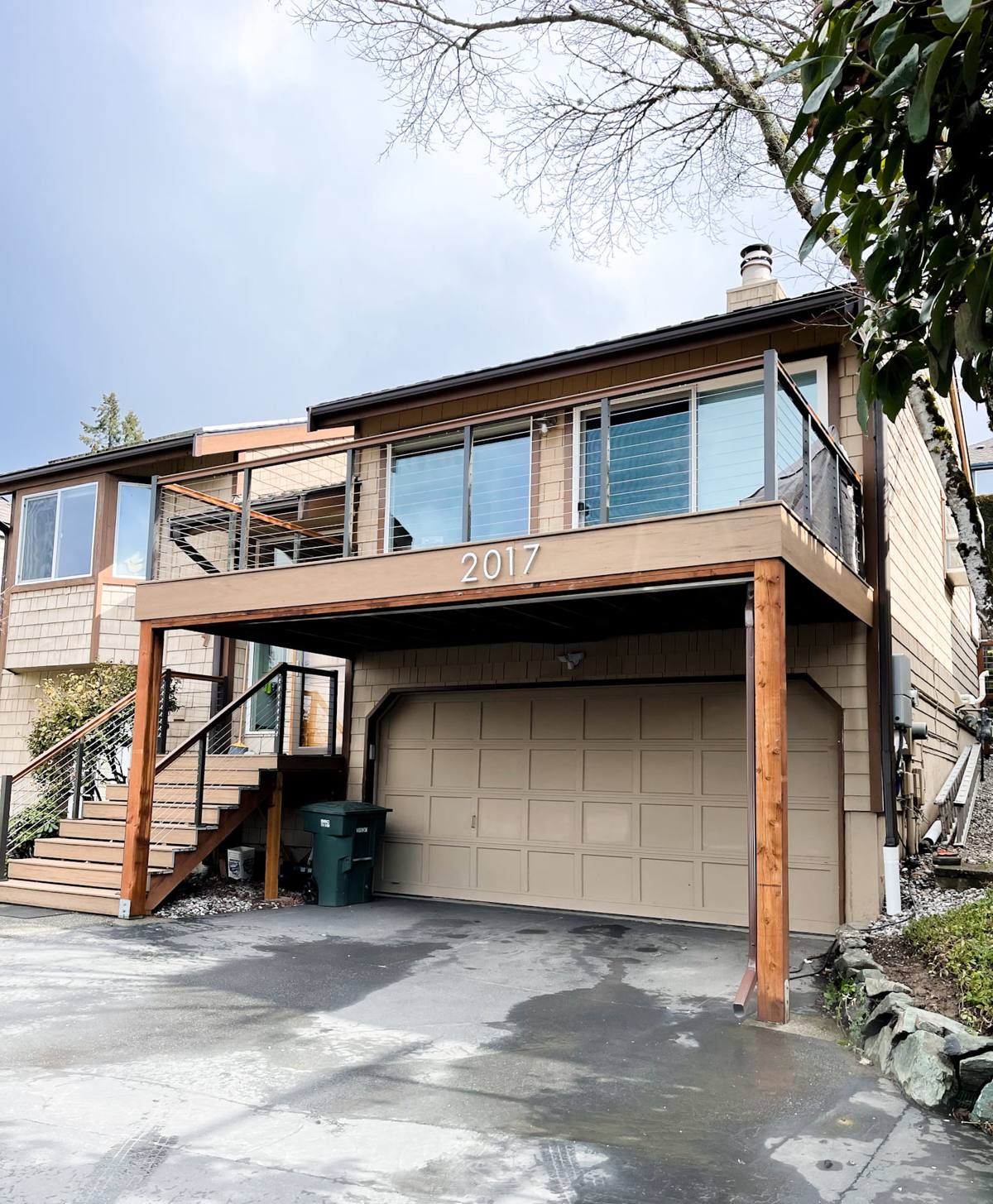
What Semiahmoo's Climate Actually Does to a Deck
Salt Air and Corrosion
Airborne salt from the bay accelerates corrosion on anything metal — screws, joist hangers, bolts, and railing hardware. Standard coated fasteners that work fine twenty minutes inland can start rusting within a couple of years this close to the water. Rust doesn't just look bad; it weakens the connection points holding your deck together, and a corroded fastener head is one of the most common reasons a deck starts to feel "loose" over time.
Driving Rain and Moisture Retention
Rain here doesn't just fall straight down — wind off the water pushes it sideways, driving moisture into ledger connections, under rail posts, and into any gap where end grain is exposed. Wood that stays damp longer than it should is wood that rots faster, and it's also the wood that grows moss and algae fastest once the temperature drops.
The Long Moss Season
Blaine's moss season isn't a brief nuisance — it runs long, often from fall through spring, and a shaded or north-facing deck can stay green and slick for months. Beyond the appearance issue, moss holds moisture against the deck surface, which is exactly the condition that breaks down wood fiber and finish coatings over time, and creates a real slip hazard on stairs and walking surfaces.
Material Choices That Make Sense for This Location
There's no single "best" decking material for every home — the right call depends on your budget, how much upkeep you want to do, and how exposed your specific site is to wind and salt spray. Here's how the common options actually perform in a Semiahmoo-type environment.
| Material | Salt Air Behavior | Moss / Moisture Resistance | Maintenance |
|---|---|---|---|
| Pressure-treated lumber | Fine with stainless or hot-dip galvanized fasteners; standard coated hardware corrodes faster here | Moderate — needs sealing and regular cleaning to resist moss | Annual cleaning, re-sealing every 1-2 years |
| Cedar | Naturally decent rot resistance; still needs corrosion-rated fasteners | Good if finished and kept clean; unfinished cedar grays and holds moisture | Regular finish maintenance to preserve appearance and shed water |
| Composite decking | Excellent — no rot, minimal fastener exposure with hidden clip systems | Best — dense surface sheds moss more easily and doesn't absorb water | Periodic washing; no sealing or staining needed |
| PVC decking | Excellent — fully synthetic, unaffected by salt | Very good — non-porous surface resists moss buildup | Low; occasional cleaning |
We're upfront with clients about trade-offs rather than pushing one product. Composite and PVC cost more up front but save real time and money on maintenance over a coastal deck's life. Cedar and pressure-treated wood cost less initially and give a more traditional look, but they demand a consistent maintenance schedule to perform well this close to the water — skip a year or two of sealing and you'll feel it.
What a Correctly Built Coastal Deck Includes
Hardware and Fasteners
For any deck we build in the Semiahmoo area, we use stainless steel or hot-dip galvanized fasteners and connectors rated for coastal exposure — not the standard coated screws that are fine in drier, inland parts of the county. This is one of the cheapest details to get right and one of the most expensive to fix later, since replacing corroded structural hardware often means partially disassembling the deck.
Substructure Protection
Joists and beams get flashing tape or a protective barrier at the top edge before decking goes down, keeping water from wicking into the end grain and framing lumber where it can't dry out. Ledger board connections — where the deck attaches to the house — get properly flashed to stop water intrusion into the wall structure, which is a common failure point on older decks in wet climates.
Drainage and Board Spacing
Correct gapping between boards lets water drain through rather than pool on the surface. On a shaded, moss-prone deck, that drainage matters even more, since standing water is what keeps moss and algae established. We also grade the substructure slightly to shed water away from the house rather than toward it.
Railing and Post Connections
Rail posts take the brunt of wind load in an exposed, waterfront-adjacent spot like Semiahmoo. We use structural connections rated for that load, not just surface-mounted brackets, and protect the post base from standing water where it meets the deck surface.
Our Process for a Custom Deck Project
- Site walk and assessment — we look at sun exposure, wind exposure, drainage patterns, and how close the site is to the water, since that changes material and hardware recommendations.
- Design and material selection — we go over the trade-offs between wood and composite/PVC options honestly, based on your budget and how much maintenance you want to take on.
- Permitting — deck projects in Whatcom County and the City of Blaine often require permits depending on size and height; we handle that process rather than leaving it to you.
- Structural build — framing, flashing, and fastener selection matched to the coastal exposure of your specific site.
- Surface and rail installation — decking, stairs, and railings installed with correct spacing and drainage in mind.
- Walkthrough — we go over basic care for whatever material you chose, so moss and moisture issues don't sneak up on you later.
Why a Crew That Works Semiahmoo Regularly Matters
A contractor who mostly builds decks inland, away from the water, doesn't necessarily think to spec corrosion-rated hardware or plan for a long moss season — because they don't see the failures those choices cause. We work this specific stretch of Whatcom County, including Semiahmoo and the broader Blaine area, and the material and hardware choices above come directly from what actually holds up here versus what doesn't. That local knowledge shows up in details that aren't visible on day one but matter five years later — the fastener that hasn't rusted, the ledger flashing that's kept water out of the wall, the surface that still sheds water instead of holding moss.
Maintenance Reality for Semiahmoo Decks
Whatever material you choose, a deck in this environment needs a maintenance rhythm that accounts for the climate, not a generic once-a-decade approach.
- Sweep debris and clean the surface regularly, especially in shaded areas prone to moss
- Check fastener heads and railing connections annually for early signs of corrosion
- Re-seal or re-stain wood decking on the schedule the finish product actually requires — don't stretch it
- Keep gutters and downspouts clear so runoff isn't draining directly onto or under the deck
- Address any soft or spongy boards immediately rather than waiting for a full failure
- Rinse salt residue off composite and PVC surfaces periodically, even though they don't rot
Common Problems We See on Existing Semiahmoo Decks
When we're called out to repair or replace an existing deck in this area, the same issues come up repeatedly: standard coated fasteners rusted through at load-bearing connections, ledger boards that were never properly flashed and have let water into the framing, and moss-covered surfaces on shaded decks that were never sealed or cleaned on a real schedule. Most of these are avoidable with the right build details from the start, which is the whole reason we spec differently for a Semiahmoo project than we would for a deck twenty miles inland.
Get a Straight Answer for Your Property
Every lot near Semiahmoo has its own mix of sun, wind, and water exposure, and that affects what deck design and materials actually make sense for your home. If you're planning a new deck or replacing one that's showing its age, we're happy to take a look and give you a straightforward, no-pressure estimate — just fill out the form below and we'll get in touch.