 Blaine Siding
 Why Sandy Point Roofs Wear Out Faster Than Inland Homes
Sandy Point sits right up against the water, and that location is exactly why roofs there don't age the same way a roof does ten miles inland in Whatcom County. Salt-laden air corrodes exposed metal faster — nail heads, flashing, vent caps, and drip edge all take the hit first. Add in driving rain that comes in sideways during winter storms, and you've got wind-driven water finding every weak seam, lap, and fastener a roofer left loose. Then there's moss season, which around here isn't a few weeks — it's most of the year. Shade, moisture, and mild temperatures are a perfect combination for moss and algae to take hold on north-facing slopes and anywhere debris collects.
None of that means Sandy Point homes need exotic materials or gimmicks. It means the installation details that get skipped on an easier job — corrosion-resistant fasteners, properly lapped underlayment, real ventilation — are not optional here. A roof that would hold up fine in a drier, more sheltered part of Blaine can fail early at Sandy Point if it's built to a generic standard instead of a coastal one.
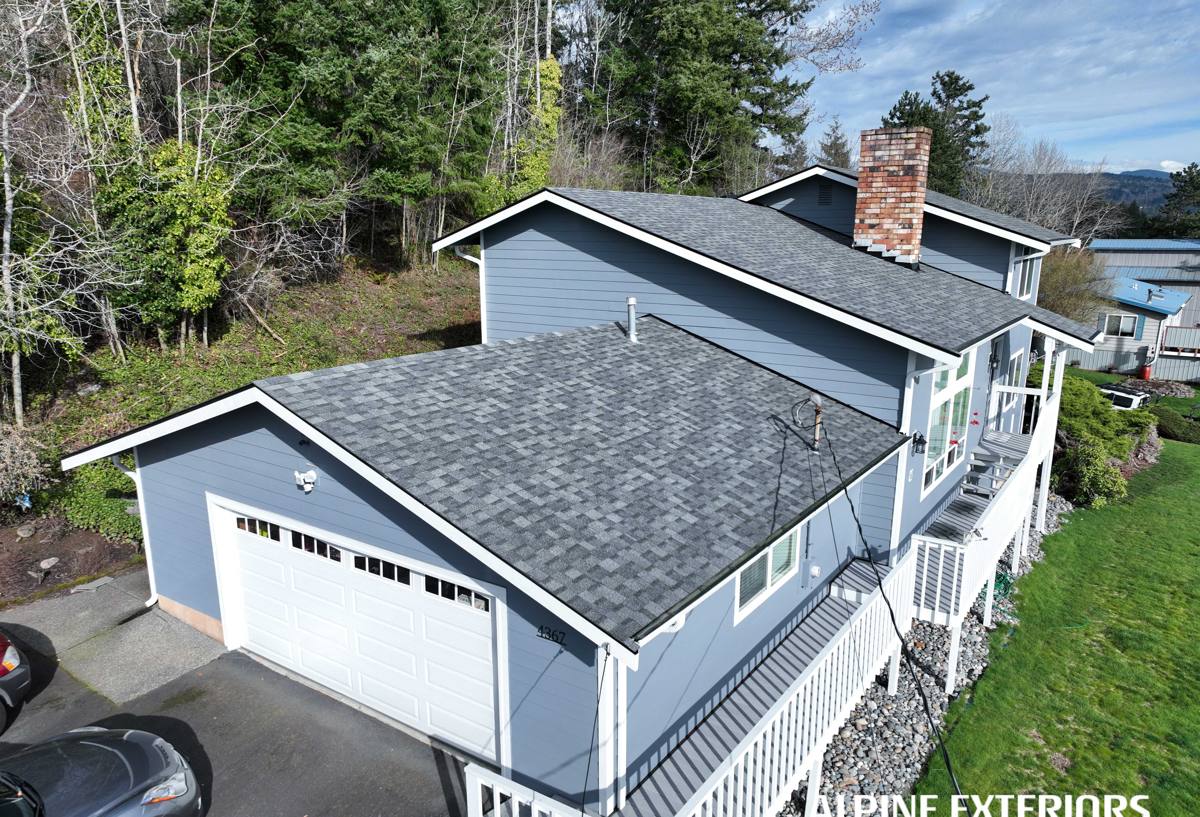
Signs a Sandy Point Roof Has Reached Replacement, Not Repair
We get a lot of calls asking whether a roof needs a patch or a full tear-off. Around Sandy Point, a few signs tend to point toward replacement rather than repair:
- Granule loss heavy enough that you can see bare asphalt on multiple slopes, not just one worn spot
- Shingles that are cupping, curling at the edges, or cracking when you walk the roof
- Soft spots in the decking found during a repair, which usually means water has been getting in for a while
- Moss and algae that come back within a season or two of cleaning, even after treatment
- Flashing around chimneys, vents, or skylights that's rusted, lifted, or was never properly stepped in the first place
- Interior staining on ceilings or in the attic that shows up after wind-driven rain events specifically
One or two of these on their own might mean a targeted repair is enough. Several at once, especially combined with a roof that's already past 20-25 years old, usually means repair money is better spent toward a full replacement.
What a Correct Roof Replacement Actually Involves
Tear-Off, Not Cover-Over
We tear off down to the decking rather than laying new shingles over old ones. A layover hides the condition of the deck, traps moisture between layers, and voids most manufacturer warranties. On a coastal property, hidden rot under a second layer is exactly the kind of problem that turns into a much bigger repair later.
Deck Inspection and Repair
Once the old roofing is off, we inspect the plywood or plank decking for soft spots, delamination, and rot — common wherever a roof has had a slow leak for years without visible interior signs yet. Any damaged sections get replaced before anything new goes down; nothing waterproofs well over a compromised deck.
Underlayment and Ice-and-Water Protection
Given the volume of driving rain Sandy Point sees, we pay particular attention to underlayment coverage and self-adhered ice-and-water membrane at eaves, valleys, and around every penetration — chimneys, vents, skylights. These are the spots where wind-driven water pushes uphill under standard shingle laps, and it's where most coastal leaks actually start.
Flashing and Fasteners
We use corrosion-resistant flashing and fasteners throughout, not just at the most exposed points. Standard galvanized nails can start showing rust streaks within a few years this close to salt air; stainless or high-quality coated fasteners cost more up front but they're one of the cheapest ways to extend a roof's real service life here.
Ventilation
Proper intake and exhaust ventilation keeps the attic space closer to outdoor temperature and moisture levels, which reduces condensation on the underside of the deck and slows moss growth on the surface by keeping the roof drying out evenly instead of staying damp longest on shaded slopes.
Choosing Materials for a Marine Climate
There's no single "best" roofing material for every Sandy Point home — it depends on budget, roof pitch, and how long you want to go before thinking about it again. Here's how the common options actually compare for this specific environment:
| Material | Coastal Durability | Moss Resistance | Typical Lifespan | Trade-Offs |
|---|---|---|---|---|
| Standard asphalt composition shingle | Good with proper fasteners/flashing | Moderate; needs periodic cleaning | 20-25 years | Lowest upfront cost; most familiar to insurers and appraisers |
| Algae-resistant (AR) asphalt shingle | Good | Better; copper/zinc granules slow algae growth | 25-30 years | Modest cost premium over standard shingle |
| Standing seam metal | Very good with correct coatings/fasteners | Good; sheds moss more easily on steeper pitches | 40-50+ years | Higher upfront cost; installation sensitivity around fasteners and expansion |
| Synthetic/composite shingle | Good | Moderate to good depending on product | 30-40 years | Mid-to-high cost; fewer long-track-record installers locally |
We don't push one product line over another as a rule — we walk through pitch, sun exposure, and budget with each homeowner and recommend what actually fits the house. What we do insist on, regardless of material, is proper fastening and flashing detail for a marine environment. A premium shingle installed with standard inland practices will underperform a mid-grade shingle installed correctly for this climate.
What Drives the Cost of a Sandy Point Roof Replacement
Every roof is priced individually after a walk-through, but the same handful of factors move the number up or down on almost every job in this area:
| Factor | Why It Matters Here |
|---|---|
| Roof size and pitch | Steeper roofs and multiple planes take longer to tear off and install safely |
| Number of existing layers | Tear-off of two layers costs more in labor and disposal than tear-off of one |
| Decking condition | Rot from long-term moisture intrusion means plywood or plank replacement before roofing goes on |
| Material grade chosen | Standard shingle, algae-resistant shingle, and metal carry different material costs |
| Access and site conditions | Narrow lots, limited staging area, and distance from the road affect crew setup time |
| Chimneys, skylights, and penetrations | Each one needs individual flashing work, which adds labor regardless of material |
We'd rather walk your roof and give you real numbers than throw out a broad range that doesn't mean much once we see the actual conditions. Deck rot in particular is the one factor that's hard to price until the old roofing is off, which is why we build a contingency conversation into every estimate up front rather than surprising anyone mid-job.
Timing Around Weather and Moss Season
We can install roofs through most of the year, but we plan around Whatcom County's weather rather than fighting it. Dry stretches in late spring through early fall give the most predictable working conditions for tear-off days, since an open roof deck needs to stay dry until underlayment is down. Winter jobs are still doable — we just watch forecasts closely and stage materials so a section of open deck is never left exposed overnight. If moss removal is part of the scope, we handle that as its own step before any new roofing goes down, rather than roofing over a surface that hasn't been properly cleaned.
Our Process From Estimate to Cleanup
- On-site walk-through and roof inspection, including attic access where possible, to assess deck condition and ventilation
- Written estimate covering material options, scope, and a realistic timeline
- Material order and a scheduled start date, with weather contingency built in
- Tear-off, deck inspection and repair, then underlayment and ice-and-water membrane installation
- New roofing installed with corrosion-resistant flashing and fasteners throughout
- Full site cleanup, including a magnetic nail sweep of the yard and driveway
- Final walk-through so you can see the completed work before we consider the job done
Why Local Experience at Sandy Point Actually Matters
Roofing a house at Sandy Point isn't the same as roofing one a few miles inland, and it's not just about the salt air. Crews who haven't worked this specific stretch of coastline near Blaine often underestimate how much wind-driven rain a roof takes in a winter storm, or they use standard fastener and flashing specs that are fine elsewhere but marginal here. A crew that's already done roofs in this community knows which details to over-build rather than build to the minimum code requirement, and knows what a Sandy Point roof looks like after five winters versus after fifteen.
There's also a practical side: familiarity with the roads, staging areas, and general layout of the community means less time lost getting set up and more time actually working, which keeps your project on schedule and your property disrupted for a shorter window.
Keeping a New Roof Performing Long-Term
A correct installation is most of the battle, but a little maintenance keeps a Sandy Point roof performing for its full expected life instead of aging early:
- Clear debris — needles, leaves, moss fragments — from valleys and gutters at least twice a year
- Have moss treated or gently removed before it builds up thick mats on shaded slopes
- Walk the roofline visually after major windstorms to check for lifted shingles or displaced flashing
- Keep gutters and downspouts flowing freely so water isn't backing up under the eaves
- Schedule a professional inspection every few years, even with no visible problems, to catch flashing or fastener issues early
None of this requires climbing on the roof yourself — most of it can be checked from the ground or handled during a routine gutter cleaning.
If you're weighing repair versus replacement, or just want an honest read on what your Sandy Point roof has left in it, we're glad to come take a look. The estimate is free, there's no pressure attached to it, and you'll get a straight answer either way — use the form below to get started.