 Blaine Siding
 Building Decks for Sandy Point's Marine Climate
Sandy Point sits close enough to the water that every outdoor structure on the property deals with conditions a few miles inland simply doesn't see. Salt-laden air moves through constantly, driving rain comes in sideways more often than straight down, and the moss season here runs long compared to most of the state. A deck built without those three things in mind will look fine for a year or two and then start showing problems — soft spots, rusting hardware, slick green film on the boards, railings that wiggle. A deck built for this specific environment holds up the way it should.
We build and repair decks throughout the Blaine area and Whatcom County, and Sandy Point jobs get treated differently from the start. Material selection, fastener choice, framing details, and even the slope of the decking all get adjusted for a site that's exposed to salt air and heavy seasonal moisture.
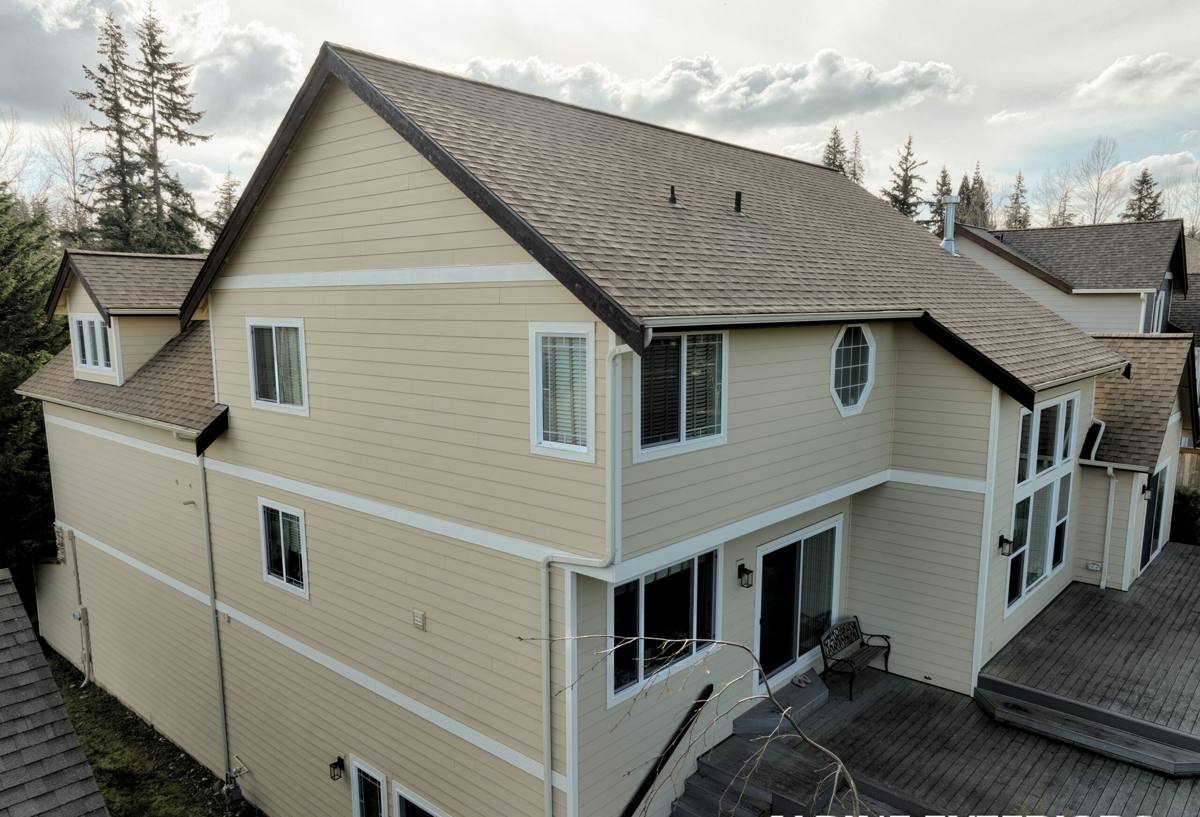
What a Sandy Point Deck Actually Needs
Drainage First
More deck failures near the coast trace back to trapped water than any other single cause. Driving rain doesn't just fall on a deck — it gets pushed under railings, into ledger connections, and along the tops of joists where standing water can sit for days during a wet stretch. A properly built deck sheds water fast: correct board spacing, a slight pitch away from the house, and flashing details at the ledger board that actually keep water out instead of channeling it into the rim joist.
Corrosion Resistance
Salt air accelerates corrosion on anything metal — fasteners, joist hangers, post bases, railing brackets. Standard hot-dip galvanized hardware can start showing rust streaks within a couple seasons this close to the water. It's a bigger factor here than it would be for a deck built twenty miles inland.
Structural Stability in Wind
Open, exposed lots near the water take more wind load than sheltered inland lots. Railing posts, guardrail connections, and ledger attachment all need to be built to handle that — not just to code minimums, but with a margin that accounts for the site.
Choosing Decking Material for a Coastal Property
There's no single "best" decking material — there's a best material for this site, this budget, and how much maintenance the homeowner actually wants to do. Here's how the common options compare for a Sandy Point property specifically:
| Material | How It Handles Salt Air & Moisture | Moss/Mildew Behavior | Maintenance |
|---|---|---|---|
| Pressure-treated lumber | Good, if fasteners are corrosion-rated and boards are properly spaced for drainage | Needs regular cleaning and sealing to resist buildup | Highest — annual cleaning, periodic sealing |
| Cedar | Naturally decay-resistant, but softens over time without upkeep | Prone to moss and mildew if not cleaned and treated | High — sealing every 1–2 years |
| Capped composite | Excellent — doesn't absorb moisture, no corrosion concerns for the board itself | Best resistance; surface film is much easier to rinse off | Low — occasional washing |
| Uncapped composite | Good, but can absorb moisture at cut edges if not sealed correctly during install | Moderate — can hold moss in the grain texture | Moderate |
None of these are wrong choices. A well-built pressure-treated deck with the right hardware and a maintenance routine will last for decades. Capped composite costs more up front but trades ongoing upkeep for material cost — a fair trade for owners who don't want to be out there scrubbing and sealing every year, especially given how long the moss season runs in this part of Whatcom County.
Framing and Fasteners That Actually Hold Up
The framing is the part of the deck nobody sees once it's finished, and it's also the part that determines whether the deck is still solid in fifteen years or needs major repair in five. For Sandy Point builds, we treat the framing package as the place to spend on quality, not the place to cut costs:
- Stainless steel or heavy-duty coated fasteners at every connection point exposed to weather
- Joist hangers and post bases rated for coastal/high-corrosion exposure, not generic interior-grade hardware
- Proper ledger flashing so water is directed away from the house framing, not into it
- Joist tape or a comparable moisture barrier on top of framing lumber to slow rot at the fastener points
- Post bases set above grade and away from standing water, not buried in soil that stays wet through the fall and winter
None of this is visible in the finished deck, which is exactly why it's worth asking a contractor directly what hardware and flashing details they use before work starts.
Railings and Wind Exposure
Open lots near the water take wind loads that sheltered inland properties don't see as often. Railing posts need solid blocking and correctly torqued through-bolt or structural screw connections — not just toe-screws into a rim joist. Cable and glass railing systems look great on a view lot but need hardware rated for the corrosion exposure here, since their connection points are often smaller and more concentrated than a standard wood baluster railing. If a view of the water is part of why you're building the deck, the railing choice deserves the same attention as the decking material.
Moss, Mildew, and the Long Wet Season
Whatcom County's moss season runs longer than most people expect, and a deck that sits shaded or gets steady moisture will start showing green film faster than a deck in full sun. This isn't just cosmetic — moss and algae hold moisture against the board surface, which accelerates rot on wood decking and can make composite surfaces slick and unsafe underfoot. A few things reduce the problem at the build stage:
- Board spacing that allows airflow underneath and between boards
- Decking oriented and sloped so water actually runs off instead of pooling
- Underdeck ventilation where the structure allows for it
- Material selection that matches how much cleaning the homeowner is realistically willing to do
No deck is maintenance-free in this climate, but a deck built with drainage and airflow in mind needs far less scrubbing than one that wasn't.
Permitting and Local Requirements
Most deck projects in Whatcom County require a building permit, and requirements can vary depending on deck height, attachment to the house, and proximity to property lines or shoreline setback rules — which matter more for a Sandy Point lot than for most inland properties. We handle the permitting process as part of the job, including any shoreline-related review that applies to the specific property. Skipping this step is one of the more common mistakes we see on older decks we're asked to repair or replace — work that was never permitted often wasn't inspected either, which means problems can go unnoticed until they're expensive.
Our Process for a Sandy Point Deck Build
- Site visit and assessment — we look at sun exposure, wind exposure, drainage, and how close the deck will sit to the water
- Material and design discussion — honest trade-offs on decking material, railing style, and layout based on your budget and how much upkeep you want long-term
- Permitting — we pull the required permits and handle any shoreline-related requirements that apply
- Framing built to coastal-exposure standards — corrosion-rated hardware, proper flashing, and drainage details throughout
- Decking and railing installation — installed with the fastening and spacing details that hold up to salt air and driving rain
- Final walkthrough — we go over maintenance expectations for the specific material you chose, so there are no surprises
Why It Matters That We Already Work Sandy Point
A deck built by a crew that hasn't dealt with a marine environment before will often use standard hardware, standard spacing, and standard assumptions — and those assumptions don't hold up as well this close to the water. We've built and repaired decks throughout Blaine and the surrounding Whatcom County coastline, so the corrosion-resistant hardware, drainage details, and moss-conscious material choices described above aren't upgrades we're pitching — they're what we build by default for a property like this. That experience is also why we can give you a straight answer about what a given material or design choice will actually cost you in upkeep five and ten years down the road, not just what it costs to install.
If you're planning a new deck or need an honest look at an existing one, we're glad to come take a look. Fill out the form below for a free, no-pressure estimate — we'll walk the site, talk through your options, and give you a straightforward price with no games.