 Blaine Siding
 Why Point Roberts Is a Different Siding Job
Point Roberts sits on its own peninsula, cut off from the rest of Whatcom County by water and an international border, and that geography shapes what happens to a house's exterior. Homes here take salt-laden air off the water on multiple sides, near-constant winter rain, and a moss season that can stretch from October into May. That combination is harder on siding than what you'll find a few miles inland, and it's why we treat a Point Roberts install differently than a typical Blaine or Ferndale job. The salt air accelerates corrosion of fasteners and trim metal. The driving rain finds every gap in flashing and caulking. The moss holds moisture against the wall long after the rain stops. None of that is exotic weather, but stacked together year after year, it exposes any weak point in a siding system fast.
What This Means for Material Choice
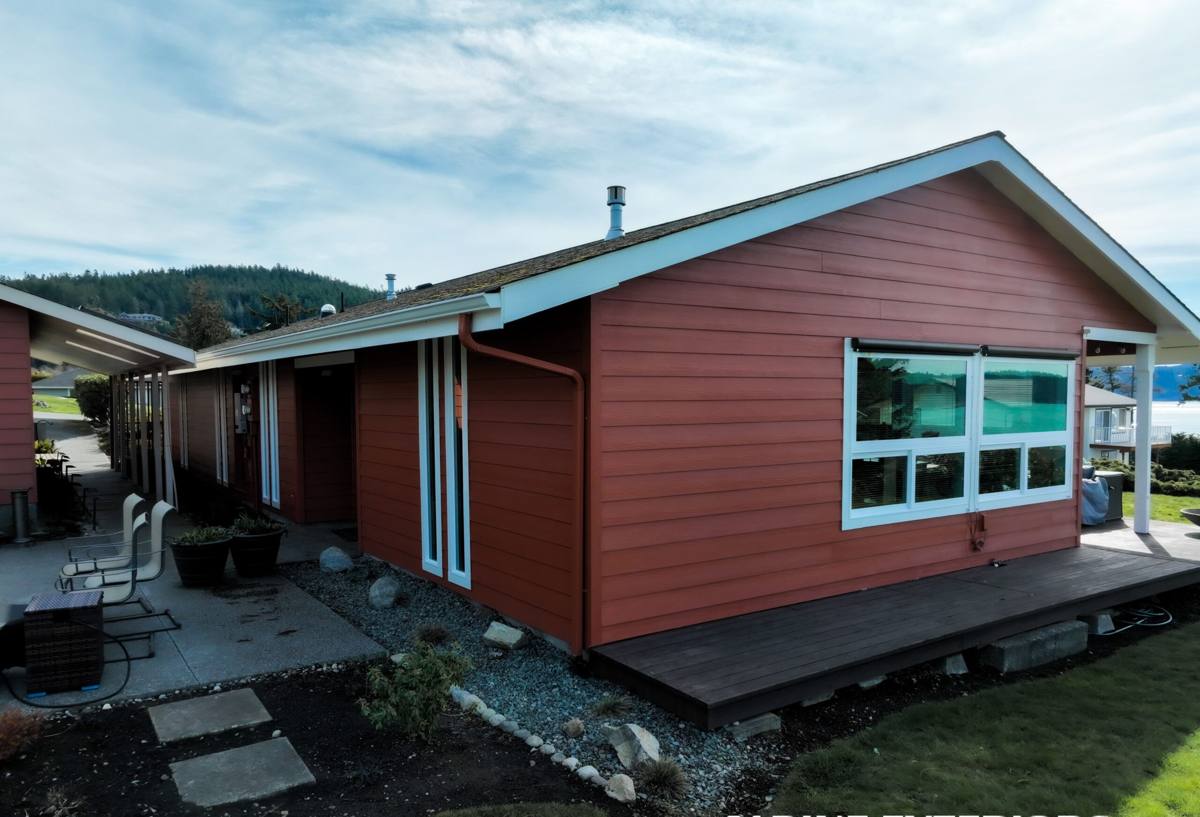
We install James Hardie fiber cement siding exclusively, and Point Roberts is one of the clearer cases for why. Fiber cement doesn't rot, doesn't feed moss the way wood fiber products can, and it holds up to salt exposure far better than the alternatives we've chosen not to install. It's not that other products can't survive here — it's that the margin for error is smaller on this peninsula, and we'd rather build in that margin from the start than have a homeowner discover it the hard way in year eight.
What a Correct Job Actually Involves
James Hardie makes a good product, but the product is only half the equation. A siding job on a home exposed to salt air and driving rain lives or dies on the details underneath the panels — the parts nobody sees once the job is done.
Water Management Comes First
Before a single piece of Hardie board goes up, the wall needs a drainage plane that actually drains: correct house wrap or building paper, properly lapped and taped, with a rain screen gap where the assembly calls for one. On a peninsula where wind-driven rain can hit siding almost horizontally, the water management layer behind the siding matters as much as the siding itself. We don't shortcut this step, because it's the one step a homeowner can't inspect after the wall is closed up.
Flashing and Fasteners
Every window, door, and penetration needs flashing that sheds water down and out, not into the wall cavity. In a salt-air environment, fastener choice matters too — we use corrosion-resistant fasteners appropriate to Hardie's specifications, because a fastener that starts bleeding rust or backing out in a few years undermines the whole installation, no matter how good the panels are.
Gaps, Caulking, and Clearance
Hardie's install specs call for specific gaps at butt joints, trim, and ground clearance, and for those gaps to be caulked with the right sealant, not just any tube from the shelf. Skipping this is the single most common shortcut we see on jobs we're asked to bid over or repair, and it's usually invisible until moisture starts working its way in behind the panel.
Moss and Maintenance in a Long Wet Season
Moss doesn't damage fiber cement the way it can damage wood-based siding, but it still needs to be managed so it doesn't hold moisture against trim, caulk lines, or fastener heads for months at a stretch. A few habits go a long way on a Point Roberts home:
- Keep gutters clear so runoff doesn't sheet down the wall face and feed moss growth at panel laps
- Trim back vegetation and tree cover that keeps north- and west-facing walls shaded and damp longer than the rest of the house
- Rinse visible moss or algae buildup with a garden hose and soft brush rather than a pressure washer, which can force water behind properly caulked joints
- Walk the exterior once a year and look at caulk lines around windows and trim for cracking or separation
- Repaint or touch up any field-cut edges that were factory-primed but not fully sealed with ColorPlus-matched paint
None of this is heavy maintenance — that's part of the appeal of fiber cement over wood-based alternatives — but it's not zero-maintenance either, and being honest about that upfront saves frustration later.
ColorPlus Finish and Salt Air Exposure
James Hardie's ColorPlus factory finish is baked on under controlled conditions, which gives it better fade and wear resistance than field-applied paint, and that matters on a home facing sustained salt exposure and UV off open water. Field-painted fiber cement can work, but it puts the long-term finish quality in the hands of whoever's painting it, on whatever day the weather cooperates. For Point Roberts homes, we generally steer people toward ColorPlus for the walls that take the most weather, and we're upfront when a custom paint color means giving up some of that factory durability.
Which Hardie Product Line Fits Point Roberts Homes
| Product Line | Best Fit | Why It Works Here |
|---|---|---|
| HardiePlank Lap Siding (HZ10 climate zone) | Most single-family homes, standard walls | Engineered for the Pacific Northwest's wet, moderate-freeze climate; wide color and texture options |
| HardiePanel Vertical Siding | Accent walls, gable ends, modern designs | Fewer horizontal laps means fewer joints for wind-driven rain to test |
| HardieShingle | Coastal or craftsman-style homes wanting a shingle look | Delivers the wood-shake appearance without the moisture and moss vulnerability of real shingles |
| HardieTrim | Window and corner trim, fascia | Matches panel durability so trim doesn't become the weak point in an otherwise solid install |
Why We Won't Install Alternatives Here
We get asked from time to time about vinyl, LP SmartSide, or lower-cost fiber cement alternatives, usually because of price. We understand the appeal, but we've made a standard for our company: James Hardie only, installed to spec. On a peninsula dealing with salt air, driving rain, and a long moss season, the trade-offs of engineered-wood or vinyl products — moisture sensitivity, seam behavior, warranty structure, long-term appearance — show up faster and more visibly than they would on a sheltered inland lot. We'd rather turn down jobs outside that standard than install something we don't believe will hold up to this specific climate.
Our Process for a Point Roberts Project
1. On-Site Assessment
We look at wall exposure by direction, existing moisture damage, current siding condition, and drainage around the foundation before we talk product or price. A wall facing open water on the west side gets treated differently than a sheltered side yard.
2. Detailed Written Estimate
You get a scope that specifies the Hardie product line, trim package, fastener type, and water management approach — not just a lump-sum number. Point Roberts jobs sometimes carry a modest premium over comparable Blaine work due to ferry-adjacent logistics and material delivery timing to the peninsula, and we'll flag that upfront rather than let it surprise you later.
3. Tear-Off and Wall Prep
Old siding comes off, sheathing gets inspected for hidden rot or moisture damage (common on older homes here), and any needed repairs happen before new water-resistive barrier goes on.
4. Installation to Hardie Spec
Panels, trim, flashing, and fasteners go in following James Hardie's published installation guidelines — not a shortcut version of them.
5. Final Walkthrough
We walk the finished exterior with you, check caulk lines and clearances together, and go over the maintenance basics specific to your home's exposure.
What to Look For If You're Comparing Bids
- Does the bid specify which Hardie product line and HZ climate designation, or just "Hardie siding"?
- Is house wrap/rain screen detail called out, or assumed?
- What fastener type is specified, and is it corrosion-resistant?
- Does the crew have documented experience installing on Point Roberts or comparable coastal Whatcom County properties?
- Is the warranty James Hardie's manufacturer warranty, transferable to a future owner, plus a separate workmanship warranty from the installer?
Why a Crew That Already Works Point Roberts Matters
Point Roberts' logistics are unlike the rest of Whatcom County — material deliveries, crew scheduling, and border-crossing logistics all take planning that a contractor unfamiliar with the peninsula tends to underestimate. A crew that already works here has that built into scheduling and pricing, so it doesn't turn into delays or change orders mid-project. It also means we've already seen how salt air and moss season play out on homes like yours, not just in a manual.
If you're weighing a siding replacement on your Point Roberts home, we're happy to walk the exterior with you and give a straightforward, no-pressure estimate — including an honest read on what your home's exposure actually needs. Use the form below to get started.