 Blaine Siding
 Deck Building in Everson, Washington
Everson sits inland from the coast, but it doesn't escape what the rest of Whatcom County deals with every winter: long stretches of driving rain, damp ground that rarely dries out between October and May, and the moss that creeps across any wood surface that stays shaded and wet for too long. On windy days, marine air off the coast reaches further inland than most homeowners expect, and it carries the same corrosive moisture that eats at fasteners and finishes anywhere in the region. A deck built here has to handle all of it — not just the occasional sunny weekend it gets used for.
We build and repair decks for homeowners in and around Everson as part of our regular service area, alongside our siding work. A deck is really an extension of the building envelope: it ties into the house at the ledger board, it sits low to often-saturated ground, and every joint is an opportunity for water to get in and stay in. Building one that lasts here takes different choices than building one in a dry climate — this page walks through what those choices are.
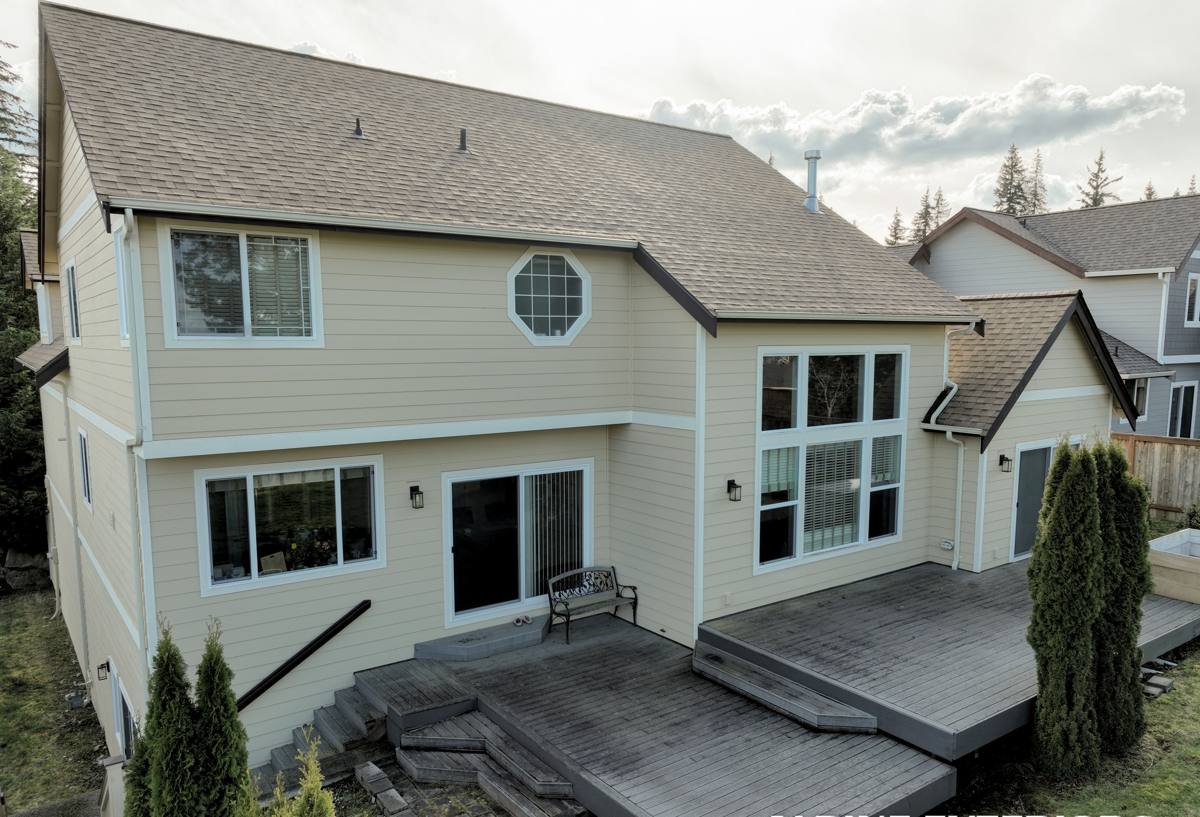
What Everson's Climate Actually Does to a Deck
Three things drive almost every deck failure we get called out for in this area:
Sustained moisture, not just rain volume
It's not any single storm that causes damage — it's the number of days per year the wood stays wet. Whatcom County's fall-through-spring pattern of steady, low-intensity rain keeps framing lumber and decking saturated for days at a time, especially on the north side of a house or under a roof overhang where sun never reaches to dry things out.
Moss and organic growth
Moss doesn't just look bad — it holds moisture against the decking surface, keeps boards from drying between rains, and makes the deck surface slick and dangerous when wet. A "long moss season" here effectively means most of the year for shaded or north-facing decks.
Fastener and hardware corrosion
Standard steel screws, nails, and joist hardware corrode faster in this climate than in drier parts of the state. Rust stains bleeding down decking boards are one of the most common signs of a deck that was built with the wrong hardware for the region.
What a Correct Deck Build Involves Here
A deck that's going to hold up in Everson's conditions isn't built any differently in terms of tools or basic carpentry — it's built differently in the details that don't show up until year three or four.
- Footings below frost depth and sized for the actual soil conditions on the lot, not just a minimum spec pulled from a generic plan
- Ledger board flashing installed correctly at the house connection — this is the single most common source of hidden rot we find on older decks
- Joist tape or a moisture barrier on top of every joist so screws don't create a wick point for water into the wood
- Corrosion-resistant fasteners and hardware rated for ground contact and treated lumber, not standard interior-grade hardware
- Proper drainage slope and spacing between decking boards so water sheds instead of pooling
- Airflow underneath the structure so the framing has a chance to dry out between rain events
Skip any one of these and the deck will probably still look fine for a few years. The problems show up underneath, where you can't see them, which is exactly why so many older decks in this area get "surprise" structural repairs.
Choosing Decking Material for This Climate
There's no single "best" decking material — there's a best material for your budget, your maintenance tolerance, and how much sun exposure the deck actually gets. Here's how the common options actually perform in Whatcom County conditions:
| Material | How it handles wet/mossy conditions | Maintenance | Rough installed cost range |
|---|---|---|---|
| Pressure-treated wood | Good if properly sealed and re-sealed; still needs airflow underneath to avoid cupping | Annual cleaning, re-stain/seal every 2-3 years | Lowest of the common options |
| Cedar | Naturally rot-resistant but softer surface; moss and mildew still take hold without upkeep | Regular cleaning and refinishing to keep its look | Mid-range |
| Composite (capped) | Doesn't absorb water or feed moss the way wood does; some uncapped composites can still stain | Occasional washing, no sealing or staining | Higher upfront |
| PVC decking | Fully synthetic, doesn't absorb moisture, most moss-resistant surface of the group | Lowest — soap and water cleaning | Highest upfront |
For a lot of Everson homeowners, the honest trade-off is upfront cost versus how much time you want to spend maintaining the deck every year. If your deck sits in a shaded, damp spot, that pushes the math further toward composite or PVC just because wood surfaces there stay wet longer and grow moss faster no matter how well they're built.
Railings and Hardware: Where Corrosion Shows Up First
Railing posts, connectors, and fasteners take more direct weather exposure than almost any other part of the deck. We use stainless or coated hardware rated for the moisture and, where relevant, any coastal-influenced air the area gets on windy days — not because code requires the upgrade everywhere, but because we've seen what standard hardware looks like after a few wet seasons here. Rust streaking down a rail post or decking board is cosmetic at first, but it's also an early warning that the fastener itself is weakening.
Common Problems on Older Everson Decks
When we're called out to look at an existing deck rather than build a new one, the issues tend to repeat:
- Soft or spongy decking near the house — almost always a ledger flashing failure letting water behind the board
- Rust-streaked fasteners and visibly corroding joist hangers
- Moss buildup so heavy the deck surface stays wet for days after rain stops
- Undersized or shifted footings on decks that were never engineered for the soil on that particular lot
- Guardrail posts that have loosened because the framing behind them softened
Most of these are repairable without a full rebuild if they're caught early. Left alone through another wet season or two, they usually turn into structural work.
Our Process
- On-site visit — we look at your lot's drainage, sun exposure, and how the deck will tie into the house before we talk materials or design
- Design and material selection — sized to your budget and how much upkeep you actually want to do long-term
- Permitting — we handle the permit and inspection requirements that apply to the build
- Framing — footings, ledger flashing, joists, and hardware installed to hold up under this region's moisture, not just to pass a one-time inspection
- Decking and railing installation — proper spacing and slope for drainage from day one
- Final walkthrough — we go over basic care so you know what to watch for as the seasons change
Maintenance That Actually Matters Here
A well-built deck still needs some seasonal attention in this climate. What actually moves the needle:
- Clear leaves and debris from between boards before fall rains set in — trapped debris is where moss gets its start
- Scrub or power-wash (carefully, at low pressure) any shaded areas showing moss at least once a year
- Check fastener heads and railing hardware annually for rust staining
- Re-seal wood decking on the schedule the product actually calls for, not "whenever it looks dry" — damage happens before the surface looks bad
- Keep gutters and downspouts near the deck clear so runoff isn't dumping extra water onto or under the structure
Why It Matters to Hire a Crew That Already Works Everson
Deck-building fundamentals are the same everywhere, but the details that determine whether a deck lasts 10 years or 25 in Whatcom County are regional. A crew that mostly builds in drier parts of the state may not default to the flashing details, fastener grades, or airflow spacing that this area actually needs — they'll build to a generic standard instead of the conditions on your lot. We work this area regularly, alongside our siding projects, and we build decks the same way we approach siding here: assume the moisture is relentless and build so the structure can shed and dry, not just repel water on a good day.
If you're planning a new deck, replacing an aging one, or just want an honest look at whether yours has hidden problems, we're happy to come take a look. Reach out for a free, no-pressure estimate using the form below.