 Blaine Siding
 Why Decks in Point Roberts Wear Out Faster
Point Roberts sits out on its own peninsula, with water on most sides and very little standing between a deck and whatever weather rolls in off the Strait of Georgia and Boundary Bay. That exposure is part of what makes the area beautiful, and it's also exactly why decks here age differently than decks fifteen miles inland. Salt-laden air corrodes metal fasteners and connectors faster than it does in drier, more sheltered parts of Whatcom County. Driving rain off the water finds every gap in flashing and every unsealed end cut. And the long, wet moss season coats north-facing boards and shaded corners in a slick green film that holds moisture against the wood long after the rain has stopped.
None of this means a deck in Point Roberts is doomed — it means it needs to be built and repaired with those specific stresses in mind. A deck that would hold up fine in a dry inland yard can fail early here if it's built the same way. That's the difference we focus on: not just replacing boards, but replacing them in a way that actually accounts for this stretch of coastline.
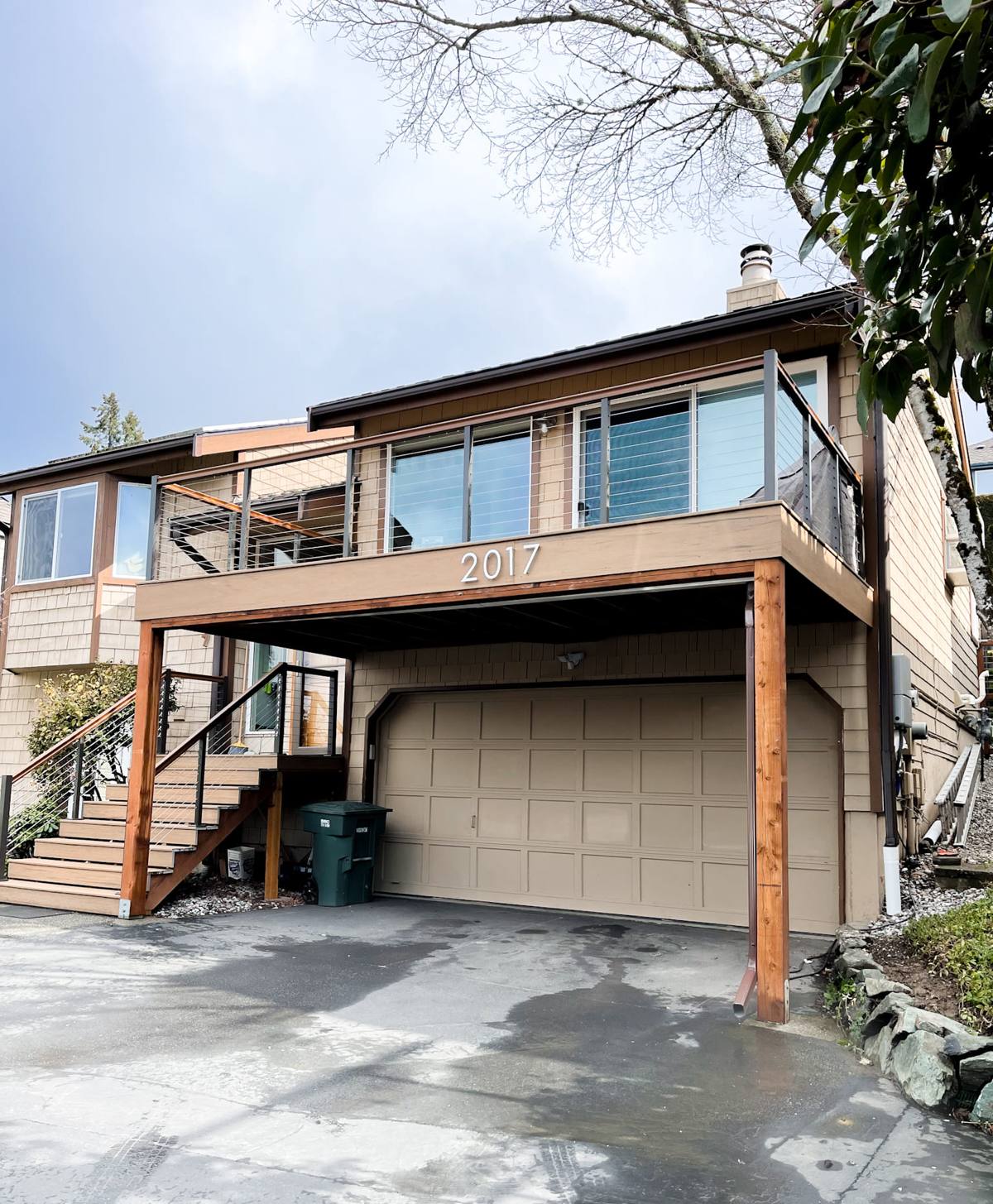
How Salt Air, Rain, and Moss Actually Damage a Deck
Salt Air and Fasteners
Standard galvanized screws and nails can start showing surface corrosion within a couple of seasons this close to salt water. Once a fastener starts to rust, it weakens at exactly the point where it's holding two boards together, and rust stains bleed into the surrounding wood or composite. Corroded ledger bolts and joist hangers are a bigger concern than cosmetic staining — those are structural connections, and a compromised one isn't something you want to discover by feel.
Driving Rain and Hidden Moisture
Wind-driven rain doesn't fall straight down — it gets pushed sideways into ledger boards, under railing posts, and into any seam that isn't properly flashed or sealed. Water that gets behind a ledger board or pools where a post meets the frame doesn't dry out quickly in our climate. It sits, and it starts rot from the inside, which is why so many deck problems out here are worse than they look from the surface.
Moss and Shaded Surfaces
Point Roberts has plenty of tree cover and plenty of overcast, damp stretches — the exact conditions moss needs. On horizontal deck surfaces, moss isn't just a slip hazard; it holds water against the wood grain, which accelerates rot and softens the surface fibers. Once moss gets established on a deck, it tends to come back season after season unless the underlying moisture and shade problem is actually addressed, not just power-washed away.
Signs Your Point Roberts Deck Needs Replacement, Not Repair
- Soft, spongy decking boards, especially near the house or in shaded areas
- Rust streaks running down from screw heads or metal connectors
- Gaps or separation where the deck meets the house (ledger board area)
- Persistent moss or algae that returns within weeks of cleaning
- Wobbly railings or posts that move when pushed
- Visible rot or a screwdriver that sinks easily into the wood at joists or beams
- A deck older than 15-20 years that has never had the substructure inspected
A few of these on their own might mean a targeted repair is enough. Several together, especially anything involving the ledger board or the framing underneath, usually means the structure has been compromised long enough that patching individual boards won't solve the underlying problem.
What a Correct Deck Replacement Involves
A deck replacement done right isn't just tearing off old boards and screwing down new ones. It's an opportunity to fix the things that caused the last deck to fail early, which matters even more in a salt-air, high-rainfall spot like this.
1. Full Tear-Off and Substructure Inspection
We remove the old decking and railing down to the framing, then actually inspect the joists, beams, posts, and — critically — the ledger board and its flashing. This is where a lot of hidden rot lives, and it's the step that gets skipped when a job is just a surface-level board swap.
2. Ledger Flashing Done Properly
The ledger board is where the deck attaches to the house, and it's the single most common source of long-term water damage on any deck in a wet climate. Proper flashing — installed so water sheds away from the house rather than behind the ledger — is non-negotiable on a correct replacement. We don't reuse old, failed flashing just to save a step.
3. Fastener and Hardware Selection for Salt Air
Given the corrosion issue described above, we use stainless steel or coated fasteners and connectors rated for coastal or marine-adjacent exposure rather than standard-grade hardware. It costs more up front and saves the homeowner from dealing with rust stains and weakened joints five years down the road.
4. Framing and Structural Repairs
Any joists, beams, or posts that show rot or insect damage get replaced, not patched around. Post bases get set so they're not sitting in standing water, and where drainage under the deck is poor, we address grading or add gaps that let air move and water escape.
5. Decking Material Matched to the Site
Shaded, moss-prone areas need a different approach than a sun-exposed deck facing the water. Material choice, board spacing, and even deck orientation relative to drainage all factor into how well the new deck resists moss buildup going forward.
6. Railings and Code Compliance
Railings get rebuilt to current code height and baluster spacing, with the same attention to corrosion-resistant hardware. This matters both for safety and because Whatcom County inspectors will check it.
Choosing the Right Decking Material for This Climate
There's no single "best" decking material for every home — it depends on budget, how much upkeep you want to do, and how exposed the deck is to salt air, shade, and standing moisture. Here's how the common options actually perform in a Point Roberts setting.
| Material | How It Handles Salt Air & Moisture | Moss/Algae Resistance | Maintenance |
|---|---|---|---|
| Pressure-treated wood | Decent if fasteners are corrosion-resistant; wood itself can still absorb moisture at cut ends | Moderate — needs regular cleaning and resealing in shaded spots | Annual cleaning, periodic staining/sealing |
| Cedar | Naturally moisture- and insect-resistant, but still needs sealed end cuts and good fastener choice | Moderate — same shaded-area concerns as any wood | Regular sealing to maintain resistance and color |
| Composite decking | Very good — doesn't absorb moisture the way wood does, resists salt corrosion in the board itself | Better, though moss can still grow on the surface film in deep shade | Low — occasional washing, no staining/sealing |
| Aluminum decking | Excellent — highly resistant to corrosion and moisture intrusion | Good, smooth surface sheds moss more easily | Very low |
We'll walk through these trade-offs against your specific deck's sun exposure, shade, and budget rather than pushing one product across the board. Cost is real for all of these, but so is what it costs to redo the job again in eight years because the wrong material was matched to the wrong spot on the property.
Cost Factors Homeowners Should Understand
We don't quote exact prices without seeing the deck, but a few factors consistently move the number up or down on Point Roberts projects specifically:
- Substructure condition: a deck with rotted framing costs more to replace correctly than one where the frame is sound and only the surface boards need replacing
- Material choice: composite and aluminum cost more up front than treated wood but typically cost less over the deck's lifetime in this climate
- Ledger and flashing work: doing this correctly takes more labor than a quick board swap, but it's what prevents the next round of hidden rot
- Access and logistics: Point Roberts' location affects how materials and crews get to the site, which we factor into scheduling and planning from the start
- Size and layout: multi-level decks, built-in benches, and stairs all add labor beyond a simple rectangular deck
Why Working With a Crew That Already Knows Point Roberts Matters
Point Roberts is part of Whatcom County, but its geography sets it apart from the rest of the county — it's separated from the rest of Washington State by water and by the international border, which means getting crews, equipment, and materials on and off the peninsula takes real planning that a contractor unfamiliar with the area often underestimates. A crew that hasn't scheduled around that logistics reality can end up with delayed material deliveries or crew days that don't go as far as planned, and that shows up as delays or corners cut on your project.
There's also the permitting side. Deck replacements that involve structural work typically require a permit through Whatcom County, and a contractor who has already pulled permits for Point Roberts work knows what inspectors want to see — particularly around ledger attachment, railing height, and footing depth — before the inspection, not after a failed one.
Finally, a crew that has actually worked decks on this peninsula has seen firsthand how fast moss comes back on a north-facing deck under tree cover, and how quickly untreated fasteners start staining a light-colored composite board. That's the kind of thing you learn from doing the work here repeatedly, not from a general decking spec sheet.
Our Process for a Point Roberts Deck Replacement
- On-site assessment — we look at the existing deck, the framing underneath where accessible, sun/shade exposure, and drainage around the site
- Material and design discussion — honest talk through the trade-offs above, matched to your budget and how the deck gets used
- Permit handling — we manage the Whatcom County permit process for structural work so you don't have to chase it down
- Scheduling around access and weather — materials and crew time are planned with Point Roberts' logistics and our wet-season weather windows in mind
- Tear-off and structural repair — full removal of the old deck, inspection and repair of framing and ledger connection
- Build-out — decking, railing, and stairs installed with corrosion-resistant hardware throughout
- Final walkthrough and inspection sign-off — we confirm the work passes county inspection and walk the finished deck with you
Maintaining Your New Deck in This Climate
Whatever material you choose, a few habits go a long way toward getting the full lifespan out of a Point Roberts deck:
- Clean debris and standing leaves off the deck surface regularly, especially in fall and through the wet moss season
- Rinse or gently scrub shaded, moss-prone areas before growth gets established rather than after
- Check railing posts and fastener heads once a year for early rust or looseness
- Keep gutters and downspouts near the deck clear so runoff isn't dumping extra water onto or under the structure
- Reseal wood decking on the manufacturer's recommended schedule — don't stretch it because it "still looks fine"
If your deck is showing rot, rust, or moss that keeps coming back no matter how often you clean it, it's worth having someone take an honest look at what's underneath before deciding whether repair or replacement makes sense. We offer free, no-pressure estimates for Point Roberts homeowners — use the form below to get a straightforward assessment of your deck and what it would take to get it right for this climate.