 Blaine Siding
 Siding Built for Grandview's Specific Weather, Not Just "Blaine Weather"
Grandview homes sit close enough to the water and the open exposure around Blaine that they take a different beating than a house a few miles inland in Whatcom County. Salt-laden air off the water accelerates corrosion on fasteners and trim. Wind-driven rain doesn't just fall on siding here — it gets pushed sideways into laps, corners, and butt joints. And the long stretch of damp, low-sun months every year gives moss, algae, and mildew months of uninterrupted growing time on anything that holds moisture. None of that is unique to one street or subdivision, but it's the reality for homes in this part of Blaine, and it's exactly what your siding installation needs to be engineered around — not just painted over.
We install James Hardie fiber cement siding exclusively, and we've done enough work in this corner of Whatcom County to know which details actually matter here: flashing at every horizontal joint, correct fastener spacing and type, real drainage behind the cladding, and factory-applied color that doesn't rely on a field-applied coat of paint to keep water out. This page is about what that looks like specifically for a Grandview siding installation — not a generic overview.
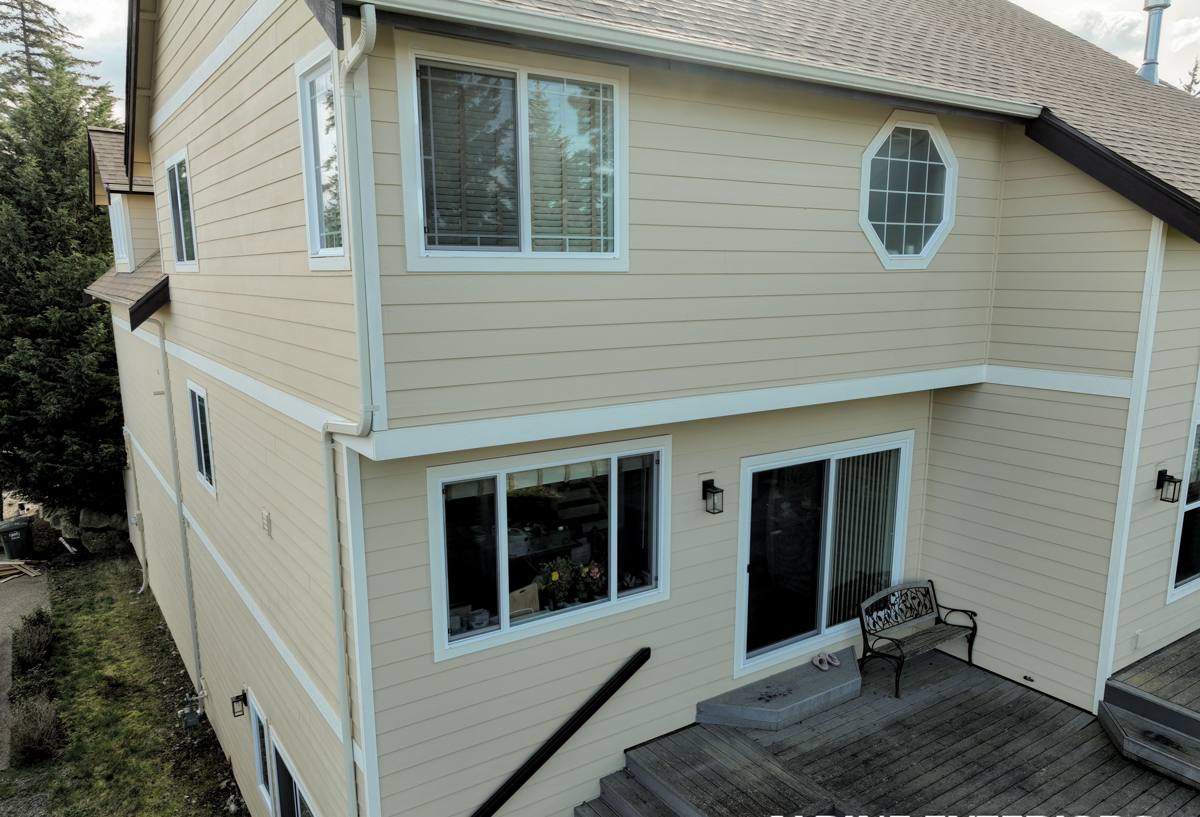
What Grandview's Climate Actually Does to Siding
Salt Air and Corrosion
Even a few miles from open water, airborne salt settles on exterior surfaces and accelerates the breakdown of anything metal that isn't rated for it. Cheap fasteners, uncoated flashing, and thin trim nails corrode faster here than they would forty miles inland. Once a fastener starts rusting, it stains the siding face, loosens its grip, and creates a path for water to track behind the cladding.
Driving Rain
Blaine's storms regularly come in sideways off the water rather than falling straight down. That matters because siding systems are designed around the assumption that most water sheds off the face — driving rain forces water into every lap, seam, and penetration instead. A siding job that isn't detailed for wind-driven rain will look fine in a still afternoon and fail during the next real storm.
The Long Moss Season
Western Whatcom County doesn't get a short shoulder season for moss and algae — it gets months of it. Anything that stays damp on north-facing walls, under eaves, or behind overgrown landscaping becomes a growing surface. Untreated wood-based products absorb that moisture and feed the growth; a dense, factory-finished fiber cement surface gives moss and algae far less to hold onto.
What a Correct Siding Installation Involves Here
A siding job is only as good as what's underneath it and how the pieces meet each other. For Grandview homes, we pay particular attention to:
- Water-resistive barrier (WRB): A continuous, properly lapped weather barrier behind the siding, not just whatever housewrap survived from the original build.
- Flashing at every horizontal transition: Windows, doors, decks, and roof-to-wall intersections are where wind-driven rain finds its way in — each one gets flashed correctly, not caulked and hoped for.
- Rainscreen or drainage gap where called for: Giving water a path to drain and air a path to dry keeps moisture from sitting against the wall assembly.
- Correct fastener type and placement: Corrosion-resistant fasteners, driven at the manufacturer's specified location and depth — not just wherever's fast.
- Proper clearances: Siding held up off decks, patios, and grade so it isn't sitting in standing moisture.
- Factory-finished color: A baked-on finish that doesn't depend on a field-applied paint job to keep water out of the substrate.
Skip any one of these and you don't get a siding failure next week — you get one in three to seven years, usually starting at a window head or a bottom course, right where this climate concentrates its abuse.
Why We Install Only James Hardie Fiber Cement
We don't install vinyl, LP SmartSide, primed spruce, cedar, or other fiber cement brands. That's a deliberate standard, not a sales pitch, and it comes down to how each of those products behaves in exactly the conditions Grandview sees every year.
Non-Combustible and Dimensionally Stable
James Hardie fiber cement is non-combustible and doesn't expand and contract with moisture and temperature the way wood-based products do. In a climate with sustained damp periods, that stability matters — it's part of why seams and paint lines hold up longer.
ColorPlus Factory Finish
Hardie's ColorPlus finish is baked on at the factory under controlled conditions, not brushed on at the jobsite in whatever weather shows up. That finish resists fading and holds its seal against moisture far better than a field-applied coat, which is one less maintenance cycle you have to chase in a climate that doesn't give paint much of a chance to cure between rain events.
Engineered for This Region
Hardie makes climate-specific HZ product lines, and the HZ5 formulation is engineered for regions like the Pacific Northwest — colder, wetter conditions where moisture management matters more than it does in a dry climate. That's a meaningful difference from a one-size-fits-all product.
Warranty That Actually Transfers
Hardie's warranty is strong and transferable to a subsequent homeowner, which matters if you ever sell — a buyer's inspector and a lender both recognize the name and the paperwork behind it.
Comparing Siding Options for a Grandview Home
| Factor | Vinyl | Wood / Primed Spruce | James Hardie Fiber Cement |
|---|---|---|---|
| Moisture behavior | Doesn't absorb, but expands/contracts and can warp; seams gap over time | Absorbs moisture, feeds moss/mildew growth, prone to rot at joints | Dense, moisture-resistant; engineered HZ lines for wet climates |
| Finish durability | Color molded in but fades and chalks; can't be easily color-matched later | Depends entirely on field-applied paint, which fails first in this climate | Factory-baked ColorPlus finish, no field paint needed to hold up |
| Fire performance | Combustible, can melt or deform near heat sources | Combustible | Non-combustible |
| Maintenance in a moss-prone climate | Periodic washing; seams trap grime | Frequent repainting and moss/rot inspection | Occasional wash; dense surface resists growth |
| Warranty | Varies widely by product tier | Typically limited to the coating, not the substrate | Strong, transferable manufacturer warranty |
This isn't about any one product being "bad" — it's about which one holds up with the least maintenance burden in Grandview's specific mix of salt air, driving rain, and extended damp seasons. That comparison is why we standardized on Hardie and stopped installing the alternatives.
Our Process for a Grandview Siding Installation
- On-site assessment: We look at your home's exposure — how much wind-driven rain and salt air it actually takes, where moisture has already caused problems, and the condition of what's underneath the current siding.
- Sheathing and WRB inspection: Before any new siding goes up, we check the sheathing for rot or soft spots and confirm the water-resistive barrier is continuous and properly lapped — or replace it if it isn't.
- Flashing and drainage detailing: Every window, door, and horizontal transition gets flashed to shed water outward, with drainage planned so moisture doesn't sit against the wall.
- Hardie installation to manufacturer spec: Correct fastener type, spacing, and clearance from grade, decks, and rooflines — installed the way Hardie's own instructions require, which is also what keeps the warranty valid.
- Final walkthrough: We go over the finished job with you, including care and maintenance specific to a Whatcom County exterior.
What to Check Before You Hire Anyone for Siding in This Area
- Do they carry proper licensing and insurance for exterior work in Washington?
- Can they explain their flashing and drainage detailing specifically, not just "we'll seal it up"?
- Do they install to the manufacturer's written installation instructions, which is usually a condition of the product warranty?
- Have they worked on homes with similar coastal exposure, not just inland siding jobs?
- Will they put the scope, materials, and warranty terms in writing before work starts?
Why Hiring a Crew That Already Works This Area Matters
A siding crew that mostly works inland, drier parts of Whatcom County can do a technically fine installation and still miss the details that matter most near the water — how far to hold siding off grade given the rain patterns here, where moss pressure is worst on a given lot's orientation, or how much extra attention flashing needs on a wall that takes rain sideways instead of straight down. None of that is exotic knowledge, but it's the difference between a job that looks right at handoff and one that's still performing correctly in year eight.
We work in and around Blaine regularly, including Grandview, and we bring the same install standards to every job: full Hardie systems, correct flashing and drainage, and factory-finished color that isn't relying on future homeowners to keep up with repainting.
What Affects the Cost of a Grandview Siding Installation
| Cost Factor | Why It Matters |
|---|---|
| Home size and wall complexity | More corners, gables, and dormers mean more cuts, more flashing details, and more labor |
| Condition of existing sheathing | Rot or moisture damage found during tear-off adds repair scope before new siding can go on |
| Siding profile and accessories | Lap width, trim style, and accessory pieces (corners, soffit, fascia) all affect material cost |
| Access and site conditions | Tight lot lines, landscaping, or multi-story sections change staging and labor time |
| Full tear-off vs. re-side | Removing old siding down to sheathing costs more upfront but lets us fully address moisture issues underneath |
We don't quote a job without seeing it — every Grandview home has a different mix of these factors, and an honest estimate has to account for your specific walls, not a generic square-footage number.
Signs Your Current Siding Is Already Losing the Battle
- Soft spots, bubbling, or visible warping, especially near the bottom courses or window sills
- Persistent moss or algae streaking that comes back within weeks of cleaning
- Paint that's peeling, chalking, or needing more frequent recoats than it used to
- Rust staining running down from fasteners or trim
- Gaps opening up at seams, corners, or where siding meets trim
Any one of these is worth a look before it turns into a sheathing repair. Caught early, it's a siding conversation. Caught late, it's a structural one.
If you're seeing any of these signs, or you're simply ready to stop maintaining a siding system that isn't built for this climate, we're happy to take a look and put together a straightforward, no-pressure estimate for your Grandview home — just fill out the form below.