 Blaine Siding
 Custom Windows Built for Grandview's Coastal Exposure
Grandview sits close enough to Semiahmoo Bay and the Strait of Georgia that salt-laden air, wind-driven rain, and long stretches of damp, low-sun weather are just part of owning a home here. Windows in this pocket of Whatcom County take a different kind of beating than windows twenty miles inland. Frame materials corrode faster, seals get tested more often, and moss and mildew find every north-facing sill that doesn't drain well. A window that's "fine" in a drier climate can fail early here if it wasn't specified and installed with this exposure in mind.
We install custom windows for homes in and around Grandview regularly, and the conversation almost always starts with the same question: what actually needs to be different about a window here, versus a standard big-box unit? The honest answer is: frame material, glazing package, flashing detail, and installation sequencing all matter more than they would in a milder climate.
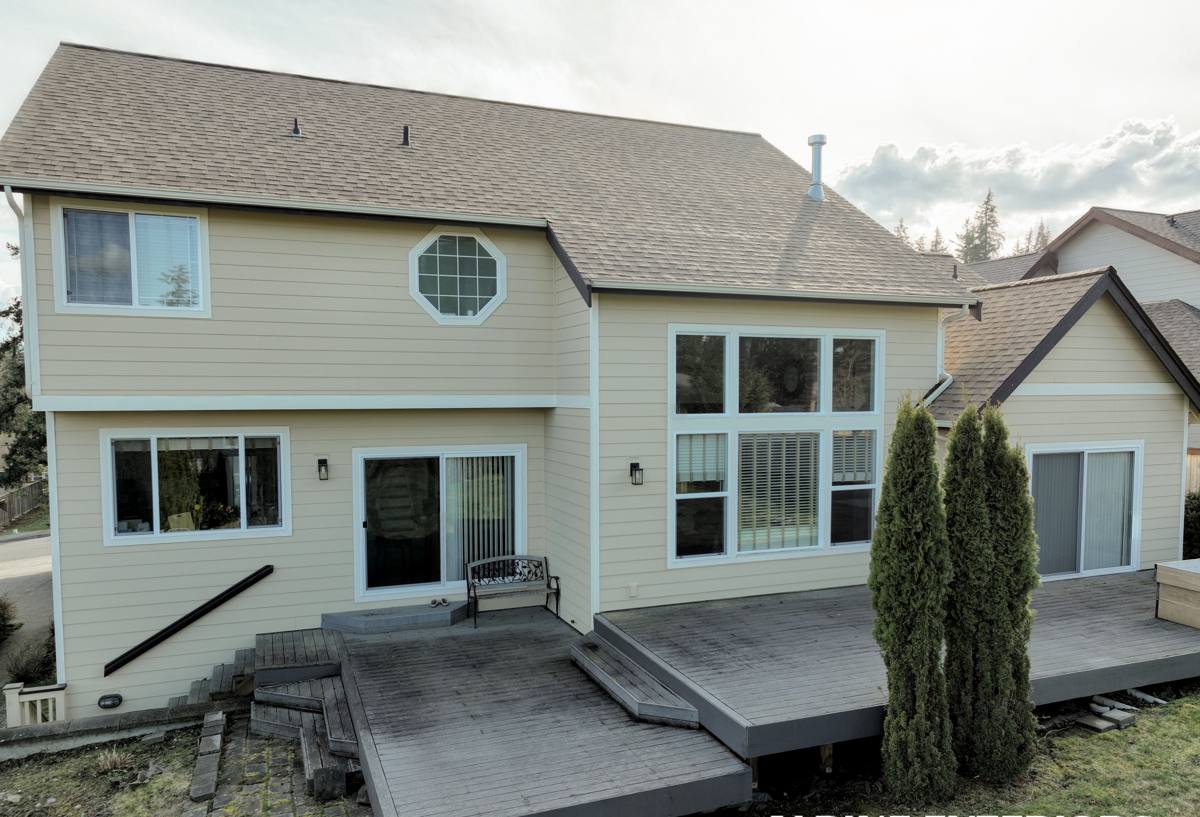
What "Custom" Actually Means for a Grandview Home
Custom doesn't have to mean expensive or unusual shapes. For most Grandview homes it means the window is sized, framed, and specified to fit an existing rough opening exactly — no resizing the wall, no filler panels, no compromises on sightlines. It also means choosing a configuration that suits how the house is used: bigger fixed panes to catch water views without adding operable hardware that has to seal against wind, or taller casements on a wall that takes rain straight on.
Common reasons homeowners go custom instead of stock
- Original openings are non-standard sizes (common in homes built before modern window sizing became uniform)
- Replacing an odd shape — arched, angled, or a large picture window — that stock lines don't cover
- Upgrading from single-pane or early dual-pane units that were undersized for today's energy expectations
- Matching a specific sightline or grid pattern to preserve a home's original character
- Combining multiple units into one opening (a bay, bow, or picture-plus-casement combo)
Frame Material: The Decision That Matters Most Here
In a salt-air, high-moisture environment, frame material is where a lot of window jobs succeed or quietly fail over the following decade.
Vinyl
Good moisture resistance, no corrosion risk, and the most cost-effective option for most Grandview homes. Modern vinyl frames with welded corners and reinforced sash hold up well against wind-driven rain, and there's no paint to maintain. The trade-off is fewer color and trim-profile choices than wood or fiberglass, though most manufacturers now offer several exterior color options that hold up under UV.
Fiberglass
Dimensionally stable in temperature swings, resists moisture absorption, and takes paint well if a homeowner wants a custom exterior color to match trim. It's a strong choice for larger openings — picture windows and bays — where a frame needs to stay true over a wide span. It costs more than vinyl.
Wood and wood-clad
Wood interiors look great and are common in older Whatcom County homes, but a bare wood exterior exposed to this much rain and salt air is a maintenance commitment — regular inspection, caulking, and repainting. We generally steer Grandview clients toward wood-clad units (wood interior, aluminum or vinyl-clad exterior) so the look is preserved without the exterior upkeep burden. It's a fair trade-off to be upfront about, not a knock on wood itself.
Aluminum
Strong and slim-profile, but aluminum conducts heat and cold efficiently, which means more condensation risk on interior surfaces during Blaine's cool, damp months unless it has a proper thermal break. We don't recommend uninsulated aluminum frames for this climate as a primary window material.
| Frame Material | Salt Air Resistance | Maintenance | Typical Cost Tier |
|---|---|---|---|
| Vinyl | Excellent — no corrosion | Low — no painting | Lower |
| Fiberglass | Excellent — stable, paintable | Low to moderate | Higher |
| Wood-clad | Good — exterior is protected | Moderate — interior wood care | Higher |
| Bare wood | Fair — needs diligent upkeep | High — regular repainting/sealing | Mid to higher |
| Uninsulated aluminum | Fair — can corrode over time | Low, but condensation risk | Lower to mid |
Glazing and Seals: Where Driving Rain Finds Weak Spots
A window can have the right frame and still fail if the glazing package and seals aren't matched to the exposure. For Grandview homes, especially anything with a west or water-facing wall, we look at a few specifics:
- Dual or triple-pane glass with warm-edge spacers, which resist seal failure better than older metal spacers in freeze-thaw and humidity cycling
- Low-E coatings to manage heat loss during the long gray stretch of the year without darkening the glass noticeably
- Multi-point locking hardware on operable units, which compresses the sash evenly against the weatherstripping — a real difference during wind-driven rain events
- Sloped sills and integrated weep systems so any water that does get past the outer seal drains back out instead of sitting in the frame
None of this is exotic. It's standard on quality window lines — the point is making sure it's actually specified, not assumed, when a homeowner is comparing quotes.
Flashing and Installation: The Part That Determines Whether Any of This Lasts
We say this on every job because it's true everywhere but especially true here: the window itself is rarely what fails first. It's the flashing and integration with the wall's water-resistive barrier. A well-built window installed with a gap in the flashing, or without proper sill pan protection, will let water into the wall assembly regardless of how good the window is.
What correct installation looks like
- Remove the old unit and inspect the rough opening for hidden rot, moss growth, or prior water staining before anything new goes in
- Install a sloped sill pan flashing so any incidental water drains outward, not into the wall cavity
- Integrate window flashing with the existing house wrap or weather barrier in the correct shingle-lap order (bottom to top) so water sheds down and out
- Set the window level, plumb, and square, then shim and fasten per manufacturer spec — not just "close enough"
- Seal the interior air barrier separately from the exterior water barrier — these are two different jobs and mixing them up traps moisture
- Finish exterior trim and caulking with a sealant rated for the temperature swings and UV exposure this area sees
Skipping or rushing any one of these steps is how a five-year-old "new" window ends up with rot in the surrounding framing. This is also the main reason we don't recommend any installer who wants to reuse existing flashing or skip the sill pan step to save time — it's the single most common cause of callback problems we see on older jobs done elsewhere.
Moss, Algae, and the Long Gray Season
Whatcom County's moss season isn't limited to roofs. North- and west-facing window sills, especially wood or poorly-drained vinyl sills, collect organic growth over a wet fall and winter if they don't shed water cleanly. This is largely a design and drainage issue, not just a cleaning issue:
- Sills with a proper slope and clear weep holes drain fast enough that moss doesn't get a foothold
- Rough-sawn or textured sill materials hold moisture longer than smooth vinyl or clad finishes
- Overhangs and trim details that direct water away from the sill reduce standing moisture significantly
When we replace windows on a Grandview home, we look at how water has historically behaved on that wall — staining, moss patterns, past caulk repairs — and adjust the sill and flashing detail accordingly, not just swap old-for-new in the same configuration.
Our Process for a Grandview Window Project
1. On-site assessment
We look at each opening individually — condition of the framing, current moisture evidence, sun and wind exposure per wall, and what the homeowner actually wants to change (energy performance, sightlines, ease of operation, appearance).
2. Product and glazing recommendation
We recommend frame material and glazing based on that wall's specific exposure, not a one-size answer for the whole house. A sheltered side yard window may not need the same spec as an exposed water-facing wall.
3. Measurement and ordering
Custom units are measured precisely to the existing or corrected opening. We account for any resizing, squaring, or rot repair needed before ordering so there's no guesswork when the windows arrive.
4. Removal, repair, and installation
Old units come out carefully so we can inspect the opening. Any hidden rot or framing damage is repaired before the new window goes in — this is not an optional step we skip to save a day.
5. Flashing, sealing, and finish work
Sill pan, flashing integration, insulation, and exterior trim finishing are done to the sequence described above, with attention to how that specific wall handles wind and rain.
6. Walkthrough
We check operation, sealing, and finish with the homeowner before considering the job complete.
Cost Factors Homeowners Should Know Going In
Every Grandview home is different, but the same handful of factors drive most of the cost variation between window quotes:
| Factor | Why It Matters |
|---|---|
| Frame material | Vinyl, fiberglass, and wood-clad carry different material and labor costs |
| Opening condition | Rot repair or resizing adds labor beyond a straight swap |
| Glazing package | Triple-pane and upgraded Low-E coatings cost more than standard dual-pane |
| Size and configuration | Large picture windows, bays, and multi-unit combinations cost more than a single standard casement |
| Wall exposure | Water-facing or high-wind walls may need upgraded flashing details, adding labor time |
| Number of units | Whole-house projects typically bring a better per-unit rate than one-off replacements |
Broadly, homeowners in this area should expect a meaningful range between a basic vinyl replacement and a larger custom fiberglass or wood-clad unit with upgraded glazing — enough of a spread that it's worth getting a specific, itemized quote for your home rather than relying on a general number.
Why a Locally-Experienced Crew Matters More Than It Sounds
Any competent installer can hang a window on a calm day. What separates a good job from one that fails in five years is understanding how a specific wall behaves in Whatcom County's weather pattern — where wind-driven rain actually hits hardest, which sills collect moss, how salt air affects a given frame material over time. A crew that works Grandview and the broader Blaine area regularly has already seen how different products and installation details hold up here, not in a showroom or in a different climate's install guide. That local pattern recognition is what shows up as fewer callbacks and longer-lasting seals.
Signs Your Current Windows Are Already Losing the Battle
- Condensation building up between panes (a sign the seal has failed)
- Difficulty opening or closing sashes, or hardware that feels loose
- Visible gaps, soft spots, or discoloration in the surrounding trim
- Persistent moss or algae buildup on sills that returns shortly after cleaning
- Noticeable drafts or a cold wall area near the window in winter
- Rising energy bills without another clear explanation
If you're seeing two or more of these on a window that faces the water or prevailing wind, it's worth having it looked at before the surrounding framing is affected.
If you're weighing window replacement for a Grandview home, we're happy to take a look and talk through what your specific walls need — no pressure, no obligation. Use the form below to request a free estimate.