 Blaine Siding
 Why Siding Repair Looks Different in Dakota Creek
Dakota Creek sits close to the water on Blaine's edge, in a stretch of Whatcom County where the climate doesn't do siding any favors. Salt-laden marine air moves through the area on a near-daily basis, driving rain comes in sideways off the water during fall and winter storms rather than falling straight down, and a moss season that can stretch for eight months or more takes hold in every shaded, damp corner of a lot. None of that makes siding repair here more complicated than anywhere else in the Pacific Northwest — it just means the failure points show up in different places, and a repair that ignores those local conditions tends to fail again within a season or two.
We work on siding across Blaine and Whatcom County, but Dakota Creek's proximity to the water means we see certain problems here more often and earlier than we do further inland: corroded fasteners, moss-driven staining and trapped moisture, and caulk joints that gave out years before they should have. A repair crew that already knows this pattern gets to the actual cause faster, instead of treating the symptom and sending you the same bill again in two years.
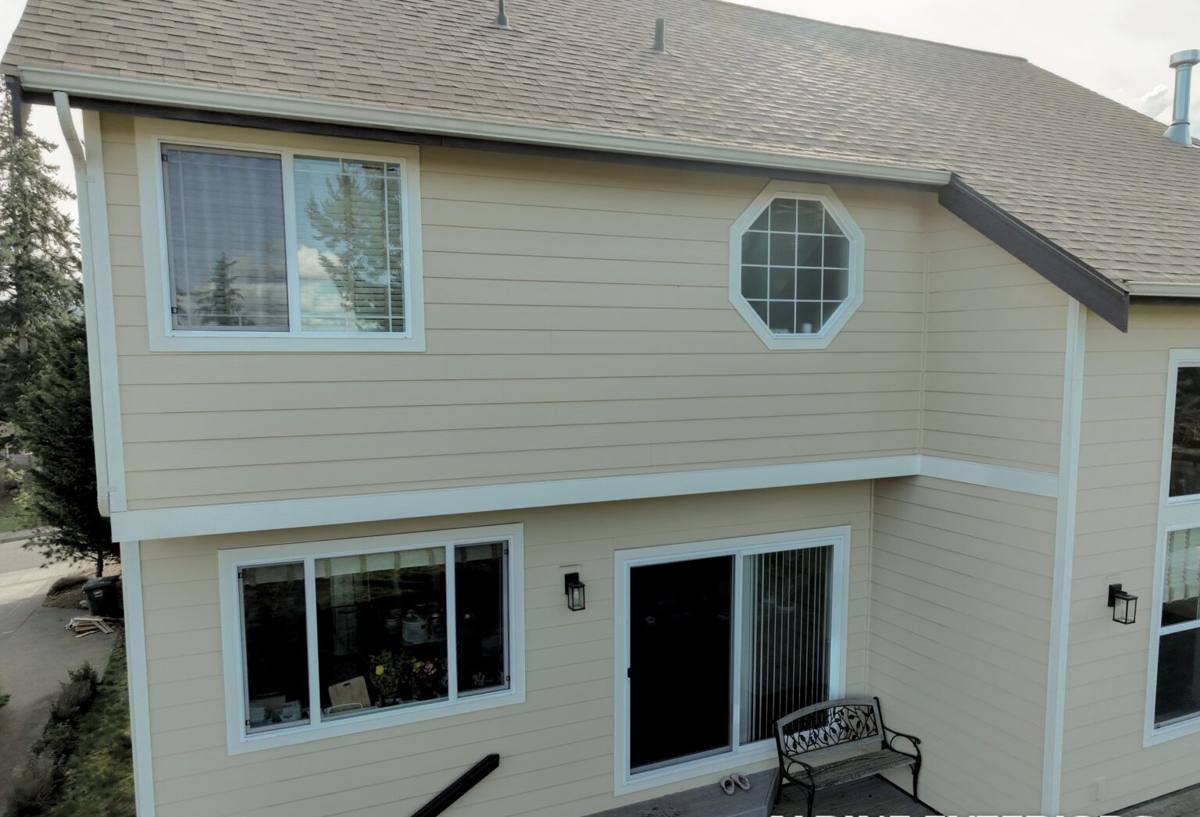
Common Siding Repair Issues We See in Dakota Creek Homes
- Moss and algae staining on north- and shade-facing walls, especially under eaves, near fences, and close to mature trees
- Rot at board butt joints and cut ends where the original caulk failed and water sat against the material for a season or more
- Corroded, loosened, or backed-out fasteners — common on older installations that used standard rather than corrosion-resistant hardware
- Cracked, cupped, or split boards from repeated wet-dry cycling, most often near grade, downspouts, and sprinkler zones
- Trim rot at window and door casings and at inside corners, where wind-driven rain finds the smallest gap and works its way in
- Brittle or shrunken caulk joints that were never rated for this kind of sustained coastal moisture exposure in the first place
What a Correct Siding Repair Actually Involves
A repair that only covers a stain, patches a hole, or lays a fresh bead of caulk over a soft spot isn't a repair — it's a delay. The stain, the hole, and the soft caulk are symptoms. If the water path underneath isn't found and closed, whatever's behind the new patch keeps getting wet, and the damage keeps spreading under a surface that now looks fine from the driveway.
Diagnose the Water Path First
Before any board comes off, we trace where water is actually getting in: a failed joint, a gap in flashing above a window or door, a seam that was never properly lapped, or siding that was installed too close to grade or a hard surface. Cutting out a damaged section without answering that question means the replacement piece is on borrowed time too.
Repair vs. Replace
Not every problem needs a full re-side, and not every problem should be patched. The table below is a general guide — the actual call depends on how far the damage has spread and what we find once a section is opened up.
| Situation | Usually a Repair | Usually Points to Replacement |
|---|---|---|
| Damage location | Isolated to a few boards, one wall, or one trim run | Recurring across multiple walls or elevations |
| Underlying structure | Sheathing and framing are sound once exposed | Soft or damaged sheathing found behind more than a small area |
| Cause | A single identifiable failure point (caulk, flashing, a cracked board) | Siding is simply past its service life or was installed without proper details |
| History | First repair call at this location | Same area has already been patched once or twice before |
Our Siding Repair Process
- On-site inspection — we walk the exterior, not just the spot you called about, since Dakota Creek's exposure means damage often shows up in more than one place at a time.
- Moisture check — suspect boards and trim get probed or metered so we're not guessing about how far the damage extends.
- Open the area — enough siding comes off to expose the actual cause, not just the visible symptom.
- Fix the cause — flashing, drainage, or a caulk detail gets corrected before anything new goes back on.
- Rebuild with matched materials — damaged boards and trim are replaced with product that matches the existing profile and finish as closely as possible.
- Finish and blend — seams, caulk lines, and touch-up are done so the repair doesn't stand out from the rest of the wall.
- Walkthrough — we show you what we found and what we did about it, in plain terms.
Repairing Hardie Siding vs. Other Materials
Most of the repair calls we get in Dakota Creek involve one of a handful of materials: fiber cement, vinyl, LP SmartSide, or cedar. As a company, James Hardie fiber cement is the only siding we install — no vinyl, no LP SmartSide, no primed wood — and that shapes how we approach a repair depending on what's already on your walls.
If your home is already sided in James Hardie, a repair is usually the cleanest kind of job: we can match the plank profile, cut a matching piece from the same product line, and get a close finish match, especially with ColorPlus factory-finished siding, because we're working within a system built to be repaired and re-matched. If your home has vinyl, LP SmartSide, or cedar, we'll still do honest, correct repair work — closing the actual water path, replacing damaged material, sealing it properly. What we won't do is oversell a patch as a permanent fix on a wall that's structurally showing its age, or pretend a repeated repair call is a coincidence. If a material is failing in the same spots year after year, we'll say so plainly and talk through what replacing that section — or eventually the whole elevation — with Hardie would actually involve, without pressure either way.
Materials and Details We Use in a Repair
- Matched Hardie plank, panel, or trim pulled from the same product line as your existing siding, when the home is already Hardie-sided
- Corrosion-resistant fasteners — an important detail this close to salt air, where standard hardware corrodes faster than the siding around it
- Sealants and caulk rated for sustained marine moisture exposure, not general-purpose product that shrinks and cracks within a couple of seasons
- Corrected flashing and lap details at the specific point of failure, not just a fresh caulk bead over the old mistake
- Repair or replacement of the underlying water-resistive barrier where it's been compromised, before new siding goes back over it
What Drives the Cost of a Siding Repair in Dakota Creek
| Factor | Why It Matters |
|---|---|
| Extent of visible damage | A few boards costs far less than a full wall section, and the difference is often only clear once the wall is opened |
| Hidden rot or sheathing damage | Water that's been sitting behind siding for a season or more can spread beyond what's visible from outside |
| Accessibility | Second-story walls, tight side yards, and areas near landscaping add time and equipment |
| Matching existing siding | Matching an older or discontinued color/profile takes more sourcing time than a straightforward same-product repair |
| Moss or mold remediation | Heavy growth needs proper treatment and cleanup before repair work begins, not just a spray-and-cover |
Broad, honest ranges only apply once we've actually seen the damage — a same-day estimate call over the phone tends to under- or over-shoot once a wall is opened, which is why we look before we quote.
Why It Matters to Hire a Crew That Already Works Dakota Creek
A contractor who mostly works drier, inland jobs can still do competent work, but they're often solving for a different set of problems than the ones Dakota Creek homes actually have. A crew that's already familiar with this stretch of the Blaine coastline knows which walls take the worst of the wind-driven rain, how long moss actually takes to come back after treatment in this microclimate, and which fastener and sealant choices hold up here instead of just on paper. That local pattern recognition is the difference between a repair that lasts and one you're calling about again.
After the Repair — A Simple Maintenance Checklist
- Rinse siding and treat moss-prone areas at least once a year, more often on shaded or north-facing walls
- Keep gutters and downspouts clear so water is directed away from the siding, not running down the face of it
- Inspect caulk joints annually, especially around windows, doors, and trim, and re-caulk before a joint fully opens up
- Trim back vegetation and keep mulch or landscaping from holding moisture directly against the siding
- Watch for new staining, soft spots, or bubbling paint, and address them early rather than waiting for a full season
- Confirm grading and drainage still slope water away from the foundation and lower siding courses
If you're seeing staining, soft boards, failing caulk, or other signs of wear on a Dakota Creek home, we're happy to take a look and give you a straightforward read on whether it's a repair, and what that would actually involve. Reach out for a free, no-pressure estimate using the form below.