 Blaine Siding
 Why Board & Batten Suits California Creek Homes
California Creek sits in the low, wooded pocket of northern Whatcom County between Blaine and the Semiahmoo peninsula, and a lot of the homes out here lean toward the same general character: rural lots, mature tree cover, farmhouse or craftsman rooflines, and a fair number of newer builds designed to look like they belong on acreage rather than in a subdivision. Board and batten siding fits that look better than almost anything else on the market. The vertical lines read as taller and more substantial than horizontal lap siding, and the style has a long history on barns, sheds, and farmhouses in exactly this kind of setting, which is probably why we keep getting asked for it out here more than in some of Blaine's tighter in-town lots.
Board and batten is not just a look, though. Done correctly, it is also one of the more forgiving profiles for a property with tree cover and shade, because the vertical channels shed water down and off the wall rather than collecting it along a horizontal shadow line the way some lap profiles can if they are installed too tight. That matters more in this specific pocket of the county than it does in drier, more open parts of Whatcom County.
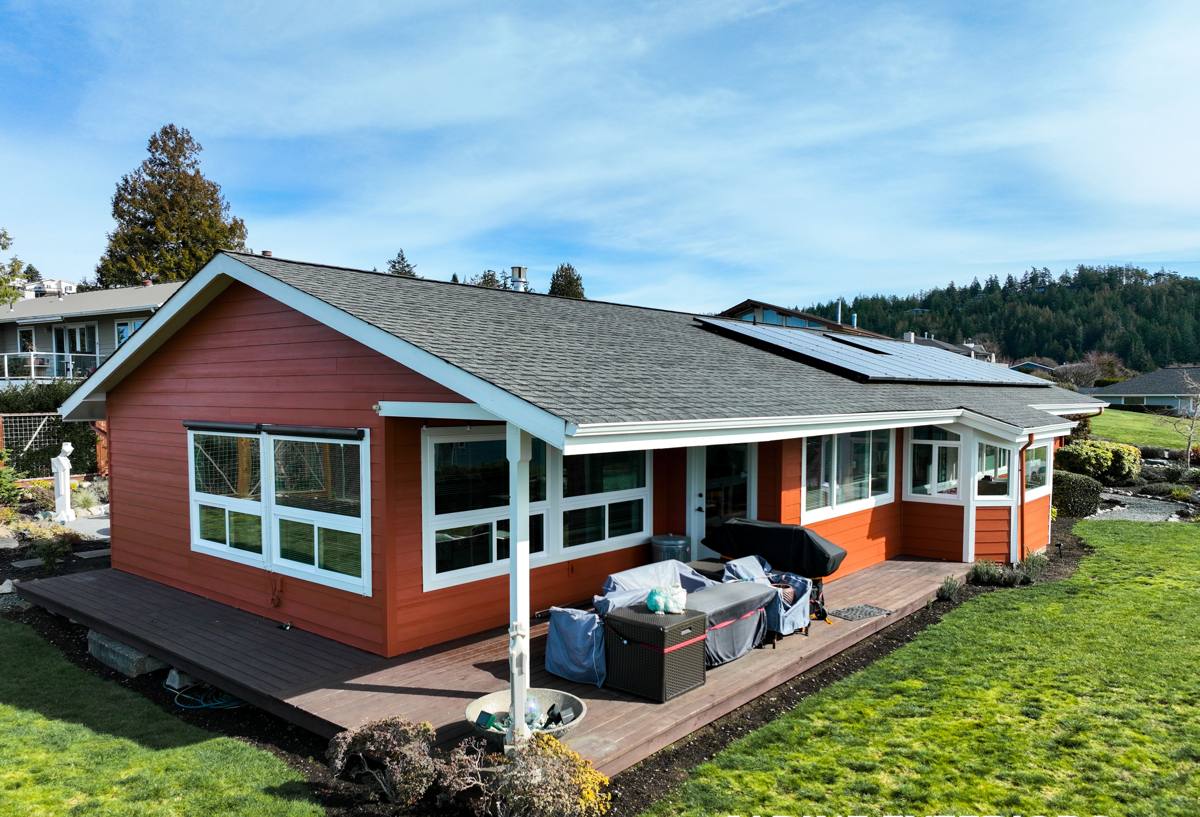
What This Climate Actually Does to Siding
Three things work against exterior siding in the California Creek area at the same time, and most siding failures we get called out to inspect are some combination of all three:
Salt Air
Proximity to Semiahmoo Bay and Drayton Harbor means a steady low-grade exposure to salt-laden air, even on lots that are not waterfront. Salt air accelerates corrosion on exposed fasteners, staples, and unprotected metal trim, and it breaks down cheap paint films faster than an inland location would see.
Driving Rain
Blaine sits in a wind corridor off the Strait of Georgia, and storms here don't just drop rain straight down — they push it sideways into wall assemblies. Any siding installed without a proper drainage plane behind it, or with joints and laps that were never meant to shed wind-driven water, will eventually let moisture behind the cladding. Vertical board and batten is more exposed to this than lap siding at the batten seams specifically, which is why those seams are the single most important detail to get right.
Long Moss Season
The tree cover and creek-adjacent humidity around California Creek keep siding damp for long stretches of the fall, winter, and spring. That's ideal growing conditions for moss and algae on any surface that holds moisture or stays shaded most of the day. A siding material that absorbs water gives moss something to root into; a material that doesn't absorb water just gets a surface film that hoses off.
What a Correct Board & Batten Job Involves
Board and batten looks simple from the curb — vertical panels or boards with a batten strip covering each seam — but the installation has more failure points than a standard lap job if it's rushed. A correct install includes:
- A continuous weather-resistive barrier behind the siding, lapped correctly at every seam and penetration
- A rainscreen gap (typically furring strips) so water that does get behind the panel has somewhere to drain and dry, rather than sitting against the sheathing
- Properly flashed window and door openings, installed before the siding goes on, not caulked in afterward
- Battens fastened only through the underlying panel into framing, with the right fastener spacing so the batten doesn't cup or pull loose over time
- Correct clearance at grade, roof lines, and decks so the bottom edge of the siding is never sitting in standing water or buried under mulch or soil
- Factory-finished edges and cut ends sealed per the manufacturer's instructions, since a raw, unsealed cut edge is where water gets in first
Skip any one of these and the siding can still look fine for a year or two. The problems show up later, usually as moss taking hold at a joint that's staying wet, or paint failing along a batten where a fastener was driven wrong and is wicking moisture into the board.
The James Hardie Board & Batten System We Install
We install James Hardie fiber cement exclusively, and for board and batten that generally means HardiePanel vertical siding with HardieTrim battens over the seams, finished in a factory-applied ColorPlus finish. A few things about that system matter specifically for this climate:
It Doesn't Absorb Water Like Wood-Based Panels
Fiber cement is engineered from cement, sand, and cellulose fiber, which means it doesn't swell, rot, or feed fungal growth the way wood or wood-composite panels can. That's a direct answer to the moss and algae pressure this area sees — moss can still grow on the surface film that forms on any siding left damp long enough, but it isn't rooting into the substrate the way it will on a softer material.
Climate-Engineered for This Region
James Hardie makes region-specific HZ product formulations, and the Pacific Northwest falls into the HZ10 zone engineered for moisture exposure. That's not a marketing label — it affects the actual composition of the board for better performance against the freeze-thaw cycles and sustained damp conditions common here.
Factory Finish, Not Field Paint
ColorPlus finish is baked on at the factory under controlled conditions, which holds up to salt air and UV exposure far better than field-applied paint, and it carries its own finish warranty separate from the substrate warranty. Cut edges still need field treatment, which is one of the installation steps above that gets skipped when crews are moving fast.
Board & Batten vs. Other Siding Approaches
| Factor | Board & Batten (Hardie) | Lap Siding (Hardie) | Vinyl or Wood-Based Panels |
|---|---|---|---|
| Visual style | Vertical, farmhouse/craftsman character | Traditional horizontal shadow lines | Varies, often mimics one of the above |
| Moisture behavior in driving rain | Good if batten seams and rainscreen are done correctly | Very good; laps naturally shed water | Depends heavily on substrate; wood-based panels absorb moisture |
| Moss/algae resistance | High — non-organic substrate | High — non-organic substrate | Low to moderate on wood-based products |
| Salt air durability | Strong with factory finish, stainless/coated fasteners | Strong with factory finish, stainless/coated fasteners | Variable; vinyl can become brittle, wood panels degrade faster |
| Installation sensitivity | Higher — batten seams are the critical detail | Moderate — well-understood lap technique | Varies by product |
Our Process on a California Creek Job
Because a lot of California Creek properties sit on wooded, sloped, or creek-adjacent lots, we spend more time up front on site assessment than we would on a flat in-town lot. That generally looks like:
- An on-site walkthrough to check existing wall condition, moisture readings behind the current siding where accessible, drainage at grade, and tree/shade exposure on each elevation
- A written scope covering tear-off, any sheathing repair needed, house wrap, rainscreen furring, flashing details at every opening, and the specific Hardie board and batten profile and color
- Material order and delivery, staged to keep panels dry and out of direct ground contact before installation
- Installation following James Hardie's published fastening and clearance specifications, not shortcuts
- A final walkthrough with the homeowner covering seams, trim, caulking, and touch-up before we consider the job complete
Why a Crew That Already Works This Area Matters
A siding crew's specs and materials matter, but so does whether they've actually dealt with the specific conditions on your lot type. Crews who work regularly around Blaine and the California Creek area already know which elevations on a shaded, creek-adjacent property tend to hold moss first, how far to keep siding off grade on lots with poor drainage, and how much more attention wind-driven rain deserves on an exposed gable versus a sheltered wall. That's not something a crew coming from a drier or more urban area necessarily accounts for on the first job. It also means less guesswork on permitting and inspection expectations specific to Whatcom County, since we've been through that process here before.
Keeping Board & Batten Looking Right After Installation
Correct installation does most of the work, but a little homeowner maintenance goes a long way in this climate:
- Rinse siding on shaded, moss-prone elevations once or twice a year with a garden hose — avoid pressure washers, which can force water behind panels or damage the finish
- Keep gutters clear so overflow isn't running down the wall face and staying trapped at a batten seam
- Trim back branches and shrubs that keep siding shaded and damp longer than the rest of the house
- Have caulking at trim and penetrations checked every few years, since caulk fails well before the fiber cement does
- Address any soil, mulch, or landscaping that has crept up over the recommended clearance at the base of the wall
If you're weighing board and batten for a home in California Creek, we're glad to walk the property, look at what your current siding is doing (or failing to do), and put together a straightforward, no-pressure estimate for a James Hardie board and batten install built for this specific stretch of Whatcom County.