 Blaine Siding
 Why Blaine Harbor Homes Wear Out Siding Faster
Houses near the water in Blaine take a different kind of beating than homes ten miles inland. Salt-laden air off the harbor settles on every exterior surface, wind-driven rain gets pushed sideways into laps and seams that would stay dry elsewhere, and the shaded, damp stretches of the year that define a Whatcom County winter give moss and algae months at a time to get established on north- and west-facing walls. None of this is exotic weather. It's just relentless, and siding here needs to shed water, resist corrosion at the fasteners, and survive constant damp-dry cycling without swelling, cupping, or losing its finish.
We install James Hardie fiber cement siding exclusively, and Blaine Harbor is one of the areas where that decision matters most. Fiber cement doesn't rot, it doesn't feed the organic growth that thrives in a marine, shaded climate, and it holds a factory-applied finish through the kind of freeze-thaw and salt exposure that strips paint off wood and chalks vinyl within a handful of seasons.
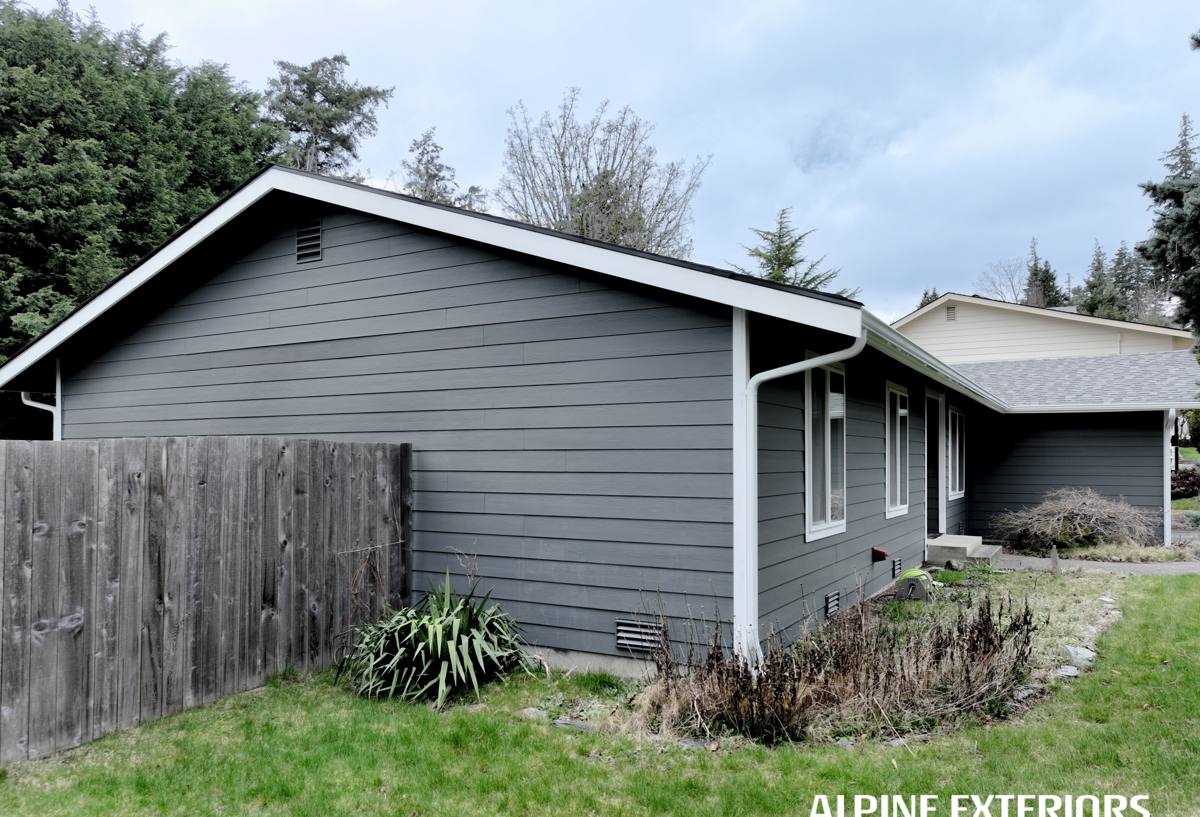
What Salt Air and Driving Rain Actually Do to Exterior Walls
Salt Air
Airborne salt is corrosive to metal and abrasive to unprotected wood fiber. Over years, it accelerates fastener corrosion, degrades caulking faster than inland exposure would, and leaves a fine residue that holds moisture against the wall surface longer after a storm passes. Materials and hardware that aren't rated for coastal exposure age visibly faster in a harbor setting than they would just a few miles away.
Driving Rain
Blaine sits exposed to weather moving in off the water, and wind-driven rain doesn't fall straight down — it gets forced up under laps, into unsealed joints, and behind trim that isn't properly flashed. A siding system that only manages rain falling vertically isn't enough here. The lap spacing, the flashing details, and the water-resistive barrier underneath all have to assume rain is coming in sideways some of the time.
The Long Moss Season
Shaded walls, tree cover, and the region's long stretch of overcast, damp days give moss and algae an extended window to take hold. Once organic growth establishes on a wall, it holds moisture against the surface and accelerates whatever degradation is already happening underneath. Siding that can be cleaned without damaging its finish, and that doesn't have an absorbent surface for spores to grip in the first place, holds up dramatically better through a normal Whatcom County winter.
Why James Hardie Is Built for This
James Hardie fiber cement is manufactured in climate-specific formulations, with a wetter-climate configuration engineered specifically for regions like the Pacific Northwest where moisture exposure is higher and more sustained than in drier parts of the country. That matters here in a way it wouldn't in an arid climate — the board itself is formulated to hold up to prolonged dampness rather than just tolerate the occasional storm.
A few specific properties do the real work on a harbor-facing home:
- Fiber cement is non-combustible and dimensionally stable — it doesn't swell, cup, or split the way wood-based siding can after repeated wetting and drying cycles.
- The ColorPlus factory finish is baked on under controlled conditions and backed by its own finish warranty, which holds up to salt exposure and UV far better than field-applied paint.
- The board's density and finish give algae and moss less to grip onto compared to wood, and a pressure-washing or gentle cleaning doesn't strip the color the way it can with painted wood siding.
- Corrosion-resistant fasteners and trim, matched correctly to the product, close the loop on hardware being the weak point in a coastal install.
None of that is a substitute for correct installation. Hardie siding installed with the wrong fasteners, insufficient gapping, or careless flashing will still fail in a marine climate — it just fails more slowly than the alternatives would. The material buys you a much bigger margin for error over time, but the installation still has to be right.
What a Correct Installation Involves in a Harbor-Exposed Setting
Weather-Resistive Barrier and Flashing
Everything starts underneath the siding. A continuous, properly lapped weather-resistive barrier, correctly flashed windows and doors, and flashed head trim at every horizontal transition are what actually stop wind-driven rain from reaching the sheathing. On a harbor-exposed wall, we treat flashing detail as non-negotiable, not an upgrade.
Fastening and Gapping
James Hardie specifies exact fastener types, spacing, and gapping requirements, and those specs shift depending on climate exposure. In a salt-air environment we use corrosion-resistant fasteners rated for the exposure, and we hold the gaps at joints and penetrations to the tolerances that let the board expand and contract without trapping water.
Drainage Plane Behind the Siding
A drainage gap behind the siding gives any incidental moisture that gets past the outer layer a path to drain and dry out instead of sitting against the sheathing. This detail matters more on a wall that's regularly hit with driving rain than it does on a sheltered, inland elevation.
Caulking and Sealant Placement
Hardie's own installation guidance is specific about where caulking belongs and where it doesn't — over-caulking traps moisture just as reliably as under-caulking lets it in. Getting this balance right is part of what separates a correct install from a fast one.
Where Installations Go Wrong on Coastal Homes
Most of the callbacks we see on coastal and harbor-adjacent homes trace back to a handful of repeatable mistakes, not to the siding material itself. Here's how a correct install compares to the shortcuts that cause problems down the road:
| Detail | Correct Practice | Common Shortcut |
|---|---|---|
| Fasteners | Corrosion-resistant, spec'd for coastal exposure and driven per Hardie's pattern | Standard fasteners that corrode and stain the face of the board within a few seasons |
| Joint gapping | Consistent gaps sized for expansion, sealed per manufacturer spec | Tight or inconsistent gaps that trap water or crack the board |
| Flashing | Continuous, lapped correctly at every window, door, and horizontal transition | Reused or skipped flashing to save time on a re-side |
| Drainage plane | Rainscreen gap maintained behind the entire field of siding | Siding installed tight to the barrier with no drainage path |
| Cut edges | Field-cut ends sealed per manufacturer guidance | Raw cut ends left unsealed, inviting moisture absorption |
Every one of these shortcuts is invisible once the wall is closed up. They only show up years later as staining, cracking, or rot at the sheathing — which is exactly why the installer's discipline matters as much as the product on the wall.
Our Process for a Blaine Harbor Siding Job
Assessment and Exposure Read
We start by looking at how each elevation of the home is actually exposed — which walls take direct weather off the water, which stay shaded and prone to moss, and where existing moisture damage might already be hiding behind the current siding. That read drives decisions on flashing detail, fastener spec, and where extra attention is warranted.
Removal and Sheathing Check
Once the old siding comes off, we inspect the sheathing and framing underneath for any moisture damage that's already occurred. This is often the first real look anyone's had at the wall in years, and it's the point where hidden problems get caught and addressed before new siding goes back on — not sealed in behind it.
Installation to Spec
We install the weather-resistive barrier, flashing, and Hardie panels or lap siding to manufacturer spec, using fasteners and gapping appropriate to a coastal exposure. We don't deviate from Hardie's published installation requirements to save time, because those requirements are exactly what keeps the product's warranty valid and the wall performing as designed.
Final Walkthrough
Before we consider a job finished, we walk the exterior with the homeowner, check every trim line and joint, and make sure everything that was promised in the estimate is what's actually on the wall.
Living With the Climate: Maintenance That Actually Matters
Correctly installed James Hardie siding is low-maintenance, not zero-maintenance. In a harbor-exposed, moss-prone setting, a short annual routine keeps it performing the way it should for decades:
- Rinse salt residue and general grime off the siding once or twice a year, especially on walls facing open water or prevailing wind.
- Gently remove moss or algae buildup on shaded elevations before it spreads — a soft wash is enough; aggressive pressure washing can damage caulking and trim.
- Check caulking at joints, trim, and penetrations annually and re-caulk where it's cracked or pulled away.
- Keep gutters clear and downspouts directed away from the foundation so runoff isn't sheeting down the wall face.
- Trim back vegetation and tree cover that keeps a wall shaded and damp longer than it needs to be.
- Watch for any staining around fasteners or trim, which can signal a flashing or sealant issue worth catching early.
Cost Factors for a Blaine Harbor Re-Side
Every home is different, but the same handful of factors drive most of the variation in price on jobs like this:
| Factor | Why It Matters Here |
|---|---|
| Home size and wall complexity | More corners, dormers, and trim detail mean more cutting, flashing, and labor time |
| Existing wall condition | Sheathing repairs found after tear-off add cost but prevent problems from being sealed in |
| Exposure level | Walls facing open water or prevailing wind may warrant upgraded flashing or fastener detail |
| Product line and profile | Lap width, texture, and color selection affect material cost |
| Access | Tight lots, second stories, and harbor-adjacent setbacks can affect equipment and labor needs |
We're direct about broad ranges once we've actually looked at the home — we don't quote sight-unseen numbers that fall apart once the old siding comes off.
Why Local Experience in Blaine Harbor Matters
A crew that already works this stretch of Whatcom County knows what a harbor-facing wall is up against before they ever pull a tape measure. That familiarity shows up in small decisions — which elevations get extra flashing attention, which fastener spec to default to, how much drainage detail a shaded wall needs — that a crew unfamiliar with coastal Pacific Northwest conditions might not think to prioritize. It also means we're not learning on your house. We've made the calls this climate demands often enough that they're standard practice, not guesswork.
We stand behind that experience by installing one product, to one standard, on every home we touch — no mixing in cheaper materials to hit a lower bid, no shortcuts on flashing or fastening to save a day of labor.
If you're weighing a siding replacement on a Blaine Harbor home, we're happy to take a look and give you a straightforward, no-pressure estimate based on what your walls actually need. There's a form below to get that started.