 Blaine Siding
 Why Birch Bay Siding Has to Work Harder
Birch Bay sits right on the water along Semiahmoo Bay, and that location is a mixed blessing for the outside of a house. The same shoreline that makes the neighborhood desirable also means homes here take on salt-laden air, wind-driven rain off the Strait, and long stretches of gray, damp weather that keep exterior surfaces wet for days at a time. Add in the moss and algae growth that thrives across Whatcom County's mild, wet winters, and you have a climate that is genuinely tougher on siding than most of the country ever sees.
None of this is a reason to panic about owning a home in Birch Bay — it's simply a reason to be deliberate about what material goes on the walls and how it gets installed. Some sidings tolerate this environment well. Others hold moisture, feed moss growth, or degrade faster than the brochure suggests. Fiber cement, specifically James Hardie's product line, was engineered with exactly this kind of climate in mind.
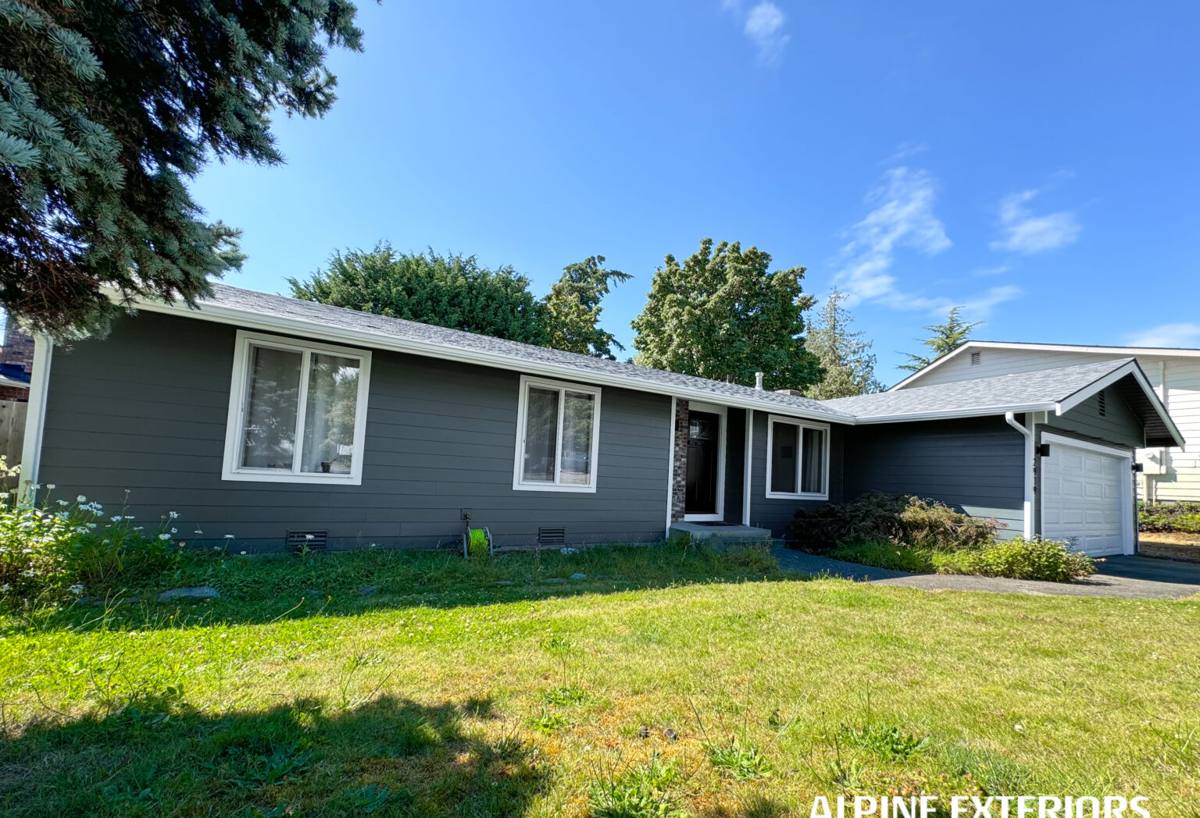
What Salt Air and Coastal Moisture Actually Do to Siding
It helps to understand the mechanism, not just the outcome. Salt air carries fine airborne particles that settle on exterior surfaces and accelerate corrosion of metal components — fasteners, flashing, trim accessories. On porous or moisture-sensitive siding materials, salt spray combined with constant dampness speeds up surface breakdown, paint failure, and in some cases warping or delamination.
Driving rain compounds the problem. Wind off the water pushes water sideways into laps, seams, and butt joints rather than letting it run straight down and off the wall. That means siding in Birch Bay needs to shed water at every joint, not just on the flat field of the wall. A material or installation that's marginal on moisture management in a calmer inland location can fail noticeably faster here.
Moss and Algae Season
Whatcom County's wet season stretches long, and north-facing or shaded walls in Birch Bay often stay damp for weeks. Wood-based and wood-composite siding products can absorb moisture into their substrate, which gives moss, algae, and mildew something to take hold in. Fiber cement doesn't have organic wood fiber for spores to feed on the way engineered wood products do, which is a meaningful advantage in a neighborhood where moss on the north wall is a normal seasonal reality, not a maintenance failure.
Why We Install James Hardie and Nothing Else
This company installs James Hardie fiber cement siding exclusively. We don't install vinyl, LP SmartSide, Cemplank, Allura, or primed wood products, and we're upfront about why: in a coastal, high-moisture climate like Birch Bay's, the differences between products show up in year eight, twelve, or twenty — not on installation day. We'd rather stand behind one system we trust fully than offer a menu of products with different long-term risk profiles.
James Hardie fiber cement is made from cement, sand, and cellulose fiber, cured into a dense, stable board. It's non-combustible, doesn't provide a food source for moss or insects, and holds its factory-applied finish far longer than field-painted alternatives. For homes exposed to salt air and sustained damp weather, that combination matters more than it does in a drier, inland climate.
HZ5 Engineering for This Climate
Hardie manufactures its boards in climate-specific HZ (HardieZone) formulations. The Pacific Northwest, including Whatcom County and the Blaine/Birch Bay area, falls into the HZ5 zone, engineered for wetter, cooler climates with more freeze-thaw cycling and moisture exposure than the HZ10 formulation sold in hot, humid regions. Using the correct HZ product for the region isn't a marketing detail — it affects how the board is engineered to handle moisture cycling over decades.
ColorPlus Factory Finish
Most Hardie siding we install carries the ColorPlus finish — a baked-on, multi-coat finish applied at the factory under controlled conditions, rather than field-primed and painted on site. In a salt-air environment, factory-cured finishes hold up better against UV and moisture cycling than field-applied paint, and touch-up product is available to match the factory color when it's ever needed.
What Correct Installation Looks Like in a Coastal Environment
Fiber cement performs the way it's designed to only when it's installed to manufacturer specification. That's true everywhere, but the margin for error shrinks in a location like Birch Bay, where every gap or shortcut gets tested by wind-driven rain far more often than in a sheltered inland neighborhood.
- Correct clearance between siding and grade, decks, and roof lines to keep the bottom edge of the board out of standing water and splash-back
- Proper house wrap and drainage plane behind the siding so any moisture that gets past the cladding has a path to drain and dry, rather than sitting against the sheathing
- Rain-screen or furring detail on exposures that take the brunt of wind-driven rain, giving the wall an air gap to dry out between storms
- Corrosion-resistant fasteners and flashing components suited to a salt-air environment, not standard inland-grade hardware
- Correctly lapped and caulked joints, with manufacturer-specified gaps and sealants rated for the exterior exposure
- Factory cut edges kept sealed or minimized, since a cut edge is the one place moisture can enter the board itself if left unprotected
Skipping any one of these doesn't usually cause an obvious problem in year one. It shows up later, as moisture intrusion, premature caulk failure, or accelerated wear at the joints — problems that are far more expensive to fix after the fact than to install correctly the first time.
Our Process for a Birch Bay Siding Job
1. On-Site Assessment
We start by walking the home and looking specifically at exposure: which walls take direct weather off the water, where moss and algae are already established, where drainage and grade clearance are marginal, and where prior repairs or patches suggest an existing moisture issue behind the current siding.
2. Substrate and Water Management Check
Before any new siding goes up, we check the condition of the sheathing and existing water management details. Coastal homes sometimes have moisture issues hiding behind the old siding that aren't visible from the outside — this step catches that before it gets covered up again.
3. Product and Color Selection
We help homeowners choose the right Hardie line and ColorPlus finish for their home, factoring in sun exposure, which affects fade over time, and how the finish will read against the Birch Bay landscape and neighboring homes.
4. Installation to Spec
Installation follows Hardie's published fastening, clearance, and flashing requirements for the HZ5 zone, with attention to the coastal-specific details above — proper drainage plane, corrosion-resistant hardware, and correctly managed joints and penetrations.
5. Final Walkthrough
We walk the finished job with the homeowner, checking clearances, trim details, and finish quality before calling it complete.
Why Local Experience in Birch Bay Matters
A crew that mostly works drier, inland jobs can install fiber cement perfectly well by the book and still miss the details that matter most on a shoreline property — how much clearance a specific wall needs given prevailing wind direction, which sides of a Birch Bay home tend to hold moss, or how aggressively salt air has already worn on the existing trim and fasteners. Crews who've worked this stretch of Whatcom County repeatedly develop a feel for those patterns that a one-off inland job doesn't teach.
That local pattern recognition is part of why hiring a crew that already works Birch Bay is worth something concrete: it's not just familiarity, it's fewer guesses about which details on your specific home need extra attention.
Cost Factors for a Birch Bay Fiber Cement Project
Every home is different, but the factors that move the price on a Birch Bay job are fairly consistent. We provide a firm, itemized quote after seeing the home in person — the table below is meant to help homeowners understand what drives cost, not to substitute for an actual estimate.
| Factor | Why It Affects Cost |
|---|---|
| Substrate condition | Hidden moisture damage behind old siding may need repair before new siding goes on |
| Wall exposure | Walls facing prevailing wind and rain may need added drainage or flashing detail |
| Existing siding removal | Tear-off complexity varies with layers, trim, and disposal requirements |
| Board profile and finish | Lap width, texture, and ColorPlus color selection affect material cost |
| Trim and accessory scope | Corner boards, fascia, and soffit work add labor and material |
| Home size and complexity | Roofline, dormers, and wall breaks affect labor hours |
Maintenance in a Coastal Climate
Fiber cement lowers the maintenance burden compared to wood-based products, but "low maintenance" doesn't mean "no maintenance," especially this close to the water. A periodic rinse to clear salt residue and organic buildup, prompt attention to any caulk or sealant wear at joints, and keeping gutters and drainage clear all help the siding perform for its full service life. None of this is heavy work — it's the kind of upkeep that takes an afternoon a year and prevents small issues from becoming bigger ones.
Get a Free, No-Pressure Estimate
If moss, salt weathering, or aging siding are showing up on your Birch Bay home, we're happy to take a look and give you a straight answer about what your walls actually need. Fill out the form below for a free estimate — no pressure, no obligation.