 Blaine Siding
 Why Sandy Point Decks Wear Out Faster Than Inland Decks
Sandy Point sits right on the water northwest of Blaine, and that location is exactly why decks out there age differently than decks a few miles inland in Whatcom County. Salt-laden air corrodes fasteners and hardware years before it would in a landlocked yard. Wind-driven rain off the Strait pushes moisture sideways into joints, ledger boards, and railing posts that a standard deck design never accounts for. And the long, damp Pacific Northwest shoulder seasons give moss and algae months at a time to take hold on any surface that doesn't drain and dry quickly. None of this means a deck can't last in Sandy Point — it means it has to be built with that environment in mind from the framing up, not just re-decked with whatever boards are on sale.
We work on homes throughout Blaine and the surrounding shoreline, and Sandy Point decks are consistently among the ones that show damage soonest when they were built to a generic spec. The fix isn't exotic. It's choosing the right fasteners, flashing the ledger properly, spacing boards for airflow, and picking a decking material that actually tolerates salt exposure — then following through on the details most crews skip because they're slower and cost a little more up front.
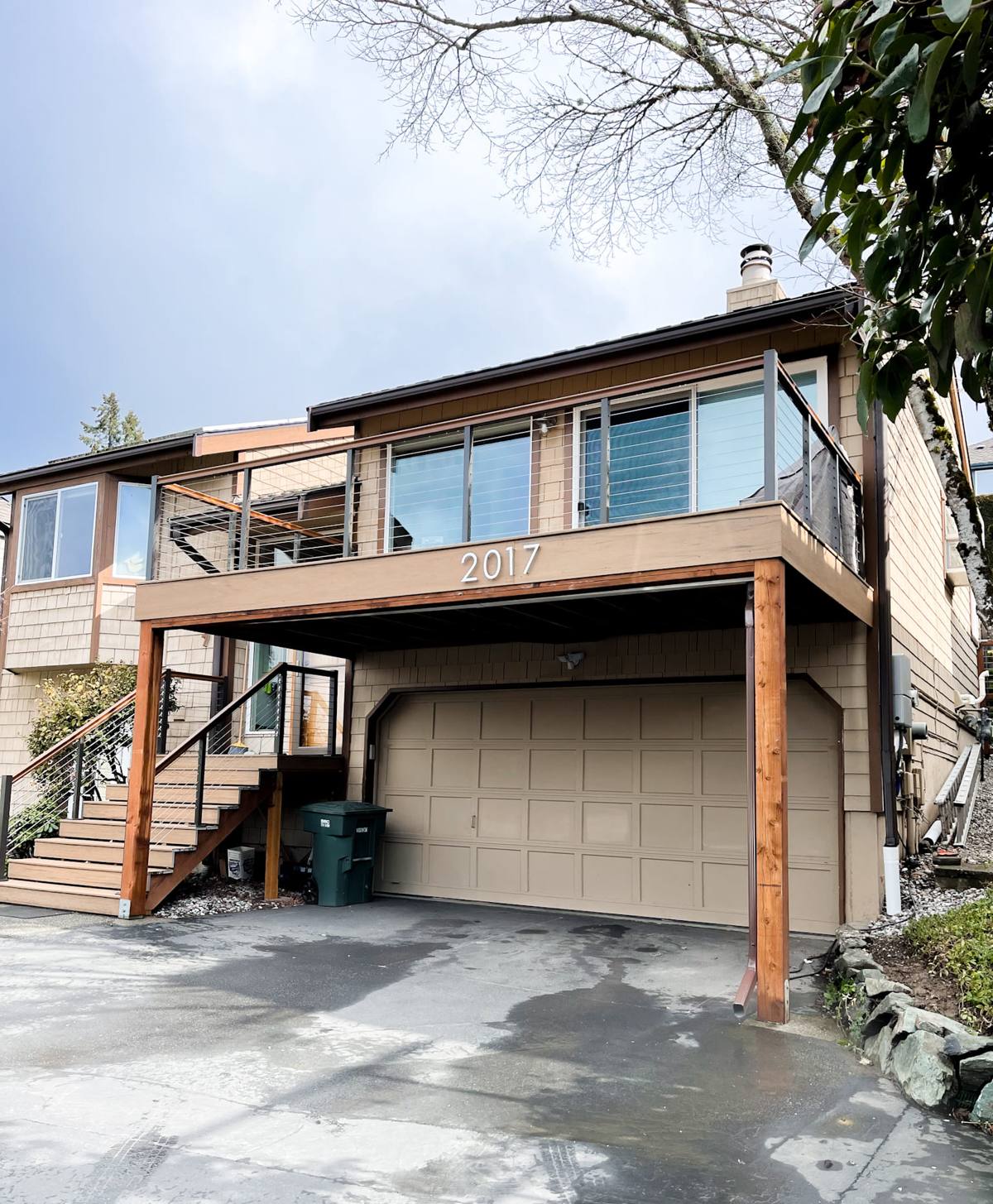
What Salt Air and Moisture Actually Do to a Deck
Fasteners and Hardware
Standard galvanized screws and joist hangers are rated for general outdoor use, not for direct salt spray. In a shoreline environment like Sandy Point, that coating breaks down faster, and you end up with rust streaks bleeding through decking boards, weakened joist hanger connections, and screws that shear off when you try to remove them for repairs. This is one of the most common failure points we find on older Sandy Point decks — the wood itself is often still serviceable, but the fasteners holding it together are corroded through.
The Ledger Board Connection
The ledger board — where the deck attaches to the house — is the single most important structural connection on any deck, and it's also the one most exposed to wind-driven rain in a coastal setting. Without correct flashing, water gets behind the ledger, soaks into the rim joist, and starts rotting the house framing from the outside in, often long before there's any visible sign from the deck surface. We see this regularly on decks that "look fine" from above but have significant hidden rot at the ledger when we pull the first few boards.
Moss, Algae, and Drainage
Whatcom County's long wet season means any deck surface that holds moisture — whether from tight board spacing, poor slope, or shade from nearby trees and structures — will grow moss and algae. Beyond being slippery and unsightly, sustained moisture retention is what accelerates wood rot and, on composite decking, can stain surfaces in ways that pressure washing won't fully undo. Good drainage design and joist-level ventilation matter as much as the decking material itself.
Signs Your Sandy Point Deck Needs Replacement, Not Repair
- Soft, spongy, or spring-back decking when you walk across it, especially near the house or stair landings
- Visible gaps, cracking, or checking in the boards that catch water instead of shedding it
- Rust staining around fasteners or joist hangers, or fasteners that back out on their own
- Any movement or gap where the ledger board meets the house siding
- Wobbly or loose railing posts — often the first sign of post rot at the base
- Persistent moss or dark staining that returns within weeks of cleaning
- Stairs that feel unstable or show separation at the stringer connections
One or two of these on their own might mean a targeted repair. Several together, or a deck that's fifteen-plus years old, usually means the structure has reached the point where patching costs more over time than a proper replacement.
Decking Material Options for a Waterfront Property
There's no single "best" decking material — there's a best material for your budget, your maintenance tolerance, and how close you are to the water. Here's how the common options compare for a coastal Blaine property specifically:
| Material | Upfront Cost | Maintenance | Salt Air / Moisture Tolerance | Realistic Lifespan |
|---|---|---|---|---|
| Pressure-treated wood | Lowest | Annual cleaning, periodic sealing/staining | Fair — needs consistent upkeep to hold up | 10-15 years |
| Cedar | Moderate | Regular sealing to prevent graying and checking | Good natural rot resistance, but surface needs attention | 15-20 years |
| Composite decking | Higher | Occasional washing, no sealing or staining | Very good — doesn't rot or absorb moisture like wood | 25-30 years |
| PVC / cellular decking | Highest | Lowest — wipe-down cleaning only | Excellent — fully impervious to moisture | 30+ years |
We're not going to tell you composite or PVC is the only "correct" choice — plenty of homeowners want the real wood look and are willing to keep up with sealing. But for a deck sitting in salt air and driving rain, we do steer clients away from budget-grade woods without a clear maintenance plan, because they're the ones that fail fastest out here and end up costing more in the long run.
What a Correctly Built Deck Replacement Includes
Structural Inspection First
Before any decking goes down, we check the framing, posts, footings, and ledger connection. If the substructure has hidden rot or the footings weren't set below frost depth or on solid bearing, replacing just the surface boards is a wasted investment — the new decking will only be as good as what's underneath it.
Coastal-Grade Fasteners and Flashing
For a Sandy Point job, we use stainless steel or coated fasteners rated for coastal/marine exposure, not standard galvanized hardware. The ledger gets proper flashing with a drip edge and appropriate water-resistive barrier detailing so wind-driven rain can't work its way behind the house connection.
Airflow and Drainage
Board spacing, joist tape, and overall deck slope are set to keep water moving off the structure instead of pooling. Adequate ventilation underneath the deck also matters — it's what keeps joists drying out between rain events instead of staying damp for weeks at a time.
Railings and Stairs Built to Code
Railing height, baluster spacing, and stair geometry all need to meet current building code, and on a waterfront property, railing hardware takes the same salt exposure as everything else — it gets the same coastal-grade fasteners and connectors as the deck frame.
Permits and Whatcom County Requirements
Deck replacement projects — especially those involving structural changes, new footings, or work near a shoreline setback — typically require a building permit through Whatcom County or the City of Blaine, depending on the property's location. Waterfront and shoreline properties can also fall under additional review depending on proximity to the water. We handle the permit process as part of the job so you're not left guessing what paperwork is required or chasing inspections yourself.
Our Process for a Sandy Point Deck Replacement
- On-site assessment — we inspect the existing deck's framing, footings, and ledger connection, not just the visible boards, and give you an honest read on repair versus replacement.
- Material and design conversation — we walk through the material comparison above based on your budget, sun/shade exposure, and how much upkeep you want to take on.
- Permit and planning — we pull the necessary permits and confirm setback and code requirements before demolition starts.
- Demolition and disposal — the old deck is removed and hauled off, with the site protected so surrounding landscaping and siding aren't damaged.
- Framing and structural work — new or reinforced footings, joists, and ledger flashing go in first, built to coastal-grade fastening standards.
- Decking, railings, and stairs — final surface materials are installed with proper spacing and drainage, followed by railings and stairs to code.
- Final walkthrough — we go over care and maintenance specific to whatever material you chose, so you know what upkeep to expect.
Maintaining a New Deck in a Salt Air Climate
- Rinse salt residue and debris off the deck surface every few weeks during dry stretches, more often right after storms
- Keep gutters and downspouts near the deck clear so runoff isn't dumping extra water onto the structure
- Trim back vegetation that's shading the deck and slowing evaporation, which is what feeds moss growth
- Check railing posts and stair connections once a year for movement or corrosion at the hardware
- For wood decks, reseal on the schedule the product calls for — don't wait until it's visibly graying
- For composite or PVC decking, wash with a soft-bristle brush and mild cleaner rather than a high-pressure setting that can etch the surface
Why a Local Crew Matters for This Job
A deck built to a generic, inland spec will underperform on a Sandy Point property, no matter how well it's installed — the environment is simply harder on the materials. A crew that already works this stretch of Whatcom County knows to spec coastal-grade fasteners as standard, not an upsell; knows which decking materials actually hold up to salt air over a full winter of storms; and understands the permitting expectations for waterfront and near-shoreline properties in Blaine. That local knowledge is what separates a deck that needs attention again in five years from one that holds up for two or three decades.
If your deck is showing its age, feels unstable, or you're just planning ahead before it becomes a safety issue, we're happy to come take a look. We'll give you a straight assessment of what's actually wrong, what your material options are, and a free, no-pressure estimate — no obligation either way.