 Blaine Siding
 Composite Decking Built for California Creek's Conditions
California Creek sits close enough to the water and the open exposure of northern Whatcom County that decks here take a harder beating than a typical inland yard. Salt-laden air off the strait works into fasteners and framing connectors, driving rain gets pushed sideways into ledger boards and stair stringers, and the long stretch of gray, damp months from fall through spring gives moss and algae plenty of time to take hold on any surface that doesn't drain and dry properly. A deck that's just "code minimum" in a drier climate often shows problems here within a few seasons — soft spots at the ledger, green film on the boards, corroded screws bleeding rust streaks into the composite. Building for this specific site means treating the substructure, drainage, and hardware as seriously as the decking material itself.
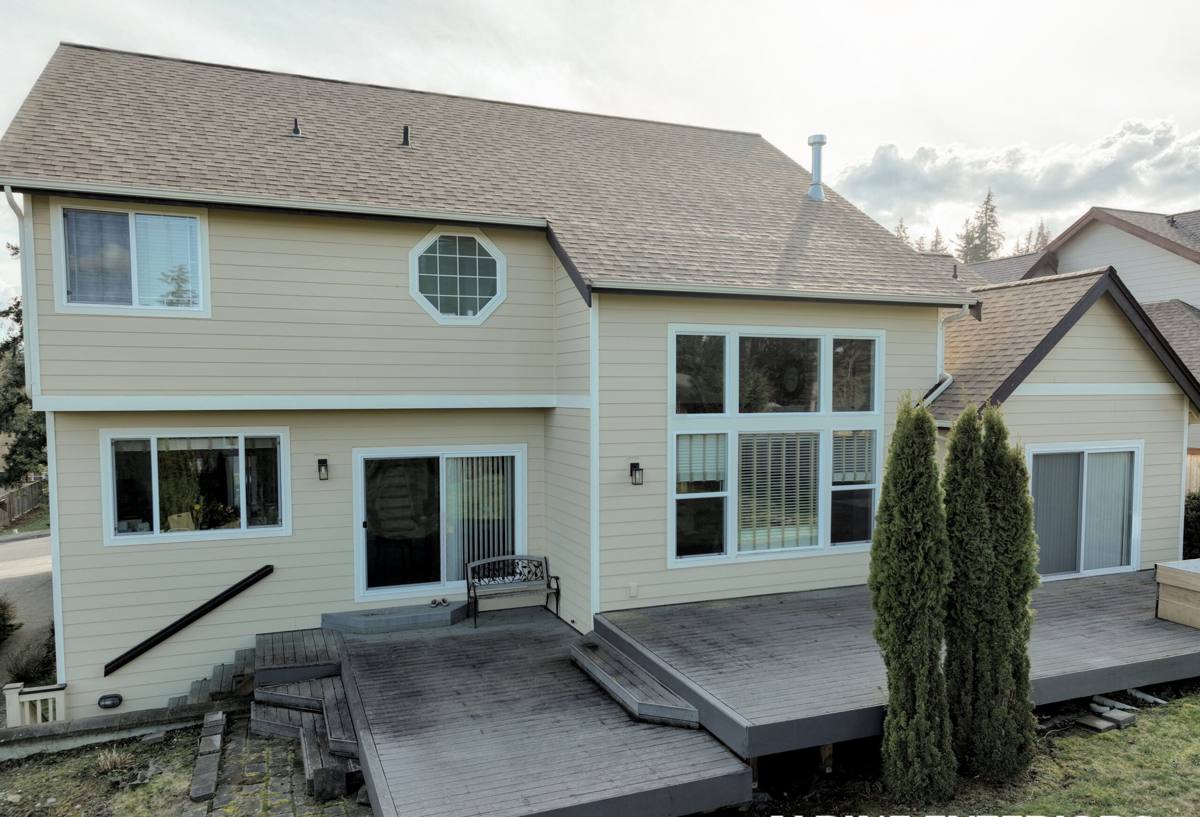
Why Composite Makes Sense in This Climate
Composite decking doesn't absorb water the way wood does, so it isn't prone to the swelling, cupping, and splintering that a rain-heavy climate causes in cedar or pressure-treated boards over time. It also resists the surface staining that salt air and organic debris leave behind, which matters a lot in a spot where boards stay damp for days at a stretch during the wet season. That said, composite isn't maintenance-free — it still needs airflow underneath, a surface that sheds water instead of pooling it, and periodic cleaning to keep moss and mildew from getting a foothold in the grain texture. The material buys you a lot of durability, but it only pays off if the deck underneath it is built to actually let it perform that way.
What Salt Air Does to a Deck Over Time
Proximity to the water means airborne salt settles on every exposed surface, including the metal you can't see. Standard zinc-coated screws and joist hangers corrode faster in this environment than they would ten or twenty miles inland, and once a fastener starts rusting, it weakens exactly where the structure needs it most — at the connections. This is why hardware selection isn't a minor spec detail on a California Creek deck; it's one of the first things that determines whether the structure is still sound in ten years.
What a Correct Composite Deck Build Involves Here
A properly built composite deck in this area comes down to a handful of decisions that matter more here than they would in a milder climate:
- Stainless or coated marine-grade fasteners and hangers — standard hardware corrodes faster this close to the water and salt air.
- Ledger flashing that actually sheds water — the ledger-to-house connection is the single most common failure point on any deck exposed to driving rain.
- Joist tape on every framing member — seals the wood from moisture wicking up into fastener holes and cut ends.
- Adequate ground clearance and airflow underneath — moss and mildew take hold fastest in still, damp air pockets under low decks.
- Hidden fastener systems with correct gapping — proper board spacing lets water drain through instead of sitting on the surface.
- Stair and rail hardware matched to the same corrosion resistance standard — these get the most direct rain exposure of any part of the structure.
Substructure First, Decking Second
It's tempting to think of a deck project as picking a board color and moving on, but the framing underneath does more to determine the deck's lifespan in this climate than the decking brand does. Joists, beams, posts, and footings all need to be sized and treated for sustained moisture exposure, not just occasional rain. On sites near California Creek with soil that stays wetter longer into the spring, footing depth and drainage around posts also need more attention than a textbook minimum — we look at how water actually moves across the specific lot, not just what the plan set assumes.
Drainage: The Detail That Determines Everything Else
Every deck failure we get called out to fix traces back to water that had nowhere to go. In a climate with this much sustained rainfall, drainage isn't a nice-to-have — it's the difference between a deck that lasts decades and one that needs structural repair in under ten years. That means grading the ground under the deck away from the house, keeping post bases off standing water, sloping any solid-surface elements slightly so water sheets off rather than pools, and making sure gutters and downspouts near the deck aren't dumping roof runoff straight into the structure. None of this shows up in a finished photo, but it's the part of the job that decides whether the composite boards and the framing under them are still doing their job a decade from now.
Moss, Algae, and Surface Care
The long stretch of overcast, damp weather typical of this part of Whatcom County is exactly the environment moss and algae favor. Composite boards resist staining better than wood, but any deck surface will grow a film of organic growth if it stays wet and shaded for weeks at a time. Board orientation, gaps for drainage, and keeping nearby vegetation trimmed back so sunlight and air can reach the deck all reduce how often it needs cleaning. Composite manufacturers generally recommend a simple soap-and-water wash a couple of times a year, more often in shaded or low-airflow areas — pressure washing on the lowest safe setting works, but high pressure held too close can etch the surface texture over time, so it's worth doing carefully or having it done as part of a maintenance visit.
Choosing a Composite Product
There are real differences between composite lines, and the right choice depends on budget, sun exposure, and how much of a wood-look finish matters to the homeowner. We don't push one brand across every job — we match the product to the site.
| Factor | What to Consider |
|---|---|
| Capped vs. uncapped composite | Capped boards have a protective outer shell that resists moisture and staining better — worth the added cost in this climate. |
| Color and heat | Darker boards get hotter in direct sun but hide moss and pollen film better than very light colors. |
| Grain texture | Deeper wood-grain texture looks more natural but can hold more surface grime, meaning slightly more frequent cleaning. |
| Warranty structure | Read what's actually covered — fading, staining, and structural integrity are often separate warranty terms with different lengths. |
| Fastening system | Hidden clip systems generally allow better drainage gaps than face-screwed boards. |
Why We're Selective About What We Install
Not every composite product on the market is built the same, and we don't install lines we don't trust to hold up to this specific climate. Our standard is straightforward: if a board's moisture behavior, cap technology, or hardware compatibility doesn't hold up to daily salt air and months of steady rain, it doesn't go on a California Creek deck with our name attached to the work, regardless of upfront price.
Our Process on a California Creek Deck Project
- Site walk and assessment — we look at drainage patterns, sun/shade exposure, existing structure condition if it's a replacement, and how the deck ties into the house.
- Design and material selection — board style, color, railing type, and layout, matched to budget and how the space will actually be used.
- Permitting — pulled and coordinated as required for the scope of work.
- Demo of the old structure (replacement projects) — including inspection of ledger and framing condition once the old decking is off.
- Framing and structural work — corrosion-resistant hardware, proper flashing, joist protection, and footing/post work sized to the site.
- Composite installation — hidden fastener systems, correct board gapping, and finish trim.
- Final walkthrough — we go over care basics and answer questions before we consider the job done.
Why Local Experience on This Site Matters
A crew that's worked other decks in and around California Creek and the broader Blaine area already knows how this stretch of Whatcom County behaves — where driving rain tends to hit hardest, how quickly moss sets in on a shaded north-facing deck versus one in full sun, and which hardware actually holds up after a few winters this close to the water. That's not something you get from a spec sheet; it comes from having pulled apart enough failed decks nearby to know exactly which shortcuts cause the problems we get called to fix. Hiring locally also means faster response if something needs a warranty check or minor adjustment after the build, without a contractor having to relearn the site conditions from scratch.
Maintenance Checklist for Composite Decks in This Climate
- Sweep debris off the surface regularly, especially fall leaf litter that traps moisture against the boards.
- Wash the deck surface with soap and water at least twice a year, more often in shaded sections.
- Keep gutters and downspouts near the deck clear so runoff isn't draining onto or under it.
- Trim back vegetation that's shading the deck or blocking airflow underneath.
- Check railing and stair hardware annually for early signs of corrosion, especially in the first few years.
- Confirm the area under the deck stays ventilated and isn't collecting standing water after heavy rain.
Cost Factors to Expect
Composite deck pricing varies with size, framing complexity, railing choice, and product tier, so a broad range is more honest than a single number. Straightforward composite deck projects in this region generally run from the mid-thousands for a small, simple deck up into the tens of thousands for larger decks with premium boards, custom railing, or significant structural work. The clearest way to get an accurate number is a site visit, since substructure condition and drainage work — the parts that matter most in this climate — vary a lot from lot to lot.
If you're planning a new composite deck or replacing an aging one in California Creek, we're happy to take a look and put together a straightforward, no-pressure estimate based on your specific site. Use the form below to get started.